
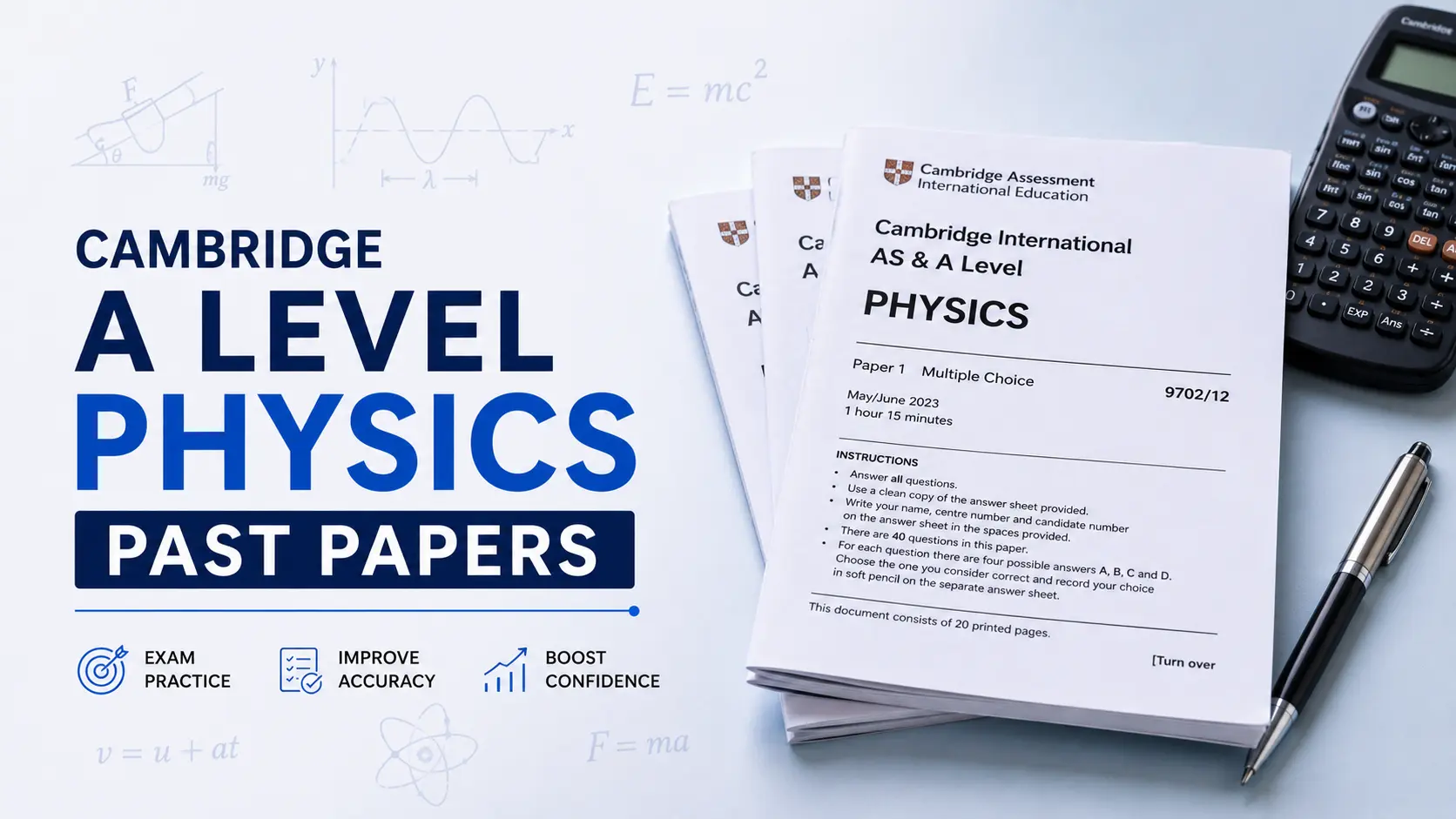
Cambridge A Level Physics Past Papers: How to Practise Smarter, Not Harder
Most CIE 9702 students know they should use Cambridge A Level Physics past papers in their revision. Far fewer know how to use them well. There is a significant difference between a student who sits down, answers questions, checks a score, and moves on — and a student who uses every paper as a diagnostic tool, a language lesson, and a performance rehearsal simultaneously.
The students who improve fastest are not always those who do the most Cambridge A Level Physics past papers. They are those who practise with purpose — who know exactly why each question matters, what the mark scheme is teaching them, and how to turn every error into a prevented mistake in the real exam.
This guide gives you a complete, proven strategy for working through Cambridge A Level Physics past papers smarter, not harder — from your very first practice session to the final week before your exam.
Understand What Cambridge A Level Physics Past Papers Actually Test
Before your revision strategy can be smart, you need to understand what Cambridge A Level Physics past papers are actually measuring. CIE 9702 is not testing whether you can recall facts — it is testing whether you can apply physics precisely, communicate it clearly, and handle unfamiliar contexts under time pressure.
This distinction matters enormously. A student who revises by reading notes and watching explanations is preparing to recognise physics. A student who practises with Cambridge A Level Physics past papers is preparing to produce physics — under time pressure, in the exact format examiners reward, using the precise language the mark scheme requires.
These are fundamentally different skills, and only one of them is directly trained by past paper practice. This is why no amount of passive revision fully substitutes for working through real papers.
Phase 1: Topical Practice Before Full Papers
The most common mistake students make with Cambridge A Level Physics past papers is attempting full timed papers before they have built sufficient topic knowledge. This produces frustration rather than learning — a student who cannot answer a question on SHM because they have not studied it yet gains nothing from the exposure.
The smarter approach: start with topical practice. Work through questions from one chapter at a time before moving to timed full papers. This means taking questions on, say, Waves from multiple years of Cambridge A Level Physics past papers and answering them together — before moving to Electricity, then Fields, and so on.
Topical practice achieves three things simultaneously:
First, it builds topic-specific confidence. Each chapter feels manageable when you are not simultaneously overwhelmed by everything else on the syllabus.
Second, it reveals gaps immediately. If you cannot answer topical questions on Capacitance after studying it, you know precisely where your understanding is incomplete — before a full paper reveals it as a broad weakness without pointing to the cause.
Third, it trains you in the specific question styles and command words used for each topic. CIE examiners have characteristic ways of asking about particular topics — these patterns become visible when you read multiple years of questions on the same subject together.
The free topical past paper workbooks at Quality Notes organise questions from Cambridge A Level Physics past papers by chapter and topic, making this kind of structured practice immediately accessible without manually searching through individual papers.
Phase 2: The Five-Step Full Paper Protocol
Once topical practice has covered all syllabus chapters, move to full timed papers. But a full paper session is not simply “sit the paper and check answers.” Smart practice follows a specific five-step protocol for every session.
Step 1 — Simulate Exam Conditions Fully
Strict timing. Formula sheet only — no notes. No pausing mid-paper. Phone away. This discipline is non-negotiable because exam anxiety and time pressure are skills that only develop through realistic practice. Students who have timed themselves dozens of times before the real exam are not practising a new experience on exam day — they are repeating a familiar one.
Know the timings for each paper of Cambridge A Level Physics past papers:
- Paper 1 (Multiple Choice, AS): 1 hour 15 minutes for 40 questions
- Paper 2 (AS Structured): 2 hours for 60 marks
- Paper 4 (A Level Structured): 2 hours for 100 marks
- Paper 5 (Planning, Analysis, Evaluation): 1 hour 15 minutes for 30 marks
Step 2 — Mark Rigorously, Not Generously
After completing the paper, mark every response against the official mark scheme with strict honesty. Do not award yourself marks for answers that are “close” or “almost right.” If the mark scheme requires “rate of change of displacement” and you wrote “how fast displacement changes,” mark it wrong. The real examiner will.
Generous self-marking is one of the most consistent reasons students are surprised by their actual exam results — they have been overcounting their own marks throughout revision.
Step 3 — Study the Mark Scheme Line by Line
This step is where the real improvement happens and where most students cut corners. After marking, read the complete mark scheme for every question — not just the ones you got wrong.
For every question you answered correctly, confirm your reasoning matches the mark scheme’s reasoning. Many students get the right answer through luck or flawed logic — the mark scheme reveals whether the physics was actually right.
For every question you answered incorrectly or partially, identify precisely why. Was it a missing keyword? A wrong formula? A unit error? A misread question? Unclear explanation structure? Each failure has a specific cause, and each cause has a specific fix.
Step 4 — Read the Examiner Report for That Session
Cambridge publishes an Examiner Report for every session of Cambridge A Level Physics past papers. These documents describe — in the examiner’s own words — which questions were answered poorly across all candidates, what the most common errors were, and how top-scoring answers were structured.
Reading the examiner report for the same session you just completed is one of the highest-value actions in your entire revision. It reveals patterns that your individual mark scheme analysis cannot: you learn which of your mistakes were unique to you and which are systemic errors that thousands of students share — meaning the examiner specifically watches for them.
Step 5 — Update Your Error Log
Record every mistake in a dedicated error log. For each entry, note the paper reference, the topic, your answer, the correct answer, and the specific reason marks were lost. Review this log before every subsequent paper session. In the final two weeks before your exam, this log is more valuable than any new paper — it is a personalised catalogue of every preventable error you have made.
For structured support working through Cambridge A Level Physics past papers Paper 2 and Paper 4 questions with expert explanation, recorded lessons at Quality Notes cover every major topic with worked examples drawn directly from past exam questions.
How to Prioritise Which Papers to Use
Not all Cambridge A Level Physics past papers are equally valuable for exam preparation. Here is how to prioritise:
Use 2025–2022 first. These reflect the current syllabus most accurately. Examiner expectations, question style, and mark scheme language from the last three to four years are the most reliable predictors of what you will face.
Use 2021–2018 next. Still highly relevant for question practice and topic coverage. Some minor syllabus differences exist but most content is identical.
Use pre-2018 papers selectively. Useful for topic practice and developing problem-solving fluency, but some topics may differ from the current syllabus. Do not rely on these papers for examiner language or mark scheme phrasing.
Prioritise the May/June series. The May/June session of Cambridge A Level Physics past papers is typically the most widely sat and often produces the clearest examiner reports. October/November papers are equally valid for practice but may reflect slightly different question distribution.
Paper-Specific Strategies for Cambridge 9702
Paper 1 — Multiple Choice Time pressure is the primary challenge: 40 questions in 75 minutes leaves under two minutes per question. Use the process of elimination on every question — even ruling out one option improves your odds significantly. Flag uncertain questions and return after completing the rest. Never leave a blank — there is no negative marking in Cambridge A Level Physics past papers Paper 1.
Paper 2 — AS Level Structured Questions Read every question fully before writing. Underline the command word — “state,” “explain,” “describe,” “calculate,” “show that” — each demands a different type of response. For multi-mark explanation questions, structure your answer as a chain of reasoning: principle → application → conclusion. One-line answers to four-mark questions will always score poorly.
Paper 4 — A Level Structured Questions The extended questions in Paper 4 are where A and A* grades are won or lost. Questions worth five or more marks require structured, multi-point answers. Spend 30 seconds identifying key physics principles before writing. Use precise syllabus vocabulary — “directly proportional,” “conservation of energy,” “electromagnetic induction” — in every answer.
Paper 5 — Planning, Analysis and Evaluation This paper is consistently under-revised. It does not include the formula sheet, requires recall of practical methodology, and demands precise quantitative uncertainty analysis. Regular practice with Paper 5 questions from Cambridge A Level Physics past papers is the only reliable preparation method — this paper cannot be crammed.
Access to complete AS Level Physics and A Level Physics resources at Quality Notes provides the topic-level foundation needed to approach each of these papers with genuine confidence.
The Smarter Practice Calendar: 8 Weeks to Your Exam
Weeks 1–2: Topical past paper questions on all remaining weak chapters. No full papers yet.
Weeks 3–6: Two full timed papers per week — rotate between Paper 1, Paper 2, Paper 4, and Paper 5. Apply the five-step protocol to every session. Update error log after each paper.
Week 7: Review error log. Revisit every chapter where patterns of errors appear. Use books and revision notes to consolidate any conceptual gaps revealed by the log.
Week 8: One full paper per session, maximum two sessions. Focus shifts from finding new mistakes to confirming previous errors are fixed. Review examiner report language for high-frequency topics.
Common Mistakes Students Make With Cambridge A Level Physics Past Papers
Doing papers without timing. Untimed practice builds topic knowledge but not exam performance. Time pressure is a skill — it must be trained.
Skipping the examiner report. The mark scheme tells you what the right answer is. The examiner report tells you why students get it wrong and what separates good answers from great ones. Missing this step leaves significant improvement on the table.
Treating a correct answer as evidence of understanding. Many correct answers come from partial reasoning or fortunate recall. The mark scheme review reveals whether your physics was actually right — not just your answer.
Doing the same paper twice. Re-sitting a paper you have already seen and marked produces inflated scores that do not reflect genuine improvement. Keep a log of which papers you have used and rotate through new sessions.
Starting with the hardest questions. In a timed paper, always attempt questions you are confident about first. Spending 20 minutes on a single difficult question while leaving three easier questions unanswered is one of the most costly time management errors in Cambridge A Level Physics past papers practice.
If you need a personalised past paper schedule built around your specific exam date, current performance level, and target grade, students counselling at Quality Notes provides exactly this kind of targeted revision planning.
People Also Ask About Cambridge A Level Physics Past Papers
Where can I find Cambridge A Level Physics past papers?
Cambridge A Level Physics past papers for CIE 9702 are available on the official CAIE website and through organised educational platforms. Quality Notes provides structured topical workbooks built from real 9702 past paper questions, organised by chapter for efficient topical practice.
How many Cambridge A Level Physics past papers should I do?
Aim for a minimum of 12 to 15 full timed papers in the final eight weeks before your exam, in addition to topical practice earlier in your revision. Prioritise the most recent five years — 2025 to 2022 — as these most accurately reflect current examiner expectations and mark scheme language.
What is the difference between Paper 2 and Paper 4 in CIE 9702?
Paper 2 covers the AS Level syllabus content and is worth 60 marks over 2 hours. Paper 4 covers A Level content and is worth 100 marks over 2 hours. Both are structured question papers, but Paper 4 contains more extended-response questions and covers a wider range of advanced topics including fields, SHM, thermal physics, and quantum physics.
Should I read examiner reports when practising past papers?
Yes — reading examiner reports is one of the highest-value actions in past paper revision. The reports reveal which questions were answered poorly by most candidates, the most common errors, and how top-scoring answers were structured. This intelligence is not available from the mark scheme alone.
What is the best order to practise Cambridge A Level Physics past papers?
Begin with topical questions chapter by chapter before attempting full papers. When moving to full papers, start with the most recent sessions — 2025, 2024, 2023 — and work backwards. These reflect current syllabus requirements most accurately and produce the most useful examiner report feedback.
How do I improve from a C to an A in A Level Physics using past papers?
The biggest grade improvements come from deep mark scheme analysis, not additional paper volume. Study the exact language the mark scheme rewards, keep a detailed error log of every mistake, read examiner reports after every session, and work with a teacher who can identify the root cause of patterns in your errors.
Conclusion
There are only so many Cambridge A Level Physics past papers available and only so many weeks before your exam. Every session you spend practising without the five-step protocol — without rigorous marking, mark scheme analysis, and error logging — is a session that produces far less improvement than it could.
Practise smarter. The grade boundary between a B and an A, or between an A and an A*, in CIE 9702 is often fewer than ten marks. That margin is entirely recoverable through disciplined, purposeful past paper practice — the kind that treats every error as information rather than just a wrong answer.
When you get help from Mr. Adeel Chowhan, who is known as the best online physics teacher in Pakistan, you can’t do better in your studies. Go to Quality Notes right now to get a free trial class, for further access to structured topical past papers, lessons taught by experts, and all the tools you need to get the best grades.