
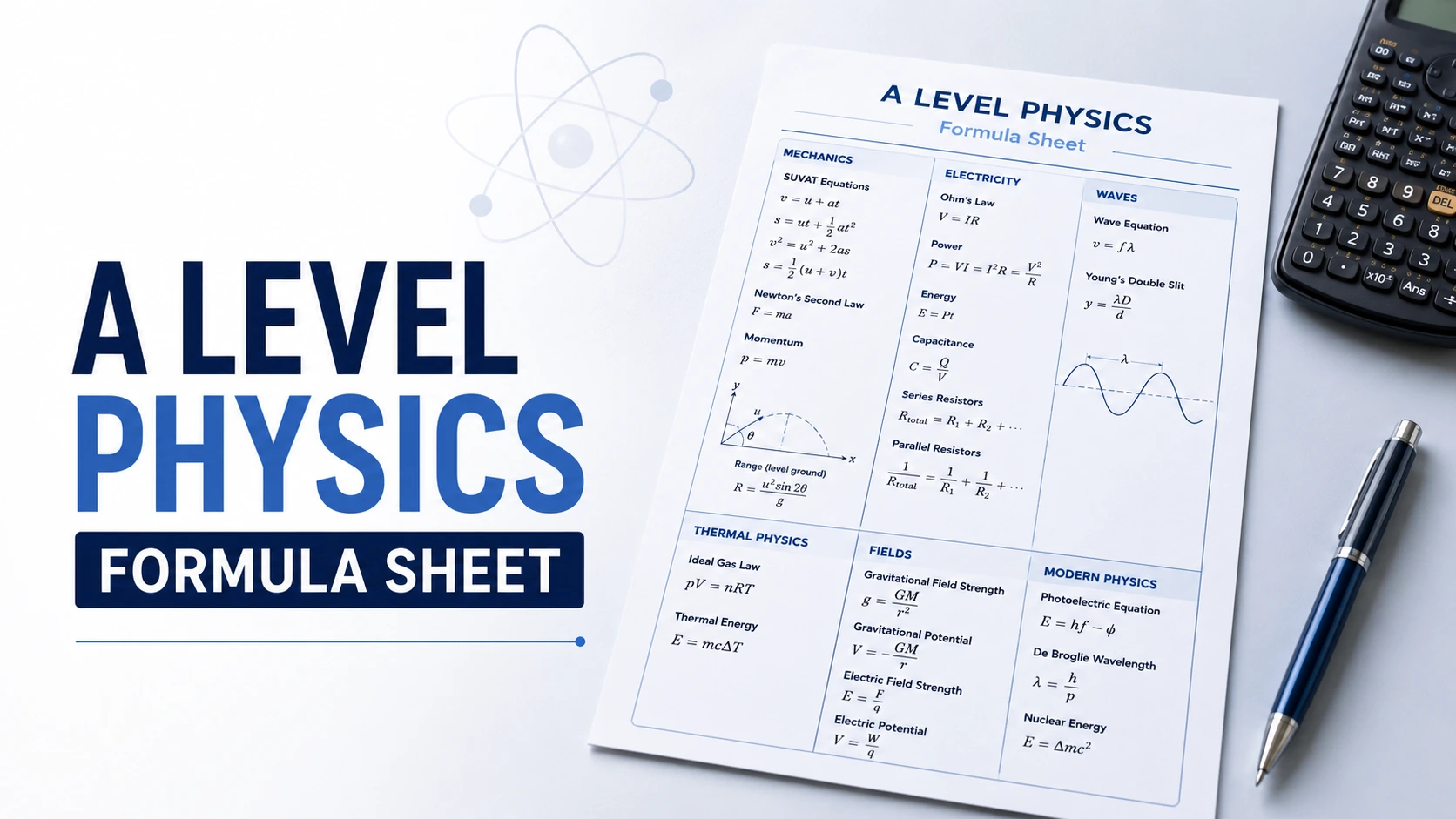
A Level Physics Formula Sheet: Every Equation You Need for CIE 9702
One of the most common questions CIE 9702 students ask is: “Which formulas are given in the exam and which do I have to memorise?” It is a critical question — and one that directly affects how you revise. Spending hours memorising equations that appear on the A Level Physics formula sheet is wasted time. But walking into the exam not knowing the formulas that are not provided is a costly mistake.
This complete guide covers everything on the official CIE A Level Physics formula sheet, the physical constants provided in Papers 1, 2 and 4, the additional equations you must commit to memory, and the exam strategy that helps you use the formula sheet effectively under timed pressure.
What Is the CIE A Level Physics Formula Sheet?
The official CIE A Level Physics formula sheet — formally titled “Data and Formulae” — appears as pages 2 and 3 in Papers 1, 2 and 4 of the 9702 examination. It contains two sections: a Data section listing physical constants, and a Formulae section listing key equations organised by topic.
This sheet is provided to every student in every session. You do not bring your own — it is printed into the paper. Understanding exactly what it contains, and more importantly what it does not contain, is fundamental to effective exam preparation.
Section 1: Physical Constants Provided in the Data Sheet
The following constants appear verbatim on the official CIE A Level Physics formula sheet and are available in every exam. You do not need to memorise their values — but you must know what each constant represents and when to use it.
| Constant | Symbol | Value |
| Speed of light in free space | c | 3.00 × 10⁸ m s⁻¹ |
| Permeability of free space | μ₀ | 4π × 10⁻⁷ H m⁻¹ |
| Permittivity of free space | ε₀ | 8.85 × 10⁻¹² F m⁻¹ |
| (1/4πε₀) | — | 8.99 × 10⁹ m F⁻¹ |
| Elementary charge | e | 1.60 × 10⁻¹⁹ C |
| Planck constant | h | 6.63 × 10⁻³⁴ J s |
| Unified atomic mass unit | u | 1.66 × 10⁻²⁷ kg |
| Rest mass of electron | mₑ | 9.11 × 10⁻³¹ kg |
| Rest mass of proton | mₚ | 1.67 × 10⁻²⁷ kg |
| Molar gas constant | R | 8.31 J K⁻¹ mol⁻¹ |
| Avogadro constant | Nₐ | 6.02 × 10²³ mol⁻¹ |
| Boltzmann constant | k | 1.38 × 10⁻²³ J K⁻¹ |
Key exam point: knowing the value is not enough. You must understand when each constant applies. The Boltzmann constant k connects the energy of gas molecules to temperature (E = 3/2 kT). The Planck constant h links photon energy to frequency (E = hf). The permittivity ε₀ appears in electric field and capacitance equations. Passive familiarity with these values does not translate into marks — active understanding of their context does.
Section 2: Formulae Provided on the A Level Physics Formula Sheet
These equations appear directly on the official CIE A Level Physics formula sheet and are available in Papers 1, 2 and 4. They are organised by topic below.
Uniformly Accelerated Motion
- s = ut + ½at²
- v² = u² + 2as
Work Done on/by a Gas
- W = pΔV
Gravitational Potential
- φ = −Gm/r
Hydrostatic Pressure
- p = ρgh
Pressure of an Ideal Gas
- p = ⅓(Nm/V)⟨c²⟩
Simple Harmonic Motion
- a = −ω²x
- v = v₀ cos ωt
- v = ±ω√(x₀² − x²)
Doppler Effect
- f₀ = fₛv / (v ± vₛ)
Electric Potential
- V = Q / (4πε₀r)
Capacitors in Series
- 1/C = 1/C₁ + 1/C₂ + …
Capacitors in Parallel
- C = C₁ + C₂ + …
Energy of a Charged Capacitor
- W = ½QV
Electric Current (Drift Velocity)
- I = Anvq
Resistors in Series
- R = R₁ + R₂ + …
Resistors in Parallel
- 1/R = 1/R₁ + 1/R₂ + …
Hall Voltage
- Vₕ = BI / (ntq)
Alternating Current/Voltage
- x = x₀ sin ωt
Radioactive Decay
- x = x₀ exp(−λt)
Decay Constant
- λ = 0.693 / t½
Section 3: Essential Equations NOT on the Formula Sheet — Memorise These
This is the section most revision guides miss. The official A Level Physics formula sheet does not contain every equation tested in CIE 9702. The following equations must be memorised because they will not appear in the papers but are regularly required to answer questions.
Kinematics and Dynamics (AS Level)
- v = u + at
- s = ½(u + v)t
- Momentum: p = mv
- Impulse: FΔt = Δp
- Weight: W = mg
- Kinetic energy: KE = ½mv²
- Gravitational PE: GPE = mgh
- Power: P = Fv and P = W/t
- Efficiency: useful output / total input × 100%
Waves and Superposition
- Wave speed: v = fλ
- Period: T = 1/f
- Intensity: I = P/A
- Intensity and amplitude: I ∝ A²
- Refractive index: n = sin i / sin r = c/v
- Critical angle: sin c = 1/n
Electricity and Circuits
- Charge: Q = It
- Ohm’s Law: V = IR
- Power: P = IV = I²R = V²/R
- EMF: ε = I(R + r)
- Potential divider: Vout = Vin × R₂/(R₁ + R₂)
- Resistivity: R = ρL/A
Fields — Gravitational and Electric
- Gravitational field strength: g = F/m = GM/r²
- Electric field strength: E = F/Q = V/d = Q/(4πε₀r²)
- Coulomb’s law: F = Q₁Q₂/(4πε₀r²)
Capacitance
- Capacitance: C = Q/V
- Energy: W = ½CV² = Q²/2C
- Capacitor discharge: Q = Q₀e^(−t/RC)
- Time constant: τ = RC
Magnetic Fields and Electromagnetism
- Force on conductor: F = BIL sin θ
- Force on charge: F = BQv sin θ
- Faraday’s law: ε = −NΔΦ/Δt
- Magnetic flux: Φ = BA cos θ
- Transformer: Nₚ/Nₛ = Vₚ/Vₛ
Quantum and Nuclear Physics
- Photon energy: E = hf = hc/λ
- Photoelectric effect: hf = φ + ½mv²max
- de Broglie wavelength: λ = h/mv
- Einstein mass-energy: E = mc²
- Activity: A = λN
Thermal Physics
- Ideal gas law: pV = nRT = NkT
- Internal energy: ΔU = q + w
- Specific heat capacity: Q = mcΔT
- Specific latent heat: Q = mL
Simple Harmonic Motion (additional)
- Angular frequency: ω = 2πf
- Maximum speed: v₀ = ωx₀
- Maximum acceleration: a₀ = ω²x₀
- Period of pendulum: T = 2π√(l/g)
- Period of mass-spring: T = 2π√(m/k)
For topic-by-topic practice on all equations across the full syllabus, the free topical past paper workbooks at Quality Notes give you structured exam-style questions organised by chapter — the most efficient way to test whether you can apply each formula under exam conditions.
How to Use the A Level Physics Formula Sheet Effectively in the Exam?
Knowing what is on the A Level Physics formula sheet is not the same as knowing how to use it strategically. The following habits separate students who gain marks from those who waste time:
Familiarise yourself with the layout before exam day. The formula sheet has a fixed two-page layout in every paper. Students who know exactly where each equation sits can locate it in seconds. Students who search for equations under timed pressure waste valuable minutes and introduce anxiety. Practise with real past papers using the actual formula sheet — available as pages 2 and 3 of any downloaded 9702 question paper.
Never copy a formula directly without checking context. Every formula on the A Level Physics formula sheet applies under specific conditions. The SHM equations (v = v₀ cos ωt and v = ±ω√(x₀² − x²)) apply under different initial conditions — v₀ cos ωt when displacement is zero at t = 0, and the other form when you know displacement and maximum displacement. Using the wrong form gives a wrong answer even though the right formula was in front of you.
Use the data constants actively. Many students look at the data section and think it is simply reference material. In practice, the Planck constant, electron mass, and elementary charge appear in calculation questions across Paper 2 and Paper 4. Build the habit of scanning the data section at the start of a new question set to see which constants are relevant.
Learn which equations require unit conversions. The most common mark-losing mistake when applying the A Level Physics formula sheet is not the formula itself — it is substituting values in the wrong units. The radioactive decay equation x = x₀ exp(−λt) requires t in seconds and λ in s⁻¹. The ideal gas equation pV = nRT requires pressure in Pa and temperature in K. Build unit checking into every substitution.
Expert guidance on applying every formula in the correct context is what separates passive formula learning from exam-ready understanding. Recorded lessons at Quality Notes walk through the application of each major equation with worked examples from real CIE 9702 past papers.
The Most Commonly Misused Formulas in CIE 9702
Based on patterns in CIE examiner reports and past paper analysis, these are the formulas students most frequently apply incorrectly — despite having the formula sheet in front of them:
SHM velocity equations. Students confuse v = v₀ cos ωt (for timing from equilibrium) with v = ±ω√(x₀² − x²) (for position-based problems). Both are on the sheet — choosing the wrong one gives a wrong answer.
Capacitor energy. Three equivalent forms exist: W = ½QV, W = ½CV², and W = Q²/2C. Only the first appears on the formula sheet. Students who do not know the others get stuck when Q is not given.
Resistors in parallel. The formula 1/R = 1/R₁ + 1/R₂ is given — but students frequently forget to take the reciprocal of the final answer to obtain R, not 1/R.
Radioactive decay units. λ = 0.693/t½ is on the sheet, but half-life is commonly given in years or days. Converting to seconds before calculating λ is essential and frequently missed.
Electric potential vs electric field strength. V = Q/(4πε₀r) is on the sheet. E = Q/(4πε₀r²) is NOT — it must be memorised. Students confuse the two and lose marks on field strength calculations.
For deeper support on every topic in the AS Level Physics and A Level Physics syllabus, books and revision notes at Quality Notes are written specifically around the CIE 9702 syllabus structure and exam requirements.
People Also Ask About the A Level Physics Formula Sheet
What formulas are given in CIE A Level Physics 9702?
The official A Level Physics formula sheet provided in Papers 1, 2 and 4 includes: SUVAT equations (two of the four), gravitational potential, ideal gas pressure, SHM equations, Doppler effect, electric potential, capacitor rules, drift velocity, resistor rules, Hall voltage, radioactive decay, and decay constant formula. Physical constants including c, h, e, mₑ, mₚ, R, Nₐ and k are also provided.
Which A Level Physics formulas must I memorise for CIE 9702?
Many high-frequency equations are not on the formula sheet and must be memorised, including v = u + at, p = mv, v = fλ, Q = It, V = IR, P = IV, ε = I(R + r), E = hf, F = BIL, F = BQv, E = mc², pV = nRT, and the period equations for pendulums and mass-spring systems.
Does the formula sheet appear in Paper 3 and Paper 5?
No. The data and formulae sheet appears only in Papers 1, 2 and 4. Paper 3 (Advanced Practical Skills) and Paper 5 (Planning, Analysis and Evaluation) do not include the formula sheet. Students sitting these papers must recall all relevant equations from memory.
How should I study the A Level Physics formula sheet?
Familiarise yourself with the layout by practising with real past papers. Know which equations are provided and which are not. For equations not on the sheet, practise active recall — write them out from memory, then check. For equations on the sheet, focus on understanding their conditions of application, not memorisation.
Can I annotate the formula sheet in the exam?
The formula sheet is printed into the question paper, which students may write on during the exam. Highlighting relevant constants or writing units beside equations as you work through a question is permitted and encouraged as exam technique.
Why are some important equations missing from the formula sheet?
CIE expects students to have internalised fundamental relationships that are core to the subject. Equations like v = fλ, V = IR, and p = mv are considered foundational knowledge that a physics student should know without reference. Their absence from the sheet tests whether students have genuinely understood the subject rather than relying entirely on provided resources.
Conclusion
The official CIE A Level Physics formula sheet is not just an exam resource — it is a powerful revision tool when used correctly. At the start of each topic, identify which equations for that topic are on the sheet and which are not. Build a personalised “must memorise” list for the equations the sheet does not cover.
Then practise applying every equation — both provided and memorised — with A Level Physics past paper questions under timed conditions. Knowing a formula in isolation is not enough. The exam tests your ability to identify which equation applies, substitute correctly with unit conversions, and present working in the structured format the mark scheme rewards.
If you want personalised guidance on building your formula mastery plan alongside the rest of your 9702 revision, students counselling at Quality Notes is available to help you structure your preparation around your specific timeline and target grade.
When you get help from Mr. Adeel Chowhan, who is known as the best online physics teacher in Pakistan, you can’t do better in your studies. Go to Quality Notes right now to get a free trial class, for further access to structured topical past papers, lessons taught by experts, and all the tools you need to get the best grades.