
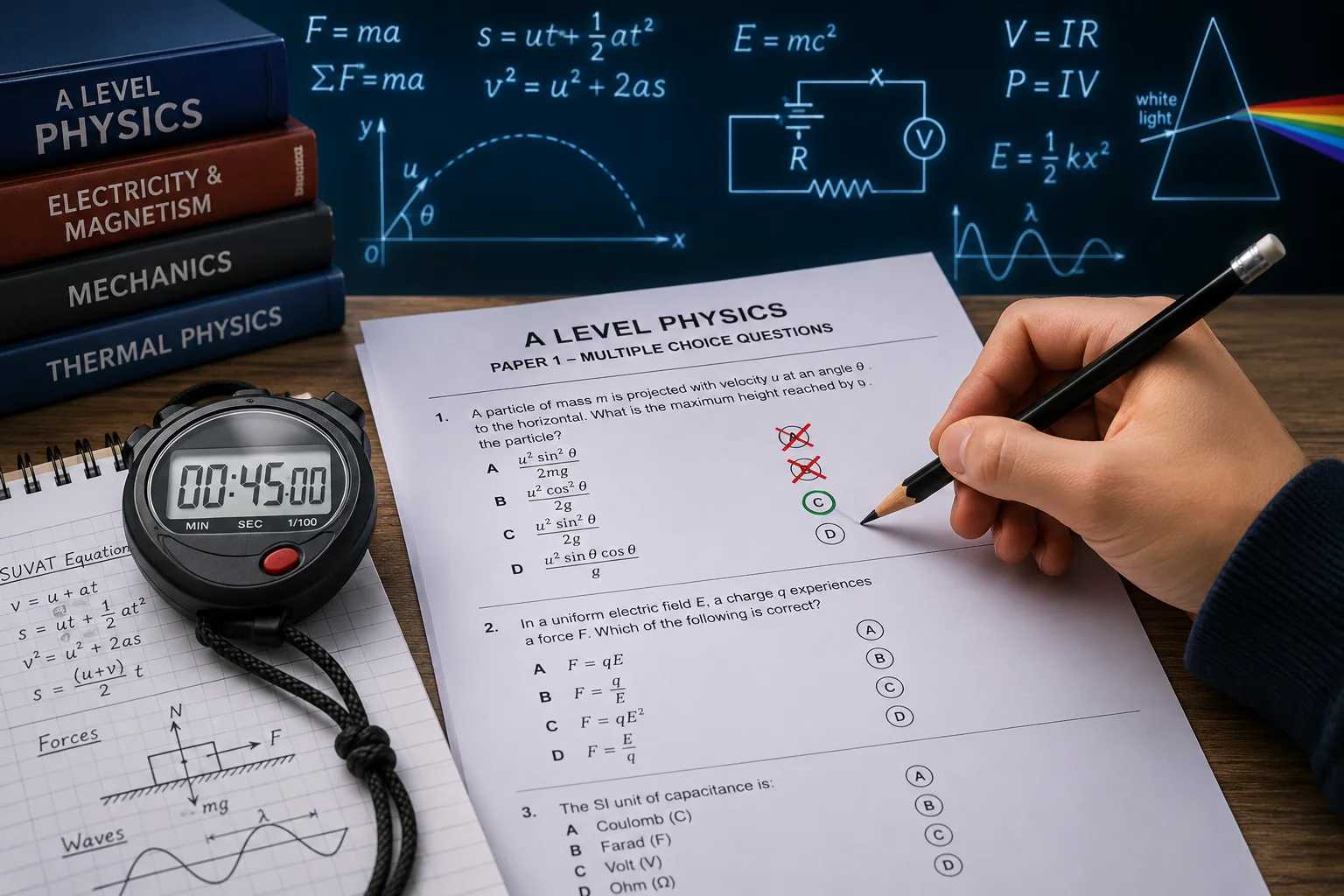
A Level Physics MCQ Tricks: Time Management and Elimination Strategies for Paper 1 Success
Many students find A level physics mcq tricks easier than structured questions because they do not require lengthy written answers. However, A Level Physics Paper 1 can be surprisingly challenging. The questions often test conceptual understanding, calculations, data interpretation and practical knowledge within a limited time frame. Students who rely solely on content knowledge frequently struggle to complete the paper efficiently.
Success in Paper 1 depends on more than knowing physics concepts. It also requires smart exam techniques, effective time management and the ability to quickly eliminate incorrect answers. Students who master these skills often achieve significantly higher marks even when facing difficult questions.
This guide explores proven A level physics mcq tricks and strategies that help students manage time effectively, improve accuracy and maximize marks in Physics Paper 1. Whether you are preparing months before the exam or looking for last-minute revision techniques, these methods can help you perform with confidence.
Why Paper 1 Requires a Different Approach
Unlike structured papers, MCQ exams reward both speed and accuracy. Students must process information rapidly while avoiding careless mistakes.
Common challenges include:
- Spending too long on difficult questions
- Misreading units and values
- Falling for distractor options
- Making calculation errors
- Running out of time before finishing the paper
- Changing correct answers unnecessarily
Strong subject knowledge is important, but strategic exam A level physics mcq tricks often make the difference between average and outstanding results.
A Level Physics MCQ Tricks That Instantly Improve Exam Performance
The most successful students use a combination of content mastery and exam strategy. These A level physics MCQ tricks can significantly improve performance on Paper 1.
Read the Question Before Looking at the Options
Many students immediately scan the answer choices. This can bias their thinking and lead them toward distractors.
Instead:
- Read the complete question.
- Identify what is being asked.
- Predict the answer mentally.
- Then compare your prediction with the options.
This method reduces confusion and improves accuracy.
Underline Key Information
Important clues often include:
- Units
- Direction
- Magnitude
- Conditions such as “maximum,” “minimum,” or “constant.”
Training yourself to identify these details prevents avoidable mistakes.
Trust Physics Principles
Physics MCQs often test fundamental laws repeatedly.
Examples include:
- Conservation of energy
- Newton’s laws
- Momentum conservation
- Electromagnetic principles
- Wave behavior
When uncertain, return to the core principle involved in the question.
Understanding the Time Pressure in Paper 1
One of the biggest obstacles students face is poor time allocation.
Many applicants hurry through the easier questions after spending too much time on the more challenging ones. A better strategy is to divide the paper into manageable phases.
First Pass
Answer questions that seem straightforward.
These may include:
- Definitions
- Formula applications
- Unit conversions
- Basic conceptual questions
Do not spend more than one minute on any difficult question during this phase.
Second Pass
Return to questions that require deeper thinking.
You now have confidence from answering easier questions and can focus without panic.
Final Review
Use remaining time to:
- Check calculations
- Verify units
- Revisit flagged questions
- Ensure all answers are filled in
This structured A level physics mcq tricks approach dramatically improves completion rates.
How to Use the Elimination Method Effectively
One of the most powerful exam A level physics mcq tricks is to eliminate incorrect options before selecting the correct answer.
Start by Removing Impossible Answers
Often, one or two choices are obviously wrong.
Examples:
- Incorrect units
- Physically impossible values
- Contradiction of known laws
Removing these options immediately increases the probability of selecting the correct answer.
Use Estimation
Exact calculations are not always necessary.
Suppose your answer should be approximately 200 J.
Options:
- 0.2 J
- 2 J
- 200 J
- 20,000 J
Even without detailed calculations, estimation quickly identifies the correct answer.
Check Dimensions
Dimensional analysis is highly useful in MCQ exams.
If the quantity should have units of:
- Newtons
- Joules
- Watts
- Volts
Any option with incompatible dimensions can be eliminated immediately.
Look for Extreme Values
Distractor options often include unrealistic values.
Ask yourself:
- Does this answer make physical sense?
- Is the magnitude reasonable?
- Would this result violate known principles?
These checks often reveal incorrect choices.
A Level Physics MCQ Tricks for Difficult Calculation Questions
Calculation-based MCQs often consume the most time.
Fortunately, several strategies can help.
Memorize Core Equations
Students should instantly recall common formulas related to:
- Motion
- Forces
- Energy
- Electricity
- Waves
- Circular motion
- Thermal physics
The less time spent remembering formulas, the more time remains for solving.
Rearrange Formulas During Revision
Many students memorize equations only in standard form.
For example:
Speed = Distance ÷ Time
Practice rearranging to find:
- Distance
- Time
This reduces exam stress when variables appear differently.
Keep Calculations Organized
Even in MCQs, writing short working steps helps prevent mistakes.
Benefits include:
- Easier error checking
- Improved accuracy
- Faster review during final checking
Estimate Before Calculating
An estimated answer provides a benchmark.
If your final value differs drastically, you know a mistake occurred.
These A level physics MCQ tricks help students solve numerical questions faster and more accurately.
Common Traps Used in Physics MCQs
Examiners often design questions to identify misconceptions.
Understanding common traps helps avoid them.
Unit Conversion Errors
Students frequently forget to convert:
- cm to m
- g to kg
- ms to s
- kW to W
Always verify units before calculating.
Sign Errors
Positive and negative signs matter in:
- Velocity
- Acceleration
- Electric charge
- Potential difference
Careless sign mistakes can lead directly to wrong answers.
Misreading Graphs
Graph questions often assess:
- Gradient
- Area under the curve
- Trend interpretation
Read axis labels carefully before selecting an answer.
Ignoring Keywords
Words such as:
- Initial
- Final
- Resultant
- Average
Change the meaning of a question significantly.
Building Speed During Revision
Speed develops through deliberate practice rather than last-minute cramming.
Complete Timed Sets
Practice 10–20 MCQs under timed conditions.
Benefits include:
- Better pacing
- Improved concentration
- Reduced exam anxiety
Track Error Patterns
Maintain a notebook of mistakes.
Categories may include:
- Formula errors
- Unit mistakes
- Misreading questions
- Calculation slips
Reviewing these patterns prevents repetition.
Simulate Real Exam Conditions
Avoid interruptions while practicing.
Use:
- A timer
- Printed questions
- Quiet environment
This develops exam stamina and focus.
The Psychology of High-Scoring Students
Top-performing students often demonstrate strong exam discipline.
They Do Not Panic
Difficult questions appear on every paper.
High achievers understand that:
- Everyone finds some questions challenging.
- Difficult questions affect all candidates.
- Staying calm improves decision-making.
They Avoid Overthinking
Physics MCQs usually have a single correct answer.
Students sometimes create unnecessary complexity.
Trust your preparation and follow logical reasoning.
They Move On Quickly
If a question seems impossible, mark it and continue.
Returning later often reveals the solution immediately.
Topic-Specific Strategies for Physics MCQs
Mechanics
Focus on:
- Forces
- Motion graphs
- Momentum
- Energy conservation
Draw simple diagrams whenever possible.
Electricity
Check:
- Units
- Circuit relationships
- Current direction
- Power calculations
Many electrical questions become easier to understand when visualized.
Waves
Remember relationships involving:
- Frequency
- Wavelength
- Wave speed
These concepts appear frequently in Paper 1.
Thermal Physics
Pay close attention to:
- Temperature scales
- Energy transfer
- Gas laws
Unit consistency remains critical.
Modern Physics
Questions often test understanding rather than calculation.
Focus on:
- Radioactivity
- Nuclear processes
- Quantum concepts
Careful reading usually reveals the correct answer.
Smart Guessing Techniques
Sometimes an answer remains unclear despite your best efforts.
Never leave a question unanswered.
Use Logical Elimination
Remove options that are clearly incorrect.
Even reducing four choices to two dramatically improves your chances.
Compare Remaining Answers
Ask:
- Which option aligns best with physics principles?
- Which value appears most realistic?
Avoid Random Changes
Research consistently shows that first answers are often correct unless a clear error is identified.
Trust evidence rather than anxiety.
These A level physics MCQ tricks are particularly useful in the final minutes of the exam.
Creating an Effective Revision Plan
Strong Paper 1 performance begins long before exam day.
Four Weeks Before the Exam
Focus on:
- Topic revision
- Formula memorization
- Concept understanding
Two Weeks Before the Exam
Increase:
- Timed practice
- Error analysis
- Past paper completion
Final Week
Prioritize:
- Weak topics
- MCQ drills
- Formula review
Avoid learning entirely new material at the last minute.
Exam Day Strategy
A clear plan reduces stress.
Before Entering the Exam Hall
Ensure you have:
- Required stationery
- Calculator
- Confidence in your preparation
During the Exam
Follow this sequence:
- Read instructions carefully.
- Complete easy questions first.
- Flag difficult questions.
- Return later.
- Review all answers.
Final Five Minutes
Check:
- Units
- Calculator entries
- Question numbering
- Unanswered items
Many marks are saved during this stage.
Advanced Elimination Techniques Used by Top Students
Elite candidates often rely on sophisticated elimination methods.
Pattern Recognition
Certain answer choices are designed to reflect common misconceptions.
Recognizing these patterns helps identify distractors quickly.
Reverse Engineering
Insert each answer option back into the problem.
The correct option often satisfies all conditions.
Consistency Checks
Compare the answer with:
- Known laws
- Typical values
- Expected trends
If inconsistency appears, eliminate the option.
Applying these advanced A level physics MCQ tricks can provide a competitive advantage in challenging papers.
Mistakes That Cost Students Valuable Marks
Avoid these common errors:
- Spending five minutes on one question
- Ignoring units
- Guessing without elimination
- Misreading graphs
- Changing correct answers
- Skipping final review
- Forgetting formula rearrangements
- Panicking after one difficult question
Awareness alone can prevent many of these mistakes.
Conclusion
Excelling in Physics Paper 1 requires more than memorizing formulas. Students who combine strong content knowledge with smart exam techniques consistently achieve higher marks. Effective pacing, strategic elimination, estimation, dimensional analysis and careful question reading all contribute to success.
Before the test, students can increase their speed, accuracy and confidence by consistently using these A level physics mcq tricks. Consistent exposure to timed MCQ practice helps transform these strategies into habits that work automatically under pressure.
For students looking to strengthen their A Level Physics preparation, Quality Notes offers valuable study resources, revision guidance, exam-focused explanations and topic-specific support designed to help learners understand difficult concepts and perform at their best in examinations.