
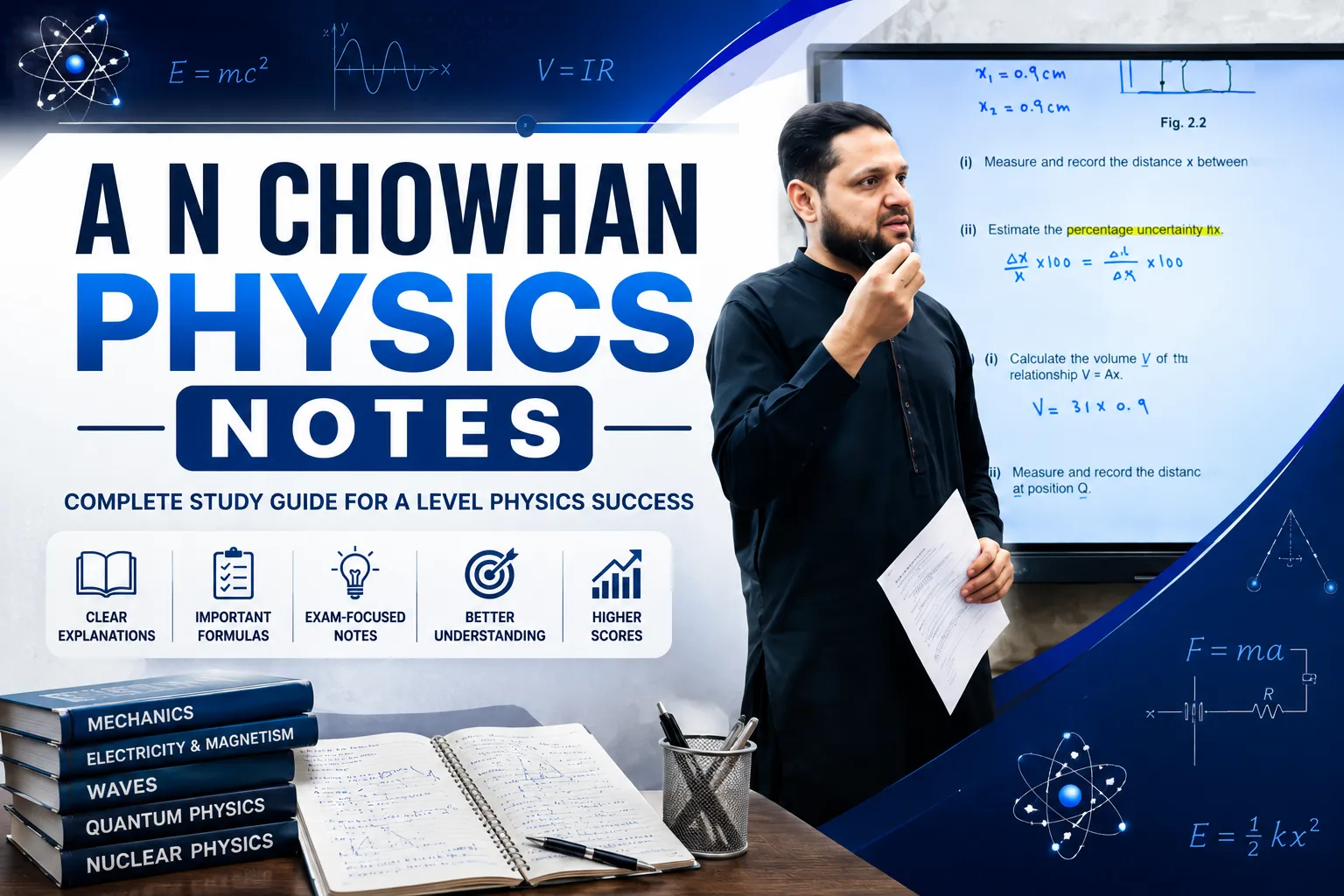
A N Chowhan Physics Notes: The Complete Study Guide for A Level Physics Success
Physics is one of the most rewarding yet demanding subjects at A Level. From mechanics and electricity to quantum physics and nuclear concepts, students need reliable study resources that explain complex topics clearly and logically. This is why A N Chowhan Physics Notes remain one of the most searched and trusted resources among A Level Physics students.
Whether you are preparing for AS examinations, completing A2 topics, or revising for your final exams, quality notes can save valuable study time and improve conceptual understanding. Alongside A N Chowhan Physics Notes, students also benefit from structured revision material available on Quality Notes, where concepts are organized for quick learning, effective revision and exam preparation.
In this guide, you’ll learn how to use these notes effectively, what topics they cover, how to prepare for examinations and which additional resources can help you achieve excellent grades.
Why Students Prefer A N Chowhan Physics Notes
Many A Level students struggle because they rely only on textbooks. While textbooks are comprehensive, they often contain more information than is required for examinations. A N Chowhan Physics Notes simplify complex concepts without removing the important details that examiners expect students to understand.
Some of the biggest advantages include:
- Easy-to-understand explanations
- Organized chapter-wise content
- Important formulas collected together
- Exam-focused theory
- Better conceptual clarity
- Faster revision before examinations
- Helpful diagrams and illustrations
Students often combine these notes with the learning resources available on Quality Notes to strengthen their preparation and cover every important syllabus objective.
How A N Chowhan Physics Notes Help During Exam Preparation
Preparing for Physics isn’t simply about memorizing formulas. Examiners test conceptual understanding and the ability to apply principles in unfamiliar situations.
Using A N Chowhan Physics Notes allows students to:
- Understand difficult theories more quickly
- Learn derivations step by step
- Practice applying formulas correctly
- Identify commonly tested concepts
- Reduce revision time
- Improve confidence before examinations
Rather than reading entire textbooks repeatedly, students can efficiently revise key concepts using summarized notes and topical practice.
Topics Covered in A Level Physics
A complete set of notes should include every major topic required by the syllabus.
Physical Quantities and Units
Students learn:
- SI units
- Base quantities
- Derived units
- Measurement uncertainty
- Significant figures
- Experimental accuracy
Understanding these basics helps avoid unnecessary mistakes throughout the examination.
Mechanics
Mechanics forms the foundation of Physics.
Topics include:
- Motion
- Velocity
- Acceleration
- Projectile motion
- Newton’s Laws
- Momentum
- Circular motion
Good notes explain these concepts with practical examples instead of lengthy theoretical discussions.
Forces and Energy
Students study:
- Work done
- Energy conservation
- Power
- Efficiency
- Gravitational potential energy
- Kinetic energy
Clear examples make numerical problems much easier to solve.
Materials
Important concepts include:
- Stress
- Strain
- Hooke’s Law
- Young Modulus
- Elastic behavior
- Plastic deformation
These topics often appear in structured questions.
Waves
Wave questions frequently appear in examinations.
Topics include:
- Wave properties
- Superposition
- Diffraction
- Interference
- Polarization
- Standing waves
Simple diagrams improve understanding significantly.
Electricity
Electricity requires strong mathematical skills.
Students revise:
- Electric current
- Potential difference
- Resistance
- Internal resistance
- Kirchhoff’s Laws
- Capacitors
- Electrical power
Well-organized revision notes simplify circuit analysis considerably.
Fields
Field topics include:
- Electric fields
- Gravitational fields
- Magnetic fields
- Electromagnetic induction
Many students find these chapters easier after studying summarized explanations.
Quantum Physics
This modern Physics topic covers:
- Photoelectric effect
- Energy levels
- Photons
- Wave-particle duality
It is more crucial to comprehend the fundamental ideas than to commit definitions to memory.
Nuclear Physics
Students learn:
- Radioactivity
- Nuclear decay
- Half-life
- Binding energy
- Nuclear reactions
These concepts often appear in both theory and calculation questions.
Secondary Resources That Improve Learning
While A N Chowhan Physics Notes provide excellent summaries, combining them with additional learning resources leads to stronger preparation.
Useful study materials include:
- A Level Physics notes
- Physics revision notes
- A Level Physics formula sheet
- Physics topical questions
- Physics solved past papers
- Physics practical notes
- Physics MCQs
- Physics definitions list
- Cambridge Physics revision guide
- A Level Physics study notes
Quality Notes brings many of these resources together in one place, making revision more organized and efficient.
Effective Study Strategy
Having good notes is only part of successful preparation.
A practical study routine includes:
1. Read Concepts Carefully
Start by understanding every chapter before attempting questions.
2. Highlight Important Formulas
Maintain a separate formula notebook for quick revision.
3. Solve Numerical Problems
Physics improves through practice rather than reading alone.
4. Attempt Past Papers
Past papers reveal common question patterns and examiner expectations.
5. Review Mistakes
Every incorrect answer teaches an important lesson.
6. Revise Weekly
Regular revision prevents forgetting earlier topics.
Common Mistakes Students Make
Many students lose marks because of avoidable errors.
Some common mistakes include:
- Memorizing without understanding
- Ignoring derivations
- Skipping practical concepts
- Not revising formulas regularly
- Poor unit conversions
- Weak time management
- Avoiding difficult numerical questions
Using A N Chowhan Physics Notes alongside structured revision from Quality Notes helps reduce these mistakes by reinforcing both conceptual understanding and exam practice.
How to Score Higher in Physics
High-performing students usually follow consistent study habits.
Some proven strategies include:
- Study every day instead of cramming.
- Revise formulas regularly.
- Practice calculations without looking at solutions.
- Focus on understanding rather than memorization.
- Solve recent past papers under timed conditions.
- Analyze examiner reports where available.
- Create short revision summaries before exams.
These habits gradually improve confidence and examination performance.
Why Organized Notes Matter
Well-structured notes reduce unnecessary stress during revision.
Benefits include:
- Faster chapter review
- Better retention
- Easy formula revision
- Improved concept clarity
- Reduced exam anxiety
- More effective time management
Students often discover that organized study materials allow them to revise the complete syllabus several times before examinations.
Conclusion
Preparing for A Level Physics becomes much easier when you use reliable and well-organized study resources. A N Chowhan Physics Notes provide concise explanations, important formulas and exam-focused summaries that help students strengthen their understanding of challenging topics while saving valuable revision time.
However, the best results come from combining these notes with regular practice, topical questions, formula revision and solving past papers.
If you’re looking for a complete learning platform, Quality Notes is an excellent resource for A Level students. Along with comprehensive notes, it offers structured revision materials, formula sheets, solved questions and exam-focused content designed to help you prepare confidently and achieve higher grades in Physics.
By using trusted resources consistently and following a smart revision plan, you can approach your examinations with greater confidence and significantly improve your performance.