
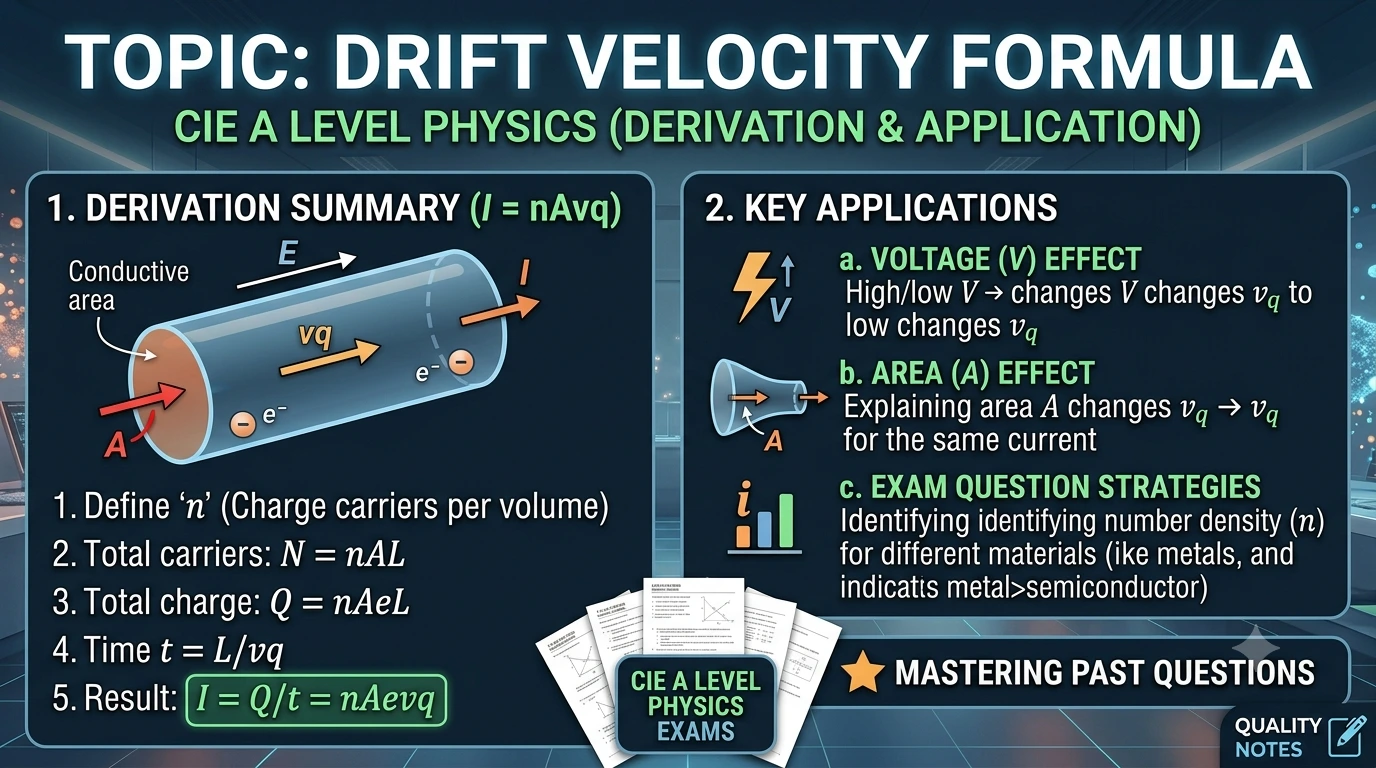
Drift Velocity Formula Explained: Derivation, Units, and Exam Questions
The drift velocity formula is one of the most elegant equations in the entire CIE 9702 electricity topic. It bridges the microscopic world of individual electrons moving through a conductor and the macroscopic quantity of electric current that we measure in circuits. Students who understand where the drift velocity formula comes from — not just what it says — answer exam questions with a precision and confidence that passive memorisation never provides.
This guide covers the full derivation of the drift velocity formula, every variable explained with its correct SI unit, three fully worked exam-style examples, the most common mistakes seen in CIE 9702 past papers, and a complete FAQ section targeting the exact questions students search for most.
What Is Drift Velocity?
Before deriving the drift velocity formula, it is essential to understand exactly what drift velocity means — because examiners frequently ask students to define it.
In a metallic conductor, free electrons are always moving. Even without any applied voltage, electrons move continuously in random directions at very high thermal speeds — typically on the order of 10⁶ m s⁻¹. However, because this motion is entirely random, the net displacement of any electron over time is zero. No current flows.
When an external electric field is applied across the conductor, every electron experiences a force in the direction opposite to the field. This force does not stop the random thermal motion — it superimposes a small, steady, net motion onto it. The average velocity of this net motion in the direction of the electric force is called the drift velocity.
The drift velocity is remarkably slow — typically on the order of 10⁻³ to 10⁻⁴ m s⁻¹ (millimetres per second). This surprises students who expect electrons to travel at near light speed through a wire. The reason a light switches on instantly is not because electrons rush from the switch to the bulb — it is because the electric field propagates through the conductor almost instantaneously, setting all the electrons drifting simultaneously along the entire length of the circuit.
CIE mark scheme definition of drift velocity: The mean (average) velocity of charge carriers in a direction along the conductor due to an applied electric field.
Deriving the Drift Velocity Formula Step by Step
The drift velocity formula is derived from first principles using the definition of electric current. This derivation is examinable in CIE 9702 Paper 2 — knowing it earns marks on “show that” and “derive” questions.
Setup: Consider a conductor of cross-sectional area A, carrying a current I. The conductor contains free charge carriers (electrons in a metal) with:
- Number density n (number of charge carriers per unit volume, in m⁻³)
- Each carrying charge q (for electrons, q = e = 1.6 × 10⁻¹⁹ C)
- Moving with mean drift velocity v along the conductor
Step 1: Find the number of charge carriers in a length L of the conductor
Volume of conductor segment = A × L
Number of charge carriers in this segment = n × A × L
Step 2: Find the total charge in this segment
Total charge Q = number of carriers × charge per carrier
Q = nALq
Step 3: Find the time for this charge to pass through a cross-section
If the charge carriers move with drift velocity v, the time for all carriers in length L to pass through one cross-section is:
t = L / v
Step 4: Apply the definition of current
Current I = charge / time = Q / t
I = nALq / (L/v)
I = nALq × (v/L)
Therefore: I = nAvq
This is the drift velocity formula for CIE 9702. Rearranged to make drift velocity the subject:
v = I / (nAq)
For metallic conductors where the charge carriers are electrons, q = e:
v = I / (nAe)
Every Variable in the Drift Velocity Formula: Definitions and SI Units
Understanding each symbol precisely is essential — both for calculations and for the “state what is meant by” questions that CIE examiners ask regularly.
| Symbol | Quantity | SI Unit | Notes |
| I | Electric current | Ampere (A) | Rate of flow of charge |
| n | Number density of charge carriers | m⁻³ | Number of free electrons per unit volume |
| A | Cross-sectional area of conductor | m² | Convert mm² by multiplying by 10⁻⁶ |
| v | Drift velocity | m s⁻¹ | Mean velocity of carriers along conductor |
| q or e | Charge per carrier | Coulomb (C) | For electrons: 1.6 × 10⁻¹⁹ C |
Number density (n) deserves particular attention because it is the variable most commonly confused in exam questions. Number density is the number of free charge carriers per unit volume — it is a property of the material, not the wire dimensions. For copper, n ≈ 8.5 × 10²⁸ m⁻³. For a semiconductor, n is many orders of magnitude smaller, which is why semiconductors have much higher resistance for the same dimensions.
The units of n (m⁻³) can be verified by checking the homogeneity of I = nAvq:
- Right side units: m⁻³ × m² × m s⁻¹ × C = m⁰ × C s⁻¹ = A ✓
How Variables Affect Drift Velocity: Proportionality Analysis
One of the most common question formats in CIE 9702 Paper 2 is: “A wire is replaced by one of the same material but with twice the cross-sectional area. State and explain the effect on the drift velocity of the electrons.”
From v = I / (nAe), drift velocity is:
- Directly proportional to current I — double the current, double the drift velocity
- Inversely proportional to cross-sectional area A — double the area, halve the drift velocity
- Inversely proportional to number density n — this explains why different materials carry the same current at different drift velocities
This proportionality analysis is tested repeatedly in the AS Level Physics electricity topic and requires careful, precise reasoning in answers.
Three Fully Worked Exam-Style Examples
Example 1 — Standard Calculation
A copper wire carries a current of 2.0 A. The cross-sectional area of the wire is 1.5 × 10⁻⁶ m² and the number density of free electrons in copper is 8.5 × 10²⁸ m⁻³. Calculate the drift velocity of the electrons.
Solution: v = I / (nAe) v = 2.0 / (8.5 × 10²⁸ × 1.5 × 10⁻⁶ × 1.6 × 10⁻¹⁹) v = 2.0 / (2.04 × 10⁴) v = 9.8 × 10⁻⁵ m s⁻¹
This is approximately 0.1 mm per second — an important order-of-magnitude result to remember.
Example 2 — Unit Conversion Required
A wire has a circular cross-section of diameter 1.2 mm. It carries a current of 3.5 A. The number density of charge carriers is 6.0 × 10²⁸ m⁻³. Calculate the drift velocity.
Step 1: Convert diameter to radius and calculate area. radius = 0.6 mm = 0.6 × 10⁻³ m = 6.0 × 10⁻⁴ m A = πr² = π × (6.0 × 10⁻⁴)² = 1.131 × 10⁻⁶ m²
Step 2: Apply the drift velocity formula. v = I / (nAe) v = 3.5 / (6.0 × 10²⁸ × 1.131 × 10⁻⁶ × 1.6 × 10⁻¹⁹) v = 3.5 / (1.086 × 10⁴) v = 3.2 × 10⁻⁴ m s⁻¹
Example 3 — Comparing Two Wires in Series
Two wires X and Y are connected in series. Wire X has cross-sectional area 2A and number density n. Wire Y has cross-sectional area A and number density 2n. Compare the drift velocities in X and Y.
Using v = I / (nAe) — note that I is the same in both wires (series circuit):
Wire X: v_X = I / (n × 2A × e) = I / (2nAe)
Wire Y: v_Y = I / (2n × A × e) = I / (2nAe)
v_X = v_Y — the drift velocities are equal.
This type of question tests deep understanding of the drift velocity formula rather than straightforward calculation. It appears in Paper 2 structured questions and always rewards students who rearrange and compare systematically.
Drift Velocity and Number Density: Why Semiconductors Behave Differently
The drift velocity formula explains one of the most important differences between conductors and semiconductors directly.
In a metallic conductor like copper, n ≈ 8.5 × 10²⁸ m⁻³. In a semiconductor like silicon, n can be as low as 10¹⁶ m⁻³ — more than twelve orders of magnitude smaller. For the same current and cross-sectional area, the drift velocity formula shows that drift velocity in a semiconductor is therefore enormously larger than in a metal.
This is precisely why semiconductors behave so differently in circuits — not because the electrons move more freely, but because there are far fewer of them, so each must move much faster to carry the same current. This concept links the drift velocity formula directly to the A Level Physics topics of resistance, resistivity, and semiconductor devices.
For deep-dive notes and topic-by-topic practice questions on electricity and all other chapters, the free topical past paper workbooks at Quality Notes provide structured exam-style practice built directly from real CIE 9702 past papers.
Common Exam Mistakes on the Drift Velocity Formula
Using mm² instead of m² for cross-sectional area. This is the single most frequent calculation error on drift velocity formula questions in CIE 9702. If the area is given in mm², multiply by 10⁻⁶ to convert to m² before substituting. A diameter in mm requires conversion to radius in metres before calculating A = πr².
Confusing number density with total number of electrons. Number density n is electrons per unit volume (m⁻³), not the total count of electrons in the wire. Using the total number of electrons rather than the density per unit volume gives a completely wrong answer and shows a fundamental misunderstanding of the formula.
Assuming drift velocity is the same everywhere in a circuit. In a series circuit, current I is the same throughout. But if cross-sectional area or number density changes between sections, the drift velocity formula shows that drift velocity changes too. Many students incorrectly assume drift velocity is constant around a series circuit.
Forgetting to take the square root when finding area from diameter. When a circular cross-section is described by its diameter, students must halve to get the radius, then use A = πr². Using diameter directly in place of radius gives an area four times too large.
Not stating the unit in the final answer. Drift velocity must be given in m s⁻¹. The CIE mark scheme deducts for missing units on final answers.
People Also Ask About the Drift Velocity Formula
What is the drift velocity formula in physics?
The drift velocity formula is I = nAvq, where I is electric current (A), n is the number density of charge carriers (m⁻³), A is the cross-sectional area of the conductor (m²), v is the drift velocity (m s⁻¹), and q is the charge per carrier (C). Rearranged: v = I / (nAq).
What is number density in the drift velocity formula?
Number density (n) is the number of free charge carriers per unit volume of the conductor, measured in m⁻³. It is a property of the material — copper has n ≈ 8.5 × 10²⁸ m⁻³, while semiconductors have values many orders of magnitude smaller.
Why is drift velocity so small?
Because the number density of free electrons in a metal is enormous (around 10²⁸ m⁻³). Even a modest current only requires each electron to move a fraction of a millimetre per second to produce a large net charge flow. The slow drift is superimposed on much faster random thermal motion at around 10⁶ m s⁻¹.
How do you derive the drift velocity formula?
Consider a conductor of length L, area A, with n charge carriers per unit volume each carrying charge q and moving at drift velocity v. The volume swept in time t is ALvt (where L = vt). The total charge in this volume is nALvtq. Dividing by time t gives current I = nAvq. Rearranging gives v = I / (nAq).
What are the SI units of drift velocity?
The SI unit of drift velocity is metres per second (m s⁻¹). This can be verified from the formula: I(A) = n(m⁻³) × A(m²) × v(m s⁻¹) × q(C) → A = C s⁻¹ ✓.
Does drift velocity change in a series circuit?
Yes. Current I is the same throughout a series circuit, but if the cross-sectional area A or number density n changes between sections, the drift velocity v = I/(nAe) changes accordingly. A narrower wire of the same material carries the same current at a higher drift velocity.
Conclusion
The drift velocity formula sits within the electricity topic of CIE 9702 — Topic 9 of the AS Level syllabus. It is examined in Paper 1 MCQs (qualitative comparisons of drift velocity in different conductors) and Paper 2 structured questions (derivation, calculation, and proportionality analysis).
The students who score full marks on these questions are those who can do three things: derive the formula from first principles, apply it correctly in multi-step calculations with unit conversions, and reason about how changes in variables affect drift velocity without reaching for a calculator.
For expert guidance on the electricity topic and every other chapter in CIE 9702, recorded lessons at Quality Notes walk through the derivation, the worked examples, and the exam-technique points that make the difference between partial and full marks. If you want a structured revision plan covering drift velocity and the rest of the IGCSE/GCE O Level and A Level syllabus, students counselling is available to help you build one.
When you get help from Mr. Adeel Chowhan, who is known as the best online physics teacher in Pakistan, you can’t do better in your studies. Go to Quality Notes right now to get a free trial class, for further access to structured topical past papers, lessons taught by experts, and all the tools you need to get the best grades.