
Particle Physics A Level: Everything You Need to Know for CIE 9702
Particle physics is one of the most fascinating chapters in the entire CIE 9702 syllabus — and one of the most reliably tested. It sits at Topic 11 of the AS Level content, meaning it appears in Paper 1 multiple-choice questions and Paper 2 structured questions in almost every exam session. Students who invest time in this topic consistently pick up marks that others miss, because the content is finite, clearly defined, and highly predictable once you understand what examiners actually test.
This complete guide covers every subtopic in particle physics for CIE 9702 — from atomic structure and radioactive decay through to quarks, leptons, and antiparticles — with the exact level of depth the syllabus demands and the precision the mark scheme rewards.
The Atom: Where Particle Physics Begins
Before quarks and leptons, the CIE 9702 particle physics syllabus begins with the nuclear model of the atom — a model inferred directly from the famous alpha-particle scattering experiment performed by Geiger and Marsden under the direction of Ernest Rutherford in 1909.
The key conclusions students must be able to state from that experiment:
- Most of the atom is empty space, because most alpha particles passed straight through the gold foil with little or no deflection
- The nucleus is very small compared to the atom, because only a tiny fraction of alpha particles were deflected through large angles
- The nucleus is positively charged, because the large-angle deflections indicated a concentrated positive charge repelling the positively charged alpha particles
- The nucleus contains most of the atom’s mass, because some alpha particles were deflected backwards (through angles greater than 90°)
The nuclear model describes the atom as a tiny, dense, positively charged nucleus surrounded by orbiting electrons. For CIE 9702 particle physics, the nucleus is composed of protons (charge +1e, relative mass 1) and neutrons (charge 0, relative mass 1). Electrons have charge −1e and negligible mass relative to nucleons.
Nuclide notation — knowing how to read and write ᴬ𝓩X — is a foundational skill tested throughout the particle physics topic and in nuclear equation questions.
Radioactive Decay: Alpha, Beta, and Gamma
Radioactive decay is the spontaneous emission of radiation from an unstable nucleus. CIE 9702 requires students to know the nature, charge, mass, and penetrating properties of all three types of radiation in the context of particle physics.
Alpha (α) decay
An alpha particle consists of 2 protons and 2 neutrons — identical to a helium-4 nucleus. In alpha decay, the proton number decreases by 2 and the nucleon number decreases by 4. Alpha particles are emitted with discrete energies — every alpha from a given nuclide has the same kinetic energy.
Example nuclear equation: ²¹⁰₈₄Po → ²⁰⁶₈₂Pb + ⁴₂He
Beta-minus (β⁻) decay
A neutron decays into a proton, emitting an electron (β⁻ particle) and an electron antineutrino (ν̄ₑ). The proton number increases by 1; the nucleon number is unchanged.
Example: ⁹⁰₃₈Sr → ⁹⁰₃₉Y + e⁻ + ν̄ₑ
A critical syllabus point: unlike alpha particles, beta particles are emitted with a continuous range of energies, not discrete values. This is because three particles share the available energy — the daughter nucleus, the beta particle, and the antineutrino. The antineutrino carries away a variable share of the energy, leaving the beta particle with a different amount each time. The existence of the neutrino was originally proposed by Pauli specifically to explain this continuous energy spectrum.
Beta-plus (β⁺) decay
A proton decays into a neutron, emitting a positron (β⁺ particle) and an electron neutrino (νₑ). Proton number decreases by 1; nucleon number is unchanged.
Gamma (γ) radiation
Gamma rays are high-energy electromagnetic radiation emitted when a nucleus transitions from an excited energy state to a lower one. No change in proton number or nucleon number occurs. Gamma emission often accompanies alpha or beta decay.
Conservation laws in all nuclear processes
In every nuclear equation, the following quantities are always conserved:
- Nucleon number (mass number)
- Proton number (charge)
- Mass-energy
- Momentum
A key examiner finding from the March 2025 CIE examiner report: when asked what quantities are conserved in nuclear decay, most students named momentum and charge but forgot nucleon number and proton number — despite having applied conservation of both correctly in their nuclear equations in the same question. Knowing this list precisely earns marks.
Antiparticles: What the Syllabus Requires
Every particle has a corresponding antiparticle. For CIE 9702 particle physics, students must understand:
- An antiparticle has the same mass as its corresponding particle
- An antiparticle has opposite charge to its corresponding particle
- The antiparticle of the electron (e⁻) is the positron (e⁺)
- The antiparticle of the proton is the antiproton
- The antiparticle of the neutron is the antineutron (same mass, but opposite in other quantum properties)
Annihilation occurs when a particle meets its antiparticle. Both particles are destroyed and their combined mass-energy is converted into two gamma-ray photons travelling in opposite directions. The energy of each photon equals the rest mass energy of one particle: E = m₀c².
This concept connects directly to PET scanning in medical imaging — a tracer that decays by β⁺ emission releases positrons, which annihilate with electrons in tissue to produce two gamma photons detected by the scanner. This application of particle physics appears in both AS and A Level exam questions.
Quarks: The Fundamental Constituents of Hadrons
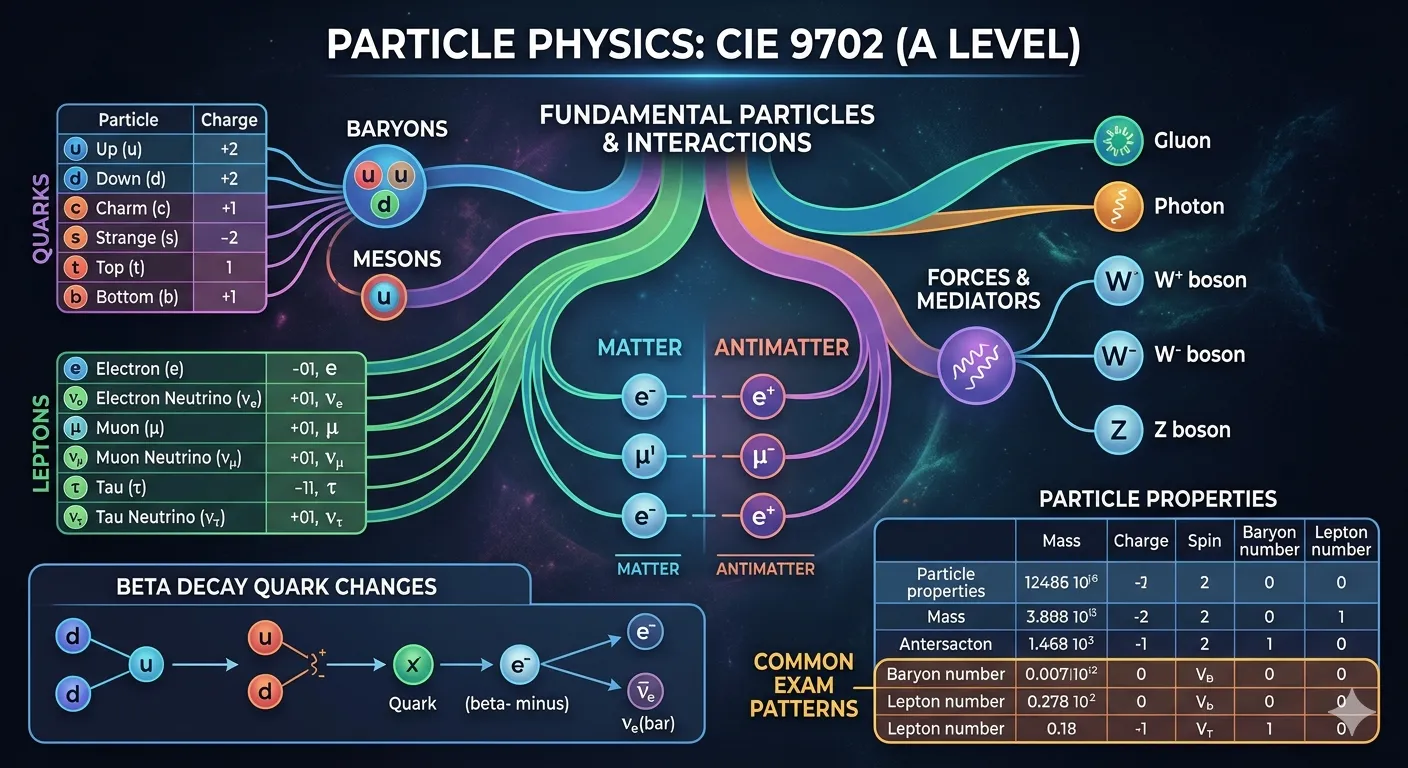
Quarks are fundamental particles — they cannot be broken down into smaller components. CIE 9702 requires knowledge of six quark flavours:
| Quark | Symbol | Charge |
| Up | u | +²⁄₃ e |
| Down | d | −¹⁄₃ e |
| Strange | s | −¹⁄₃ e |
| Charm | c | +²⁄₃ e |
| Top | t | +²⁄₃ e |
| Bottom | b | −¹⁄₃ e |
For CIE 9702 AS Level, the up and down quarks are the most important. Each quark has a corresponding antiquark with the opposite charge.
Hadrons are particles made of quarks. They experience the strong nuclear force. Hadrons are divided into two families:
- Baryons — made of three quarks. The proton (uud) and neutron (udd) are the most important baryons for CIE 9702. The proton is the only stable baryon.
- Mesons — made of one quark and one antiquark.
Proton quark composition: uud Charge: ²⁄₃ + ²⁄₃ + (−¹⁄₃) = +1 ✓
Neutron quark composition: udd Charge: ²⁄₃ + (−¹⁄₃) + (−¹⁄₃) = 0 ✓
These compositions should be committed to memory — they are tested directly in Paper 1 MCQs and Paper 2 questions every year.
Quark Changes in Beta Decay: A High-Value Exam Topic
The quark-level description of beta decay is one of the most consistently tested areas of particle physics in CIE 9702 Paper 2. Students must be able to describe exactly which quark changes during each type of decay.
Beta-minus (β⁻) decay — quark change: A down quark (d) changes into an up quark (u). This converts a neutron (udd) into a proton (uud). An electron and an electron antineutrino are emitted.
d → u + e⁻ + ν̄ₑ
Charge check: −¹⁄₃ → +²⁄₃ + (−1) + 0 = −¹⁄₃ ✓ Charge is conserved.
Beta-plus (β⁺) decay — quark change: An up quark (u) changes into a down quark (d). This converts a proton (uud) into a neutron (udd). A positron and an electron neutrino are emitted.
u → d + e⁺ + νₑ
Charge check: +²⁄₃ → −¹⁄₃ + (+1) + 0 = +²⁄₃ ✓ Charge is conserved.
The examiner most commonly asks students to “describe the change to quark composition” — expecting a statement such as “a down quark changes to an up quark” rather than just a nuclear equation. Both the quark-level description and the nuclear equation may be required in the same question.
Leptons: The Other Family of Fundamental Particles
Leptons are fundamental particles that do not experience the strong nuclear force. For CIE 9702 particle physics, the key leptons are:
- Electron (e⁻)
- Positron (e⁺) — the antielectron, also called the antilepton
- Electron neutrino (νₑ)
- Electron antineutrino (ν̄ₑ)
Leptons are produced in beta decay — electrons and antineutrinos in β⁻ decay, positrons and neutrinos in β⁺ decay. Unlike hadrons, leptons have no internal quark structure. They are truly fundamental.
The neutrino is particularly important in CIE 9702 particle physics questions about the continuous energy spectrum of beta particles. Students must be able to explain that the neutrino was proposed to account for the missing energy and momentum in beta decay, and that it was proposed before being experimentally detected.
For comprehensive notes and exam-style practice on every subtopic in particle physics and the full 9702 syllabus, the books and revision notes at Quality Notes are written specifically for Cambridge students.
The Four Fundamental Forces
CIE 9702 requires awareness of the four fundamental forces and how they relate to particle physics:
| Force | Range | Acts on |
| Strong nuclear | Very short (~10⁻¹⁵ m) | Hadrons (quarks) |
| Weak nuclear | Very short (~10⁻¹⁸ m) | All particles (governs beta decay) |
| Electromagnetic | Infinite | Charged particles |
| Gravitational | Infinite | All particles with mass |
Beta decay is governed by the weak nuclear force — this is why it proceeds much more slowly than strong interaction processes and why it produces leptons (which do not experience the strong force). The strong nuclear force is what holds the nucleus together despite the electrostatic repulsion between protons.
How Particle Physics Is Examined in CIE 9702
Understanding the exam format for this topic helps you allocate revision time correctly.
Paper 1 (MCQ)
Expect 2–4 multiple-choice questions per session covering quark compositions, identifying correct nuclear equations, properties of radiation, and antiparticle relationships. These are among the most reliable mark-earners in Paper 1 for well-prepared students.
Paper 2 (Structured)
Extended questions on this topic typically require writing and balancing nuclear equations, describing quark changes in beta decay, explaining the continuous energy spectrum of beta particles, or describing annihilation and pair production. Mark schemes award marks for precise language — “a down quark changes to an up quark” not “a neutron loses a particle.”
The free topical past paper workbooks at Quality Notes include topical particle physics questions drawn from multiple years of real CIE 9702 papers, allowing you to practise exactly the question types and phrasings that examiners use.
Common Exam Mistakes in Particle Physics
Confusing nucleon number and proton number in nuclear equations. The March 2025 CIE examiner report specifically flagged that many students used proton number instead of mass number when applying conservation of momentum in decay questions.
Forgetting the antineutrino in β⁻ decay. Many students write a correct nuclear equation but omit the ν̄ₑ. The mark scheme deducts for this consistently.
Stating that beta particles have discrete energies. They do not — they have a continuous range of energies. Alpha particles have discrete energies. This distinction is a direct syllabus learning objective and a frequent exam trap.
Describing quark changes incorrectly. Saying “a neutron becomes a proton” is insufficient. The mark scheme requires “a down quark changes to an up quark” for full credit in quark-level questions.
Confusing hadrons and leptons. Hadrons are made of quarks and experience the strong nuclear force. Leptons are fundamental and do not. Examiners frequently test this classification.
People Also Ask About Particle Physics A Level
What is particle physics in A Level Physics?
Particle physics in CIE 9702 covers the structure of atoms, radioactive decay (alpha, beta, gamma), antiparticles, quarks, leptons, hadrons, and the quark-level description of beta decay. It forms Topic 11 of the AS Level syllabus and is tested in Papers 1 and 2.
What are quarks in A Level Physics?
Quarks are fundamental particles that make up hadrons such as protons and neutrons. CIE 9702 requires knowledge of six quark flavours (up, down, strange, charm, top, bottom) with their charges. Protons are composed of two up quarks and one down quark (uud); neutrons are composed of one up quark and two down quarks (udd).
What is the difference between hadrons and leptons?
Hadrons are particles made of quarks that experience the strong nuclear force — examples include protons and neutrons. Leptons are fundamental particles that do not experience the strong nuclear force — examples include electrons, positrons, and neutrinos.
Why do beta particles have a continuous range of energies?
Because three particles share the available energy in beta decay — the daughter nucleus, the beta particle, and the (anti)neutrino. The neutrino carries a variable share of the energy in each decay, leaving the beta particle with a different kinetic energy every time. This gives rise to a continuous energy spectrum.
What quark change happens in beta-minus decay?
In β⁻ decay, a down quark changes into an up quark. This converts a neutron (udd) into a proton (uud), and an electron and electron antineutrino are emitted.
What is annihilation in particle physics?
Annihilation occurs when a particle meets its corresponding antiparticle. Both are destroyed and their combined rest mass-energy is converted into two gamma-ray photons of equal energy travelling in exactly opposite directions. This process is exploited in PET scanning in medical imaging.
Conclusion
Particle physics rewards students who learn it precisely. The content is finite and well-defined — the syllabus tells you exactly what you need to know. Every quark composition, every conservation law, every decay type, and every lepton name is in the 9702 syllabus document. There is no ambiguity about what could be asked.
The students who score full marks on particle physics questions are those who learn the exact language the mark scheme uses — not approximations. Practise writing nuclear equations from memory, describing quark changes in precise terms, and explaining the continuous beta energy spectrum in your own words without looking at notes.
For expert-guided teaching through every aspect of this topic and the rest of the CIE 9702 syllabus, recorded lessons at Quality Notes break down each subtopic with the exact exam focus it deserves. If you need a structured revision plan for the full particle physics topic and beyond, students counselling is available to help you build one around your exam timeline.
When you get help from Mr. Adeel Chowhan, who is known as the best online physics teacher in Pakistan, you can’t do better in your studies. Go to Quality Notes right now to get a free trial class, for further access to structured topical past papers, lessons taught by experts, and all the tools you need to get the best grades.