
Percentage Uncertainty in Physics: Formula, Examples, and Common Errors
Of all the skills tested in CIE 9702, percentage uncertainty is one of the most consistently mishandled — not because it is conceptually difficult, but because students learn it too shallowly. They memorise the formula, apply it to a single measurement, and think they are done. Then they encounter a multi-step calculation requiring combined percentage uncertainty across several measured quantities and lose marks they should have collected easily.
The March 2025 CIE Physics examiner report states directly that “concepts of uncertainty were not generally well understood” across the candidate pool — and that stronger candidates were distinguished precisely by their ability to calculate and combine percentage uncertainty correctly in multi-variable problems. This guide fixes that gap completely.
What Is Percentage Uncertainty?
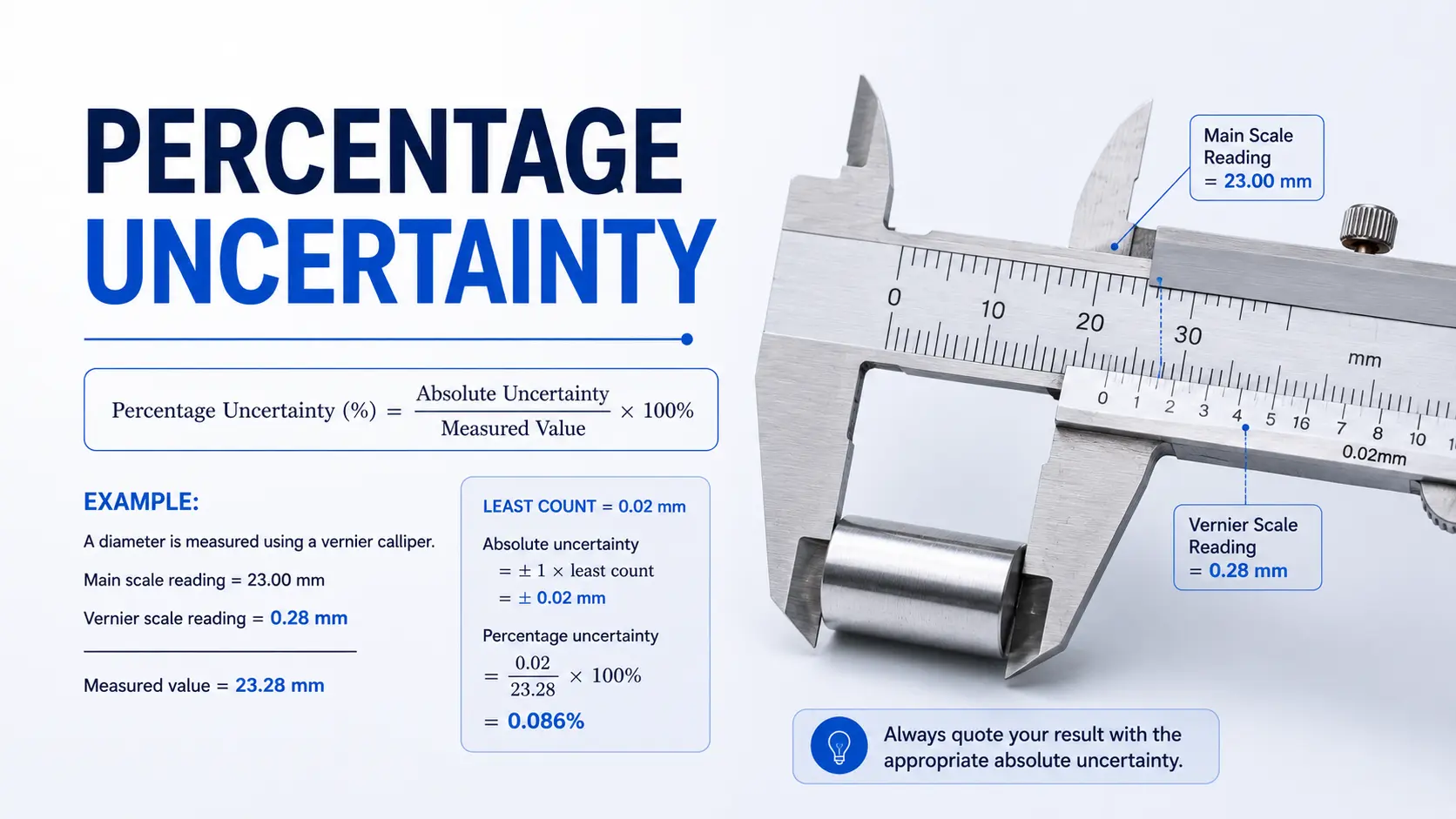
Percentage uncertainty expresses the absolute uncertainty in a measurement as a proportion of the measured value, multiplied by 100 to give a percentage. It answers the question: how significant is the uncertainty relative to the size of the measurement itself?
The formula is:
Percentage uncertainty = (Absolute uncertainty / Measured value) × 100%
Or in symbolic form:
%ΔQ = (ΔQ / Q) × 100%
Where:
- Q is the measured value
- ΔQ is the absolute uncertainty in that measurement
- %ΔQ is the percentage uncertainty
Worked Example: A student measures a length as L = 24.5 cm using a ruler with a smallest division of 1 mm. Absolute uncertainty: ΔL = ±0.5 mm = ±0.05 cm Percentage uncertainty: %ΔL = (0.05 / 24.5) × 100% = 0.20%
This tells you that the uncertainty is 0.20% of the measured value — a relatively small proportion, indicating a reliable measurement.
Why Percentage Uncertainty Matters More Than Absolute Uncertainty
Absolute uncertainty alone does not tell you whether a measurement is reliable. An absolute uncertainty of ±0.5 mm is negligible when measuring a 2-metre pendulum, but enormous when measuring a 3 mm wire diameter. Percentage uncertainty normalises the doubt relative to the quantity being measured — making it the correct tool for comparing the quality of different measurements and for identifying which measurement contributes most to the error in a calculated result.
This is why CIE 9702 examiners consistently ask for percentage uncertainty rather than absolute uncertainty when assessing the reliability of experimental results and identifying the dominant source of error in an experiment.
In any multi-variable experiment, the measurement with the highest percentage uncertainty is the dominant source of experimental error — and the one most worth improving through better equipment or technique. Recognising this and stating it explicitly earns marks in Paper 3 and Paper 5 explain questions.
The Three Forms of Uncertainty and How They Relate
Understanding how absolute, fractional, and percentage uncertainty connect to each other prevents the most common conversion errors in exam questions.
| Form | Formula | Use |
| Absolute uncertainty | ΔQ | Same unit as measured quantity. Used in addition/subtraction combinations |
| Fractional uncertainty | ΔQ / Q | Dimensionless. Used in multiplication/division combinations |
| Percentage uncertainty | (ΔQ / Q) × 100% | Dimensionless. Equivalent to fractional × 100%. Used in multiplication/division and power combinations |
The key relationship: percentage uncertainty = fractional uncertainty × 100%. These two forms are interchangeable in combination rules — you can work entirely in fractional or entirely in percentage form, as long as you are consistent. Mixing the two in the same calculation produces wrong answers.
Combination Rules: When and How to Use Percentage Uncertainty
This is where most exam marks on uncertainty questions are won or lost. The four combination rules determine which form of uncertainty to use depending on the mathematical operation involved.
Rule 1 — Addition and Subtraction: Add Absolute Uncertainties
When measured quantities are added or subtracted, add the absolute uncertainties. Do NOT use percentage uncertainty here.
If z = x + y or z = x − y: Δz = Δx + Δy
Example: Two lengths: L₁ = (45.0 ± 0.5) mm, L₂ = (18.0 ± 0.5) mm Extension = L₁ − L₂ = 27.0 mm Δ(extension) = 0.5 + 0.5 = ±1.0 mm
Critical point: uncertainties always add regardless of whether the operation is addition or subtraction. This surprises students who expect subtraction to reduce uncertainty.
Rule 2 — Multiplication and Division: Add Percentage Uncertainties
When measured quantities are multiplied or divided, add their percentage uncertainties.
If z = x × y or z = x / y: %Δz = %Δx + %Δy
Example: Density = mass / volume Mass m = (125 ± 1) g → %Δm = (1/125) × 100% = 0.80% Volume V = (50.0 ± 0.5) cm³ → %ΔV = (0.5/50.0) × 100% = 1.00% Density = 125/50 = 2.5 g cm⁻³ %Δρ = 0.80% + 1.00% = 1.80% Δρ = 1.80% × 2.5 = 0.045 ≈ 0.05 g cm⁻³ Result: ρ = (2.50 ± 0.05) g cm⁻³
Rule 3 — Powers: Multiply Percentage Uncertainty by the Power
When a quantity is raised to a power n, multiply its percentage uncertainty by n.
If z = xⁿ: %Δz = n × %Δx
Example: Volume of a sphere: V = (4/3)πr³ Radius r = (3.50 ± 0.05) cm → %Δr = (0.05/3.50) × 100% = 1.43% %ΔV = 3 × 1.43% = 4.29%
This rule extends to fractional powers. For a square root: if z = x^(½), then %Δz = ½ × %Δx.
Rule 4 — Constants and Exact Numbers: No Contribution
Pure numbers, π, and exact conversion factors carry zero uncertainty and contribute nothing to the combined percentage uncertainty of a result.
Multi-Step Worked Example: Density of a Pebble
This type of question appears directly in CIE 9702 Paper 2 structured questions. A student measures:
- Length L = (0.1242 ± 0.0001) m
- Radius r = (0.0420 ± 0.0004) m
- Mass M = (1.072 ± 0.001) kg
The density formula is: ρ = M / (k × r² × L), where k = 2.094 (exact constant)
Step 1: Find percentage uncertainty in each measured quantity. %ΔM = (0.001 / 1.072) × 100% = 0.09% %Δr = (0.0004 / 0.0420) × 100% = 0.95% %ΔL = (0.0001 / 0.1242) × 100% = 0.08%
Step 2: Apply combination rules. r² appears → multiply %Δr by 2: 2 × 0.95% = 1.90% k is exact → contributes 0% %Δρ = %ΔM + 2(%Δr) + %ΔL = 0.09% + 1.90% + 0.08% = 2.07% ≈ 2%
Step 3: Calculate density and absolute uncertainty. ρ = 1.072 / (2.094 × 0.0420² × 0.1242) = 2337 kg m⁻³ Δρ = 2% × 2337 ≈ 47 ≈ 50 kg m⁻³ (rounded to 1 sig fig)
Final answer: ρ = (2340 ± 50) kg m⁻³
This example demonstrates a real CIE 9702 Paper 2 question structure — multiple measured quantities, a power rule applied to radius, and a constant excluded from the calculation. Recognising each element and applying the correct rule at each step is the complete skill.
For topic-by-topic practice on percentage uncertainty and all other measurement skills, the free topical past paper workbooks at Quality Notes include structured exam-style questions from multiple years of CIE 9702 papers.
Percentage Uncertainty in Graphs: Paper 3 and Paper 5
Percentage uncertainty does not only appear in numerical calculations — it also appears in graph-based questions in Paper 3 and Paper 5, where students must:
Draw error bars on plotted points. Each error bar represents the absolute uncertainty in that data point, drawn symmetrically above and below the plotted value.
Draw the line of best fit through the error bars. The line should pass through or within all error bars — not necessarily through every point.
Draw the worst acceptable line (WAL) — the steepest or shallowest straight line that can still pass through all error bars. This is distinct from the line of best fit and must be drawn separately.
Calculate gradient uncertainty: Δgradient = |gradient of best fit line − gradient of worst acceptable line|
Express as percentage uncertainty in gradient: %Δgradient = (Δgradient / gradient of best fit) × 100%
The March 2025 CIE examiner report noted that many candidates correctly drew error bars but then failed to draw a worst acceptable line — losing the marks for gradient uncertainty that follow directly from it. Drawing the WAL is not optional in Paper 5; it is the specific tool by which percentage uncertainty in the gradient is quantified.
Expert-guided walkthroughs of every graph-based uncertainty skill in Paper 3 and Paper 5 are available through recorded lessons at Quality Notes, with worked examples drawn from real CIE 9702 past papers.
Identifying the Dominant Source of Uncertainty
A question type that appears regularly in Paper 3 and Paper 5 asks students to identify the dominant source of percentage uncertainty in an experiment and suggest how it could be reduced.
The dominant source is simply the measured quantity with the highest percentage uncertainty — because it contributes the most to the total combined uncertainty in the final result.
From the density example above:
- %ΔM = 0.09%
- %ΔL = 0.08%
- %Δr = 0.95% (largest — and doubled due to r²: 1.90%)
The dominant source is the radius measurement r, contributing 1.90% out of 2.07% total. To reduce the overall percentage uncertainty in density, the student should improve the measurement of radius — for example, by using a micrometer screw gauge instead of a ruler, which would reduce the absolute uncertainty in r from 0.4 mm to approximately 0.01 mm.
This type of reasoning — identifying, justifying, and suggesting improvement for the dominant uncertainty source — is worth 2–3 marks in Paper 3 and Paper 5 questions and is one of the most reliably answered sections for well-prepared students.
For comprehensive notes covering uncertainty and all practical skills across both AS Level Physics and A Level Physics, books and revision notes at Quality Notes are written specifically around the CIE 9702 syllabus.
Common Errors in Percentage Uncertainty Questions
Using percentage uncertainty in addition/subtraction combinations. The most frequent rule error. When adding or subtracting quantities, absolute uncertainties must be added — not percentage uncertainties. Applying percentage uncertainty here produces a wrong answer that examiners penalise in every session.
Forgetting to multiply percentage uncertainty by the power. When a quantity appears as r² or V^(1/3) in a formula, its percentage uncertainty must be multiplied by the power (2 or 1/3 respectively) before adding to other terms. The March 2025 CIE examiner report specifically flagged that some candidates “incorrectly multiplied the percentage uncertainty in mass by three” in a density question — applying the power rule to the wrong variable.
Quoting percentage uncertainty to too many significant figures. Percentage uncertainty should be expressed to 1 significant figure (occasionally 2). Reporting 2.07% instead of rounding to 2% violates the convention that uncertainties are estimates — excessive precision implies false accuracy.
Confusing fractional and percentage uncertainty in calculations. Fractional uncertainty (ΔQ/Q) and percentage uncertainty (ΔQ/Q × 100%) differ by a factor of 100. Mixing them without conversion in the same calculation gives an answer wrong by a factor of 100. Always work in one form consistently.
Not including all sources of uncertainty in multi-variable problems. Each measured quantity contributes its own percentage uncertainty to the final result. Omitting one term — even a small one like %ΔL = 0.08% — is penalised in mark schemes that award marks for a complete correct expression.
Failing to convert absolute uncertainty to the correct unit before calculating. If length is given in cm but measured value is in mm, the absolute uncertainty must be expressed in the same unit as the measured value before calculating percentage uncertainty. Unit mismatches in the numerator or denominator produce systematically wrong results.
If you are finding uncertainty calculations consistently problematic in practice papers, students counselling at Quality Notes can help identify whether the issue is conceptual, procedural, or exam-technique related — and build a targeted plan to fix it.
People Also Ask About Percentage Uncertainty
What is the formula for percentage uncertainty in physics?
The formula for percentage uncertainty is: %ΔQ = (ΔQ / Q) × 100%, where ΔQ is the absolute uncertainty and Q is the measured value. For example, if a mass of 125 g has an absolute uncertainty of ±1 g, its percentage uncertainty is (1/125) × 100% = 0.8%.
When do you add percentage uncertainties?
You add percentage uncertainties when measured quantities are multiplied, divided, or raised to a power. For addition and subtraction operations, absolute uncertainties are added instead. Using the wrong form of uncertainty for the wrong operation is the most common error in CIE 9702 uncertainty questions.
How do you find percentage uncertainty with a power?
When a quantity is raised to a power n, multiply its percentage uncertainty by n. For example, if the radius r has a percentage uncertainty of 2%, then the volume V = (4/3)πr³ has a percentage uncertainty of 3 × 2% = 6%. For square roots (power ½), multiply by ½.
What is the difference between percentage uncertainty and fractional uncertainty?
Fractional uncertainty is ΔQ/Q (a decimal). Percentage uncertainty is (ΔQ/Q) × 100% (a percentage). They are identical in form — percentage uncertainty is simply fractional uncertainty expressed as a percentage. Both can be used in combination rules for multiplication and division, but they must not be mixed in the same calculation.
How many significant figures should percentage uncertainty be quoted to?
Percentage uncertainty should be expressed to 1 significant figure as a standard convention in CIE 9702. Occasionally 2 significant figures are appropriate when the first digit is 1. The main calculated value is then rounded to match the same decimal place as the absolute uncertainty derived from it.
What is the dominant source of uncertainty in an experiment?
The dominant source of uncertainty is the measured quantity with the highest percentage uncertainty, since it contributes most to the combined uncertainty in the final result. Identifying it and suggesting a specific improvement in measuring technique or equipment earns marks in Paper 3 and Paper 5 evaluation questions.
Conclusion
Percentage uncertainty appears in Paper 2 structured calculations, Paper 3 practical analysis, and Paper 5 planning and evaluation. It is not a topic confined to one section of the course — it runs through every practical context in CIE 9702 from Chapter 1 to the final A Level papers.
The students who score consistently well on uncertainty questions are those who know the four combination rules precisely, apply the correct rule without hesitation, and present their working and final answer in the format the mark scheme rewards. Learn the rules actively, practise with real exam questions, and treat every mark scheme as a lesson in examiner language — not just a list of correct answers.
When you get help from Mr. Adeel Chowhan, who is known as the best online physics teacher in Pakistan, you can’t do better in your studies. Go to Quality Notes right now to get a free trial class, for further access to structured topical past papers, lessons taught by experts, and all the tools you need to get the best grades.