
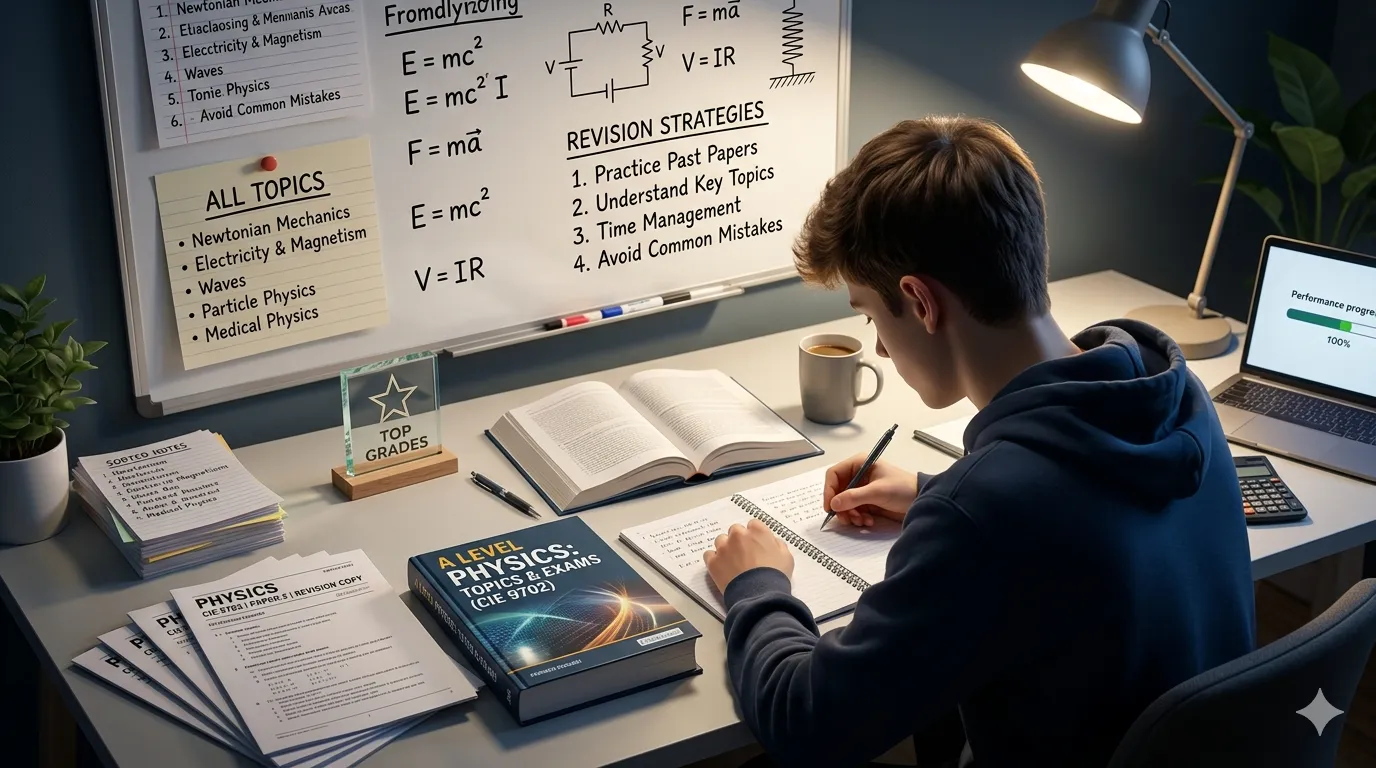
A Level Physics: The Ultimate Guide to Topics, Exams, and Top Grades
A Level Physics is one of the most rewarding and most challenging qualifications a student can take. It opens doors to university courses in physics, engineering, medicine, computer science, and mathematics. It sharpens analytical thinking, problem-solving ability, and scientific reasoning in ways that no other subject quite matches.
But it also demands a level of commitment and strategic preparation that many students underestimate. This ultimate guide covers everything you need to know about A Level Physics — the full syllabus structure, every paper explained, the highest-frequency topics, proven revision strategies, and the habits that separate A* students from the rest.
Whether you are just starting your A Level Physics journey or are in the final stretch before exams, this guide gives you a clear, honest roadmap to your best possible grade.
What Is CIE A Level Physics 9702?
Cambridge International AS and A Level Physics (syllabus code 9702) is offered by Cambridge Assessment International Education (CAIE) and is examined twice a year — in the May/June and October/November sessions. It is a two-year qualification, though students can also sit the AS Level component independently after the first year.
The 9702 syllabus is structured in two stages:
- AS Level — Covers the foundational topics and is assessed through Papers 1, 2, and 3
- A Level — Builds on AS content with advanced topics, assessed through Papers 1, 2, 3, 4, and 5
The qualification is recognised by universities worldwide as strong evidence of scientific and mathematical ability, particularly for STEM courses.
The Complete CIE 9702 Paper Structure
Understanding the paper format is the first step in building an effective revision plan for A Level Physics.
Paper 1 — Multiple Choice (40 marks, 1 hour 15 minutes)
Forty multiple-choice questions covering the AS Level syllabus. Every question carries one mark with no negative marking. Topics from across the entire AS syllabus appear, with waves, electricity, dynamics, and energy consistently appearing in the highest frequency. Speed and precision are essential — you have under two minutes per question on average.
Paper 2 — AS Level Structured Questions (60 marks, 2 hours)
Short-answer and extended-response questions drawn from the AS syllabus. Definitions, calculations, graph interpretation, and explain/describe questions all appear here. The mark scheme is extremely specific — precise physics terminology is required and rewarded.
Paper 3 — Advanced Practical Skills (40 marks, 2 hours)
A hands-on practical exam in which students carry out experiments, record data, plot graphs, and analyse results. Section A tests practical skills; Section B requires planning an experiment from scratch. This paper is where under-prepared students lose the most marks they cannot recover elsewhere.
Paper 4 — A Level Structured Questions (100 marks, 2 hours)
The core written paper for A Level content. Covers all A2 topics including gravitational fields, oscillations, thermal physics, electromagnetism, quantum physics, and nuclear physics. Extended-response questions worth 5–8 marks require structured, precisely worded answers that demonstrate deep understanding.
Paper 5 — Planning, Analysis and Evaluation (30 marks, 1 hour 15 minutes)
A written practical paper. Students analyse experimental data, identify errors, suggest improvements, and evaluate conclusions. No equipment is used — it is entirely written. Many students neglect Paper 5 during revision and pay a significant grade penalty for it.
All Topics in CIE A Level Physics 9702
The full 9702 syllabus divides into AS and A Level content across these major topic areas:
AS Level Topics (Papers 1, 2, 3)
- Physical Quantities and Units
- Kinematics
- Dynamics and Newton’s Laws
- Forces, Density and Pressure
- Work, Energy and Power
- Deformation of Solids
- Waves
- Superposition
- Electricity
- D.C. Circuits
- Particle Physics
A Level Topics (Papers 4, 5 — in addition to AS content)
- Motion in a Circle
- Gravitational Fields
- Temperature and Ideal Gases
- Thermal Properties of Materials
- Oscillations (Simple Harmonic Motion)
- Electric Fields
- Capacitance
- Magnetic Fields and Electromagnetism
- Electromagnetic Induction
- Alternating Currents
- Quantum Physics
- Nuclear Physics
- Medical Imaging (optional topic)
- Astronomy and Cosmology (optional topic)
This is a wide and deep syllabus. Students who try to revise everything equally in the final weeks consistently underperform. The key is identifying the highest-frequency topics early and ensuring those are mastered first.
The Highest-Frequency Topics in A Level Physics
Analysis of 9702 past papers and examiner reports from 2019 to 2025 shows that certain topics appear in almost every exam session across multiple papers:
Dynamics and momentum — Newton’s laws, F = Δp/Δt, impulse, and conservation of momentum appear in Paper 1 MCQs and Paper 2 structured questions every year without exception.
Waves and superposition — Interference, diffraction, stationary waves, and path difference calculations are among the most consistently tested areas, with approximately five MCQs per Paper 1 session dedicated to waves alone.
Electricity and D.C. circuits — Kirchhoff’s laws, potential divider, internal resistance, and power calculations appear in nearly every Paper 2. These questions often combine multiple concepts in a single problem.
Gravitational and electric fields — Field strength, potential, and the comparison between gravitational and electric fields is a recurring theme in Paper 4, often tested in 5–8 mark extended questions.
Simple harmonic motion — The definition of SHM, the equation a = −ω²x, energy relationships, and graphs of displacement/velocity/acceleration appear in Paper 4 every year.
Quantum physics — The photoelectric effect, photon energy calculations, and energy level transitions are high-frequency topics that are straightforward to score on if you know the definitions precisely.
Prioritising these topics in your A Level Physics revision gives you the highest return on your study time.
What Separates A* Students From Everyone Else
Having worked with A Level Physics students across many cohorts, the differences between top-grade and average-grade candidates consistently come down to a handful of specific habits — not raw intelligence.
They know definitions word-for-word. Cambridge mark schemes award marks for precise language. Approximate definitions score zero. Students who memorise the exact wording required — “the rate of change of displacement,” “the force per unit positive charge,” “the product of mass and velocity” — collect marks that others leave behind on every paper.
They show every step of working. Even if the final answer is wrong, methodical working earns method marks. The Cambridge marking system awards M marks (method) and A marks (accuracy) separately. A student who shows a correct approach but makes an arithmetic error can still earn most of the marks. A student who writes only the final answer earns zero if it is wrong.
They read the mark scheme, not just their score. After every practice question, top students study the mark scheme in detail — not just checking right or wrong, but reading every accepted phrase, every alternative approach, every common error flagged. This is how examiner language becomes second nature.
They treat Paper 3 and Paper 5 as equal priorities. Many students spend 90% of their revision on Papers 1, 2, and 4, then sit Papers 3 and 5 with minimal preparation. The practical papers carry significant marks and can be the difference between grade boundaries. Practising graph plotting, error analysis, and experimental planning from AS Level Physics onwards — not just before A Level exams — builds the skills these papers demand.
They start past papers early. The most effective A Level Physics students begin working through topical past paper questions after completing each chapter — not at the end of the course. The free topical past paper workbooks at Quality Notes are built precisely for this kind of chapter-by-chapter exam-style practice.
A Level Physics Revision Strategy: Month by Month
Year 1 (AS Level) — Build foundations topic by topic. After each chapter, complete topical past paper questions before moving on. Do not allow weak chapters to accumulate. Use recorded lessons to revisit any concept that is not fully clear after class.
Beginning of Year 2 — Consolidate AS content. A2 topics build directly on AS foundations. If kinematics, dynamics, or electricity are shaky, Year 2 topics like SHM, fields, and electromagnetic induction will be even harder. Spend the first four to six weeks of Year 2 consolidating every AS topic before moving forward.
Months 3–8 of Year 2 — Cover all A2 topics with topical practice. Work through each new A2 topic with notes, then immediately practise with relevant past paper questions. Keep a running error log for every mistake.
Final 8 weeks — Full timed papers and targeted revision. Sit full timed papers under exam conditions — Papers 1, 2, 4, and 5 at minimum. Mark rigorously, read every examiner report, and use your error log to guide targeted topic revision. Two full papers per week is the minimum target.
Common Mistakes That Cost Grades in A Level Physics
Forgetting units on final answers. One of the most cited reasons for lost marks in examiner reports. Always include the correct SI unit.
Writing approximate definitions. “Momentum is mass times speed” scores zero. “Linear momentum is the product of mass and velocity” scores the mark. The distinction is vector vs scalar — speed is scalar, velocity is vector.
Misidentifying Newton’s Third Law pairs. Covered in every dynamics section of the syllabus, tested almost every year, and still the most commonly misunderstood concept at A Level.
Ignoring the number of marks. A one-mark question needs one clear point. A four-mark question needs four distinct points or two steps of working. Students who write one-line answers to four-mark questions are leaving marks on the table every time.
Not planning extended responses. For questions worth 5 marks or more, spending 30 seconds identifying the key points before writing consistently produces better-structured, more complete answers.
For personalised guidance on identifying and fixing your specific weaknesses in A Level Physics, students counselling at Quality Notes provides targeted support built around your individual exam timeline and goals.
People Also Ask About A Level Physics
What topics are in CIE A Level Physics 9702?
The 9702 syllabus covers physical quantities, kinematics, dynamics, waves, electricity, and particle physics at AS Level, then adds circular motion, gravitational and electric fields, SHM, thermal physics, capacitance, electromagnetism, quantum physics, and nuclear physics at A Level.
How many papers are in CIE A Level Physics?
There are five papers: Paper 1 (Multiple Choice), Paper 2 (AS Structured), Paper 3 (Advanced Practical), Paper 4 (A Level Structured), and Paper 5 (Planning, Analysis and Evaluation). AS Level students sit Papers 1, 2, and 3.
How hard is A Level Physics?
CIE A Level Physics is widely regarded as one of the most demanding A Level subjects due to its combination of mathematical rigour, conceptual depth, and breadth of syllabus. However, students with a clear revision strategy, consistent past paper practice, and strong teacher support regularly achieve A and A* grades.
What grade do you need in O Level Physics to take A Level Physics?
Most schools and colleges require a minimum of a B or A in IGCSE/GCE O Level Physics or equivalent. A strong O Level foundation in kinematics, electricity, and waves significantly eases the transition to AS Level content.
What is the best way to revise for A Level Physics?
Topic-by-topic past paper practice from the start of the course, deep mark-scheme analysis, regular timed full-paper sittings, error logs, and expert teaching support for weak areas. Passive revision methods — reading notes, watching videos without practising — are consistently less effective.
How is A Level Physics useful for university?
A Level Physics is a required or strongly preferred qualification for university courses in physics, engineering, medicine, dentistry, architecture, mathematics, and computer science at institutions worldwide. It demonstrates quantitative reasoning and scientific problem-solving ability valued across STEM disciplines.
Conclusion
A Level Physics rewards students who approach it strategically — understanding not just the content but how it is examined, what language examiners reward, and how to build skill progressively through the two-year course.
The difference between a C and an A* in A Level Physics is rarely about intelligence. It is about method, consistency, and having the right support at the right time.
When you get help from Mr. Adeel Chowhan, who is known as the best online physics teacher in Pakistan, you can’t do better in your studies. Go to Quality Notes right now to get a free trial class, for further access to structured topical past papers, lessons taught by experts, and all the tools you need to get the best grades.