
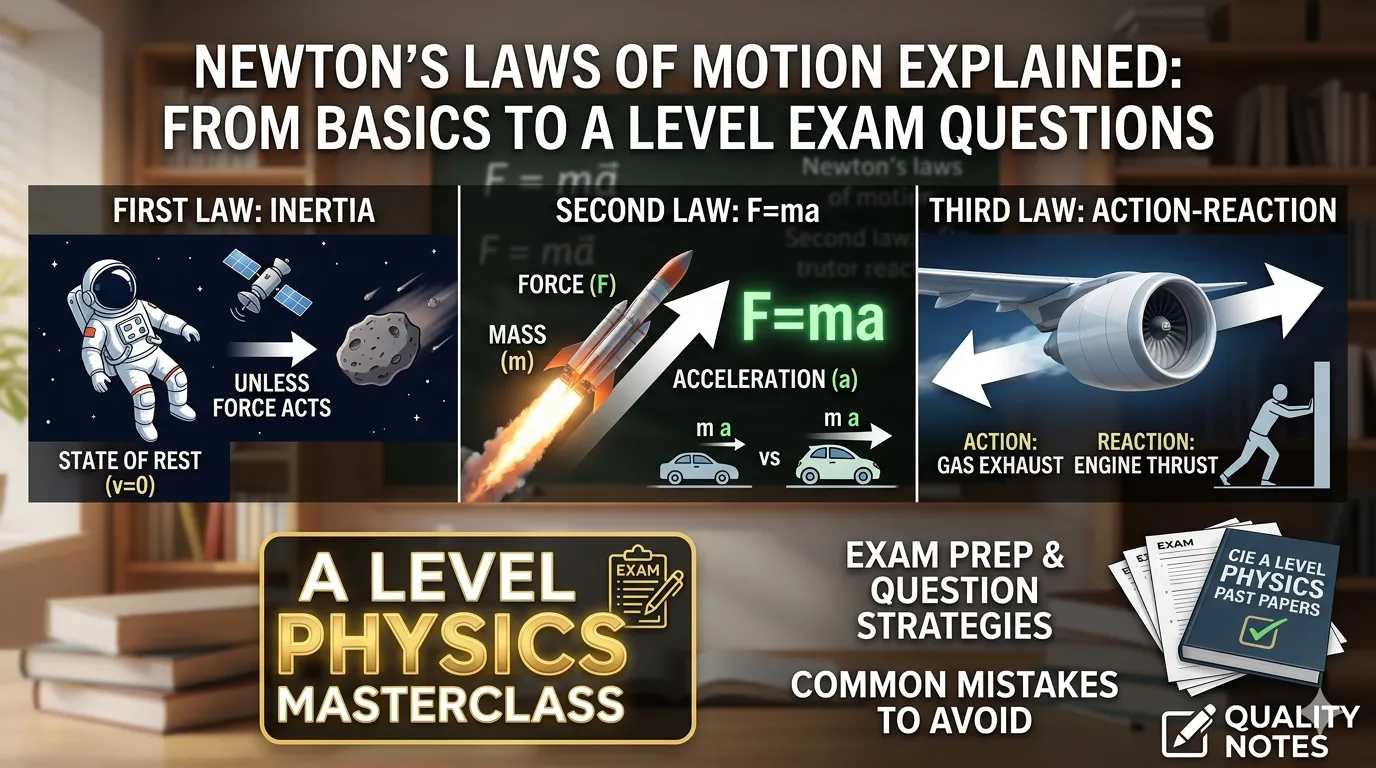
Newton’s Laws of Motion Explained: From Basics to A Level Exam Questions
No topic in physics is tested more consistently, across more syllabus levels, and in more question formats than the laws of motion. From Cambridge O Level 5054 to AS and A Level 9702, Newton’s three laws of motion form the backbone of dynamics — the study of why objects move the way they do. Master these laws properly and you gain the foundation for momentum, forces, circular motion, and beyond.
This guide explains all three laws of motion from first principles, connects them to the exact way CIE examiners test them, and highlights the mistakes that cost students marks year after year.
Why the Laws of Motion Matter So Much in CIE Physics
Analysis of Cambridge 9702 past papers from 2019 to 2025 shows that dynamics — the topic built entirely around the laws of motion — is one of the highest-frequency topics in the entire syllabus. It appears in Paper 1 multiple-choice questions, Paper 2 structured questions, and is the foundation of several A Level topics including momentum, circular motion, and gravitational fields.
Students who understand the laws of motion conceptually — not just as formulas to memorise — consistently score higher on the extended-response questions that carry the most marks. This understanding begins with getting each law exactly right.
Newton’s First Law of Motion: Inertia and Equilibrium
Newton’s First Law states that an object remains at rest or continues moving at constant velocity in a straight line unless acted upon by a resultant external force.
The key word here is resultant. It is not enough for forces to be present — what matters is whether they balance. A book sitting on a table has gravity pulling it down and a normal contact force pushing it up. These forces balance, so the resultant force is zero, and the book remains stationary. This is Newton’s First Law in action.
The concept embedded in this law is inertia — the tendency of an object to resist changes to its state of motion. Mass is the measure of inertia. A heavier object has greater inertia and therefore requires a larger force to change its motion.
How CIE tests the First Law: Examiners frequently ask students to explain why an object is in equilibrium or to identify all forces acting on a stationary or constant-velocity object. The critical trap: students often state that “no forces are acting” when what they should say is “no resultant force is acting.” These are very different statements, and the mark scheme distinguishes between them.
Newton’s Second Law of Motion: F = ma and Rate of Change of Momentum
Newton’s Second Law is the most mathematically productive of the three laws of motion. In its simplest form:
F = ma
Where F is the resultant force in newtons (N), m is the mass in kilograms (kg), and a is the acceleration in metres per second squared (m s⁻²). The resultant force and acceleration always act in the same direction — this is a direct syllabus requirement in CIE 9702.
However, the CIE syllabus also requires students to know the more fundamental statement of the Second Law:
The resultant force acting on an object is equal to the rate of change of its momentum.
In equation form: F = Δp / Δt, where p = mv is the linear momentum of the object.
This version of the Second Law is more powerful because it applies even when mass is not constant — a situation the F = ma form cannot handle. It also directly connects the laws of motion to the principle of conservation of momentum, which is one of the most important ideas in all of physics.
How CIE tests the Second Law: Paper 2 structured questions regularly ask students to apply F = Δp/Δt to calculate forces during impacts, collisions, or fluid flow problems. A common examiner complaint in reports is that students apply F = ma correctly but cannot explain the physics in words. Always be ready to state the law clearly before applying it numerically.
Newton’s Third Law of Motion: Action-Reaction Force Pairs
Newton’s Third Law states that if object A exerts a force on object B, then object B exerts an equal and opposite force on object A, of the same type.
Every word in this statement matters for exam purposes:
- Equal in magnitude — the two forces have exactly the same size
- Opposite in direction — they act in directly opposing directions
- Same type — if one force is gravitational, the paired force is also gravitational; if one is a contact force, the pair is also a contact force
- Act on different objects — this is the most important point and the most commonly confused
The single most common Third Law mistake in CIE exams:
Students confuse a Newton’s Third Law force pair with two balanced forces acting on the same object. Consider a book resting on a table. The weight of the book acts downward and the normal force from the table acts upward. These two forces are NOT a Newton’s Third Law pair — they both act on the book, and they are different types of forces (gravitational vs contact).
The actual Third Law pair for the weight of the book is: Earth pulls the book down (gravitational), and the book pulls the Earth up (gravitational) with the same magnitude. These act on different objects — the book and the Earth.
A reliable test for a true Third Law pair: swap the two objects in your description and reverse the force. If you get the other force in the pair, it is correct.
Linear Momentum and Its Connection to the Laws of Motion
Linear momentum is defined as the product of an object’s mass and its velocity:
p = mv
Momentum is a vector quantity — it has both magnitude and direction. Its SI unit is kg m s⁻¹, which is equivalent to N s (newton-seconds).
The laws of motion connect directly to momentum in two critical ways:
- Newton’s Second Law defines force as the rate of change of momentum: F = Δp/Δt
- Newton’s Third Law is the physical reason why momentum is conserved in a closed system
When two objects interact, they exert equal and opposite forces on each other for the same time. This means their changes in momentum are equal and opposite — so the total momentum of the system remains constant. This is the principle of conservation of linear momentum, and it flows directly from the laws of motion.
For deeper practice on this entire chapter, the free topical past paper workbooks at Quality Notes include dynamics questions organised year-by-year from CIE 9702 and 5054.
Free Body Diagrams: The Essential Tool for Applying the Laws of Motion
Before applying any of the laws of motion to a problem, always draw a free body diagram. This is a diagram showing a single object with all forces acting on it drawn as arrows, each labelled with its type, magnitude, and direction.
Free body diagrams:
- Prevent you from including forces that act on other objects
- Make it clear whether forces balance (resultant = 0) or not
- Show you which direction to assign as positive before calculating
CIE examiners explicitly ask for free body diagrams in Paper 2 questions. A correct diagram before any calculation demonstrates clear understanding of the laws of motion and often earns marks independently of the numerical answer.
Worked Example: Applying the Laws of Motion to a Connected System
Two blocks, A (mass 3 kg) and B (mass 2 kg), are connected by a light string on a frictionless horizontal surface. A horizontal force of 10 N is applied to block A.
Find the acceleration of the system and the tension in the string.
Step 1: Apply Newton’s Second Law to the whole system. Total mass = 3 + 2 = 5 kg F = ma → 10 = 5 × a → a = 2 m s⁻²
Step 2: Apply Newton’s Second Law to block B alone. The only horizontal force on B is the tension T. T = m_B × a = 2 × 2 = 4 N
Step 3: Check using block A. Net force on A = 10 − T = 10 − 4 = 6 N a = 6/3 = 2 m s⁻² ✓
This type of connected-system problem appears frequently in CIE 9702 Paper 2 and requires confident application of the laws of motion to individual objects separately, not just the system as a whole.
Laws of Motion at O Level vs A Level: What Changes?
At IGCSE/GCE O Level, the laws of motion are tested primarily through:
- Identifying balanced and unbalanced forces
- Applying F = ma in straightforward single-object problems
- Describing Newton’s Third Law pairs qualitatively
At AS Level Physics, the expectations increase significantly:
- F = Δp/Δt must be used alongside F = ma
- Impulse (force × time = change in momentum) is tested numerically
- Connected system problems require applying laws to individual components
At A Level Physics, the laws of motion underpin entire topics:
- Circular motion: centripetal force is explained through Newton’s Second Law
- Gravitational fields: Newton’s law of gravitation connects directly to the laws of motion
- Collisions: elastic and inelastic cases require conservation of momentum plus energy analysis
People Also Ask About Laws of Motion
What are Newton’s three laws of motion?
The First Law states that an object remains at rest or in uniform motion unless a resultant force acts on it. The Second Law states that resultant force equals the rate of change of momentum (F = ma for constant mass). The Third Law states that for every force exerted by one object on another, there is an equal, opposite, and same-type force exerted back.
What is the difference between Newton’s First and Third Law?
The First Law describes what happens to a single object when forces balance — it stays in equilibrium. The Third Law describes what happens between two interacting objects — they exert equal and opposite forces on each other. Students frequently confuse these, particularly when both balanced forces and interaction pairs appear in the same scenario.
How is momentum related to the laws of motion?
Momentum (p = mv) is defined through Newton’s Second Law: resultant force equals rate of change of momentum. Newton’s Third Law is the reason momentum is conserved — equal and opposite forces acting for the same time produce equal and opposite changes in momentum, leaving the total unchanged.
What is a Newton’s Third Law force pair?
A Newton’s Third Law force pair consists of two forces that are equal in magnitude, opposite in direction, the same type, and act on two different objects. The most common exam mistake is identifying two balanced forces on the same object as a Third Law pair — they are not.
Why does Newton’s First Law follow from the Second Law?
If the resultant force F = 0, then from F = ma, the acceleration a = 0. Zero acceleration means constant velocity (which includes the special case of rest). So the First Law is contained within the Second Law as the special case where F = 0.
What is the unit of momentum in SI?
The SI unit of momentum is kg m s⁻¹, which is equivalent to N s (newton-seconds). Both forms are accepted in CIE mark schemes.
Conclusion
The laws of motion are examined at every level of CIE Physics, in every paper type, and in every difficulty grade. The students who score highest on dynamics questions are those who:
- Can state each law precisely in words — not just recall the formula
- Always draw a labelled free body diagram before calculating
- Apply the Second Law to individual objects in connected systems, not just the whole
- Can correctly identify Newton’s Third Law force pairs and explain why common examples fail the test
- Connect momentum, impulse, and the laws of motion in extended-response answers
For expert-guided lessons on this topic and every other chapter in CIE 9702, recorded lessons at Quality Notes walk through exactly the concepts and question types that appear in real exams. If you need a personalised revision plan or targeted support on dynamics, students counselling is available to help you identify and fix your specific gaps before exam day.
When you get help from Mr. Adeel Chowhan, who is known as the best online physics teacher in Pakistan, you can’t do better in your studies. Go to Quality Notes right now to get a free trial class, for further access to structured topical past papers, lessons taught by experts, and all the tools you need to get the best grades.