
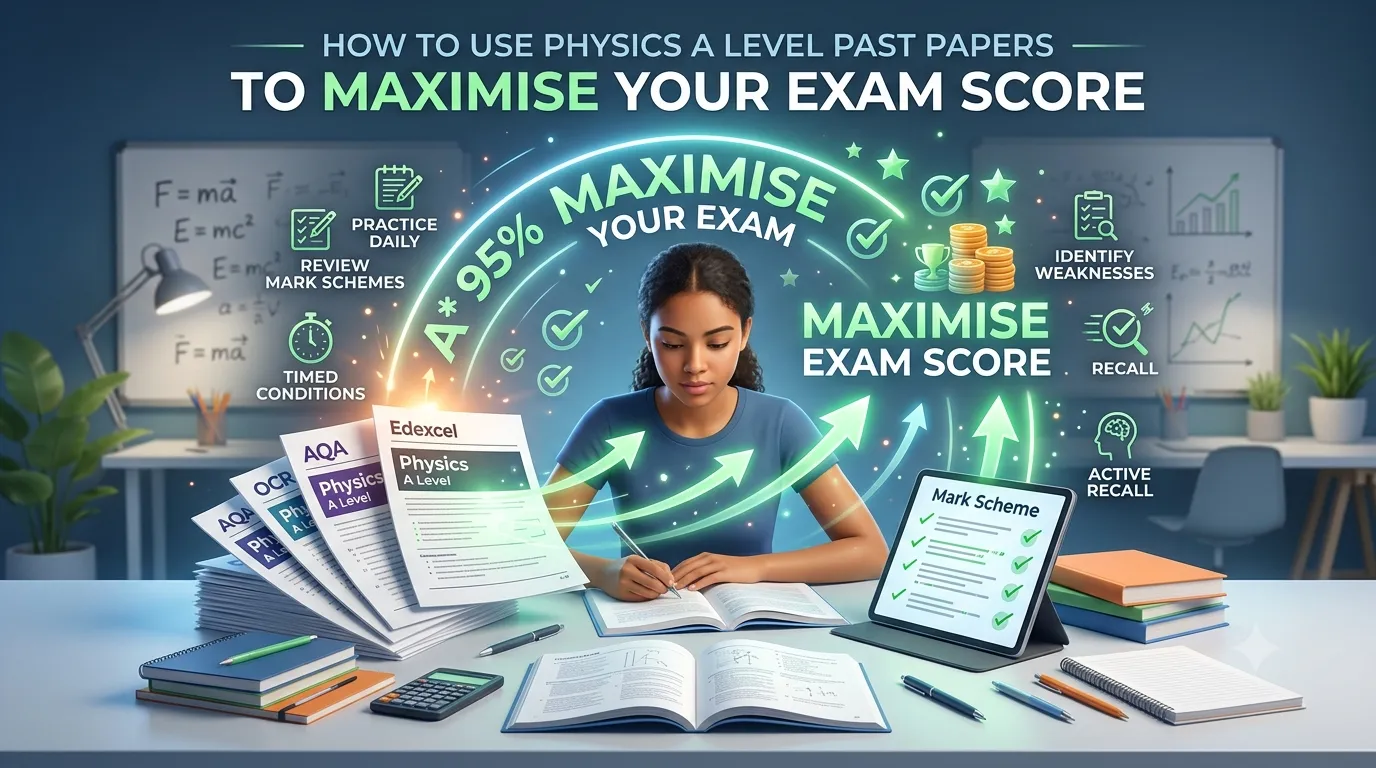
How to Use Physics A Level Past Papers to Maximise Your Exam Score
If you are preparing for Cambridge 9702, one truth stands above every other revision tip: physics a level past papers are your most powerful tool. Not textbooks. Not YouTube videos. Not passive note reading. Past papers.
Students who consistently practise with physics a level past papers outperform those who don’t — not because they get lucky, but because they learn exactly what examiners want, how marks are allocated, and where most students silently lose points. This guide breaks down a proven, step-by-step method to use past papers the right way so you walk into your exam with maximum confidence.
Why Physics A Level Past Papers Are Non-Negotiable
Physics is not a subject you can revise by reading alone. Around 40% of A Level Physics involves mathematical problem-solving, and the rest demands the ability to apply concepts under timed pressure. The only way to build that skill is through consistent, structured practice with real physics a level past papers.
Here is what past paper practice actually does for you:
- It familiarises you with the exact question style and structure of CIE 9702
- It trains you to use examiner language, which directly affects your marks
- It reveals your weak chapters before the real exam does
- It builds the time management habit you cannot develop any other way
- It shows you which topics repeat most frequently across years
No revision method replaces this. Everything else — notes, formula sheets, recorded lessons — prepares you for the past paper. The past paper is where the real learning happens.
Step 1: Start Topic-by-Topic, Not Full Papers
The most common mistake students make is opening a full physics a level past paper on day one and feeling overwhelmed. Do not do this.
Start with topical practice. Work through questions on a single chapter — say, Kinematics or Electricity — before you attempt a full paper. This method allows you to:
- Build confidence in one topic before moving to the next
- Identify specific gaps in your understanding early
- Revisit your AS-Level Physics or A-Level Physics notes immediately when a question exposes a weakness
Once you have covered all major topics topically, then move to full timed papers. The free topical past paper workbooks at Quality Notes are structured exactly for this kind of progressive practice.
Step 2: Treat Every Session Like a Real Exam
When you sit down with physics a level past papers, simulate exam conditions. This means:
- No notes open beside you
- Strict timing — Paper 1 is 1 hour 15 minutes, Paper 2 is 2 hours, Paper 4 is 2 hours
- No pausing mid-paper to look up answers
- Phones away
This discipline is what separates students who practise from students who improve. Many students go through dozens of physics a level past papers without ever timing themselves — then freeze in the actual exam because they have never experienced that pressure before.
Treat each session as a dry run for the real thing.
Step 3: Study the Mark Scheme — Not Just Your Score
This is the single step most students skip, and it costs them the most marks.
After completing a physics a level past paper, do not just check whether you got the answer right or wrong. Study the mark scheme deeply:
- Read the exact wording the examiner awards marks for
- Note the specific physics terminology used — phrases like “directly proportional,” “rate of change,” and “conservation of momentum” appear repeatedly
- Understand why a particular answer structure earns full marks and another earns zero
Physics is one of the most mark-scheme-sensitive subjects at A Level. You can understand a concept perfectly and still score zero because your phrasing does not match what the examiner expects. The mark scheme teaches you that language. Use it.
Step 4: Keep an Error Log
Every time you work through physics a level past papers, keep a dedicated notebook — physical or digital — for your errors. For each mistake, write:
- The topic and paper reference (e.g. 9702/22/O/N/23, Q4b)
- What you wrote
- What the mark scheme says
- Why you think you went wrong
- The concept or formula you need to review
This error log becomes your most personalised revision tool. In the final two weeks before your exam, reviewing this log is far more effective than doing more new papers. You are targeting the exact weaknesses that have already appeared in your practice.
Step 5: Use the Examiner Report Alongside the Paper
Cambridge publishes Examiner Reports for every session of 9702. These documents tell you — in the examiner’s own words — where students across the world lost marks in that paper.
When working through physics a level past papers, reading the examiner report for the same session reveals:
- Which questions were answered poorly by most students
- Common misconceptions examiners saw in responses
- Advice on how to structure answers to long-mark questions
- Which topics need more precise understanding
This is intelligence most students never access. Use it.
Step 6: Build a Smart Past Paper Schedule
Working through physics a level past papers randomly is not effective. Build a structured schedule. Here is a model that works well for Cambridge 9702 students:
Months 1–3: Topical questions only. Cover all 9702 syllabus topics chapter by chapter.
Months 4–5: Begin full timed papers — aim for two per week minimum. Prioritise the most recent five years first, as these reflect the current syllabus and examiner trends most accurately.
Final 4 weeks: Mix of full papers and targeted topical revision based on your error log. Revise using books and revision notes to consolidate weak chapters before retesting.
People Also Ask About Physics A Level Past Papers
How many past papers should I do for A Level Physics?
Aim for a minimum of 10–15 full papers across the course of your revision, with additional topical practice on top. Quality matters more than quantity — a well-reviewed paper is worth three rushed ones.
Where can I find Cambridge A Level Physics past papers?
Cambridge 9702 past papers are available through the official CAIE website and trusted educational resources. Quality Notes provides structured access to topical workbooks built from real past paper questions.
Do A Level Physics past papers repeat questions?
Not word-for-word, but the same topics and question styles appear with high frequency. Analysing 10+ years of physics a level past papers reveals clear patterns in which chapters are tested most heavily.
What is the best way to revise using past papers?
Start topically, simulate exam conditions, study mark schemes line by line, keep an error log, and read examiner reports. This five-step cycle applied consistently is the most effective revision method for CIE 9702.
How do I improve my grade using physics past papers?
The biggest grade jumps come from understanding why you lose marks — not just doing more papers. Deep mark-scheme analysis and examiner-guided revision turn average students into A and A* candidates.
The Role of Expert Guidance in Past Paper Revision
Practising physics a level past papers independently builds skills, but having an expert teacher analyse your errors and explain the correct approach accelerates that progress significantly. A good teacher will identify patterns in your mistakes — things you cannot always see yourself — and correct them before they become habits.
Expert-led recorded lessons aligned with the 9702 syllabus let you revisit specific concepts immediately after a past paper exposes a gap. This combination — self-practice with guided explanation — is the revision model that produces the best results.
If you are finding certain topics consistently difficult in your physics a level past papers, students counselling can help you identify whether the issue is conceptual understanding, exam technique, or study planning — and fix it.
Final Thoughts: Make Past Papers the Core of Your Revision
There is no shortcut to A Level Physics success, but there is a direct route: consistent, structured practice with physics a level past papers, combined with deep mark-scheme analysis and expert support where needed.
Whether you are targeting an A* in Cambridge 9702 or aiming to improve from a C to a B, the process is the same. Start topically, go timed, study every mark scheme, log every error, read every examiner report, and get teaching support when you need it.
The students who maximise their exam scores are not the most naturally gifted. They are the ones who take past paper practice seriously — and do it the right way.
When you get help from Mr. Adeel Chowhan, who is known as the best online physics teacher in Pakistan, you can’t do better in your studies. Go to Quality Notes right now to get a free trial class, for further access to structured topical past papers, lessons taught by experts, and all the tools you need to get the best grades.