
Physical Quantities in Physics: Types, Units, and How to Master Them
Every measurement you make in physics, every formula you apply, and every answer you write in an exam is built on one foundational idea: physical quantities. Before you can understand motion, electricity, waves, or any other topic in physics, you must first understand what physical quantities are, how they are classified, and how their units work.
This topic is Chapter 1 in Cambridge 9702 (AS and A Level) and appears in the very first section of CIE 5054 (O Level) for a reason. Examiners know that students who master physical quantities early build a stronger foundation for everything that follows. Students who skip past this chapter quickly pay for it when they cannot derive units, cannot identify scalars and vectors, and cannot handle uncertainty questions.
This guide covers everything you need — clearly, completely, and in a way that actually sticks.
What Are Physical Quantities?
A physical quantity is any property of a material or system that can be measured and expressed as a number combined with a unit. This definition sounds simple, but it contains two critical components that examiners test directly.
Every physical quantity must have:
- A numerical magnitude — the number that tells you how much of the quantity is present
- A unit — the defined standard used for comparison and measurement
For example, if you say a rod is “2.5 long,” that statement is scientifically meaningless. Is it 2.5 centimetres? 2.5 metres? 2.5 kilometres? The unit is not optional — it is part of the measurement itself. A quantity without a unit is not a physical quantity; it is just a number.
This principle — that all physical quantities consist of a numerical magnitude and a unit — is a direct syllabus learning objective in both CIE 9702 and 5054, and it is tested in multiple-choice and short-answer questions in almost every exam session.
The Two Types of Physical Quantities: Base and Derived
All physical quantities fall into one of two categories: base quantities or derived quantities.
Base Quantities
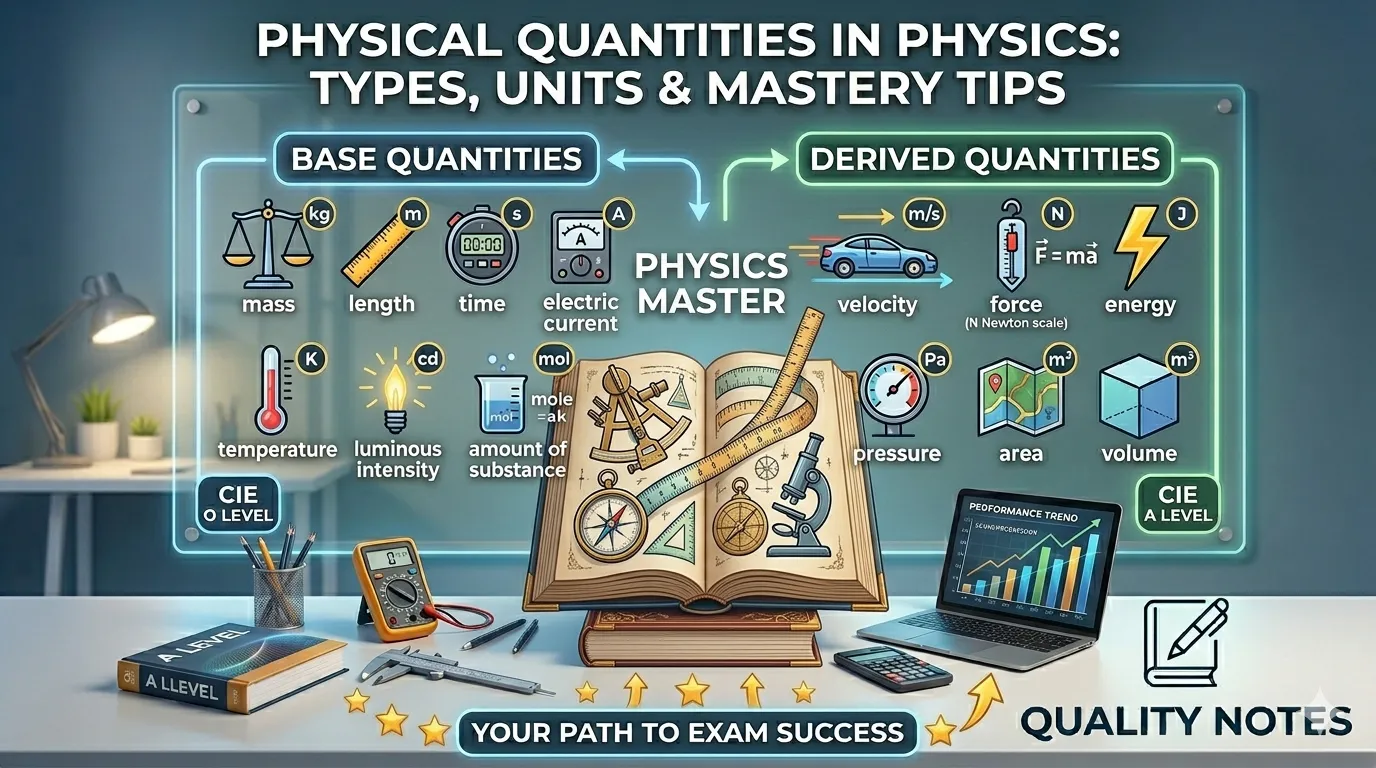
Base quantities are the seven fundamental physical quantities that are defined independently of each other. They cannot be broken down into simpler quantities. The International System of Units (SI) defines exactly seven:
| Base Quantity | SI Base Unit | Symbol |
| Mass | kilogram | kg |
| Length | metre | m |
| Time | second | s |
| Electric current | ampere | A |
| Thermodynamic temperature | kelvin | K |
| Amount of substance | mole | mol |
| Luminous intensity | candela | cd |
For CIE 9702 and 5054, you are required to recall the first six confidently. A common exam question asks students to identify which of a list of options is an SI base unit. The most frequent trap: the gram (g) is NOT a base unit — the kilogram (kg) is. The degree Celsius is NOT a base unit — the kelvin (K) is. The volt is NOT a base unit — it is derived.
Derived Quantities
Derived physical quantities are all other measurable quantities in physics. They are obtained by combining base quantities through multiplication, division, or both. Every derived quantity has a derived unit, which is itself a combination of base units.
Some examples directly relevant to CIE syllabuses:
- Speed = distance ÷ time → unit: m s⁻¹ (metres per second)
- Force = mass × acceleration → unit: kg m s⁻² (also called the newton, N)
- Pressure = force ÷ area → unit: kg m⁻¹ s⁻² (also called the pascal, Pa)
- Energy = force × distance → unit: kg m² s⁻² (also called the joule, J)
- Electric charge = current × time → unit: A s (also called the coulomb, C)
Being able to derive the SI base units of any quantity from its defining equation is a core skill tested in CIE 9702 Paper 1 and Paper 2. Practice this with every new formula you encounter in AS-Level Physics and A-Level Physics.
Scalars and Vectors: The Other Key Classification
Beyond base and derived, physical quantities are also classified as either scalar or vector. This distinction matters enormously in mechanics, forces, and almost every practical calculation you will do at A Level.
Scalar quantities have magnitude only — no direction. Examples include:
- Mass, time, temperature, energy, distance, speed, pressure, density
Vector quantities have both magnitude and direction. Examples include:
- Force, velocity, acceleration, displacement, momentum, electric field strength, weight
The most common exam mistake is confusing scalar-vector pairs. Speed is a scalar; velocity is a vector. Distance is a scalar; displacement is a vector. Mass is a scalar; weight is a vector. Memorise these pairs and you will gain easy marks on questions that test this classification directly.
When adding or subtracting vector physical quantities, you cannot treat them like ordinary numbers unless they act along the same straight line. Two forces of 3 N and 4 N do not simply add to 7 N — the resultant depends on the angle between them. This is why vector addition using the tip-to-tail method and resolution into components is a major skill in AS-Level Physics.
SI Prefixes: Handling Very Large and Very Small Quantities
Physics deals with the extremely large (the mass of the Sun: ~2 × 10³⁰ kg) and the extremely small (the diameter of a proton: ~1 × 10⁻¹⁵ m). Rather than writing unwieldy strings of zeros, SI prefixes are used as multipliers attached to base or derived units.
The prefixes you must know for CIE 9702 and 5054:
| Prefix | Symbol | Multiplier |
| pico | p | 10⁻¹² |
| nano | n | 10⁻⁹ |
| micro | μ | 10⁻⁶ |
| milli | m | 10⁻³ |
| centi | c | 10⁻² |
| kilo | k | 10³ |
| mega | M | 10⁶ |
| giga | G | 10⁹ |
A critical exam skill: always convert prefixed units to standard SI base units before substituting into equations. If a wavelength is given as 450 nm, convert to 450 × 10⁻⁹ m before calculating. Forgetting this conversion is one of the most common sources of wrong answers in numerical questions across both O Level and A Level papers.
Homogeneity of Equations: A Powerful Checking Tool
One of the most useful applications of understanding physical quantities and their units is checking whether an equation is homogeneous — meaning the units on both sides of the equation are identical.
Every valid physics equation must be homogeneous. If the units do not balance, the equation is wrong. This gives you a powerful tool to:
- Check your own derived answers for unit errors
- Verify whether a given equation is physically valid
- Find the units of an unknown quantity in an unfamiliar expression
For example, to check whether the equation for kinetic energy (KE = ½mv²) is homogeneous:
- Right side units: kg × (m s⁻¹)² = kg m² s⁻²
- Left side unit for energy: J = kg m² s⁻² ✓
The units match — the equation is homogeneous. This technique is tested directly in CIE 9702 Paper 2 structured questions and is worth mastering early.
Orders of Magnitude and Estimation
Cambridge 9702 also requires you to make reasonable estimates of physical quantities and understand orders of magnitude — the power of ten closest to a given value. This tests scientific intuition rather than calculation.
Common estimates you should know:
- Height of a person: ~1.7 m (order of magnitude: 10⁰ m)
- Mass of an adult: ~70 kg (order of magnitude: 10¹ kg)
- Diameter of a hydrogen atom: ~1 × 10⁻¹⁰ m
- Speed of sound in air: ~340 m s⁻¹
Estimation questions appear regularly in Paper 1 MCQs and require confident knowledge of the sizes of common physical quantities across the syllabus.
Common Exam Mistakes on Physical Quantities
Based on patterns seen across multiple years of CIE past papers, these are the most frequent errors students make on this topic:
Calling the gram an SI base unit. It is not. The kilogram is.
Confusing scalar and vector pairs. Speed vs velocity, distance vs displacement, mass vs weight — learn these as fixed pairs.
Forgetting to include units in answers. A numerical answer without a unit scores zero on calculation questions. Always include the unit.
Failing to convert prefixes before calculating. Always convert nano, micro, milli, kilo, and mega to standard powers of ten before substituting values.
Not being able to derive base units from equations. Practice deriving the SI base units of every new quantity you encounter. This is tested repeatedly in Paper 1 and Paper 2.
The free topical past paper workbooks at Quality Notes include focused questions on physical quantities and units from multiple years of CIE past papers — ideal for practising these exact skills in an exam context.
People Also Ask About Physical Quantities
What is a physical quantity in simple terms?
A physical quantity is anything that can be measured and expressed as a number combined with a unit. Without both the number and the unit, it is not a complete physical quantity. Examples include mass (5 kg), time (3 s), and force (10 N).
What are the 7 base physical quantities?
The seven SI base quantities are mass (kg), length (m), time (s), electric current (A), thermodynamic temperature (K), amount of substance (mol), and luminous intensity (cd). CIE syllabuses require confident recall of the first six.
What is the difference between base and derived quantities?
Base quantities are defined independently and cannot be broken down further. Derived quantities are obtained by combining base quantities using multiplication or division. Speed (m s⁻¹) is derived from length and time; force (kg m s⁻²) is derived from mass, length, and time.
What is the difference between scalar and vector physical quantities?
Scalar quantities have magnitude only (e.g. speed, mass, energy). Vector quantities have both magnitude and direction (e.g. velocity, force, acceleration). This distinction is critical in mechanics and determines how quantities are added and resolved into components.
Why are SI units important in physics?
SI units provide a globally standardised system that allows scientists everywhere to communicate measurements consistently. Without standardised units, calculations, comparisons, and scientific publications would be meaningless across different countries and laboratories.
How do you derive the SI units of a physical quantity?
Take the equation that defines the quantity and replace each variable with its SI base unit. Simplify the resulting expression. For example, pressure = force/area → (kg m s⁻²)/(m²) = kg m⁻¹ s⁻².
Conclusion
Physical quantities may be Chapter 1 of the syllabus, but they never stop appearing throughout the course. Unit derivations come up in mechanics. Scalar-vector distinctions come up in forces and fields. Prefix conversions come up in waves and electricity. Estimation comes up in Paper 1 every year.
The best approach is to treat this chapter as a living reference — revisit it regularly as you progress through the syllabus, and apply its principles actively every time you use a formula or record a measurement.
For deeper explanations of every subtopic in physical quantities and all other CIE 9702 chapters, the books and revision notes and recorded lessons at Quality Notes are built specifically around the Cambridge syllabus and exam requirements.
When you get help from Mr. Adeel Chowhan, who is known as the best online physics teacher in Pakistan, you can’t do better in your studies. Go to Quality Notes right now to get a free trial class, for further access to structured topical past papers, lessons taught by experts, and all the tools you need to get the best grades.