
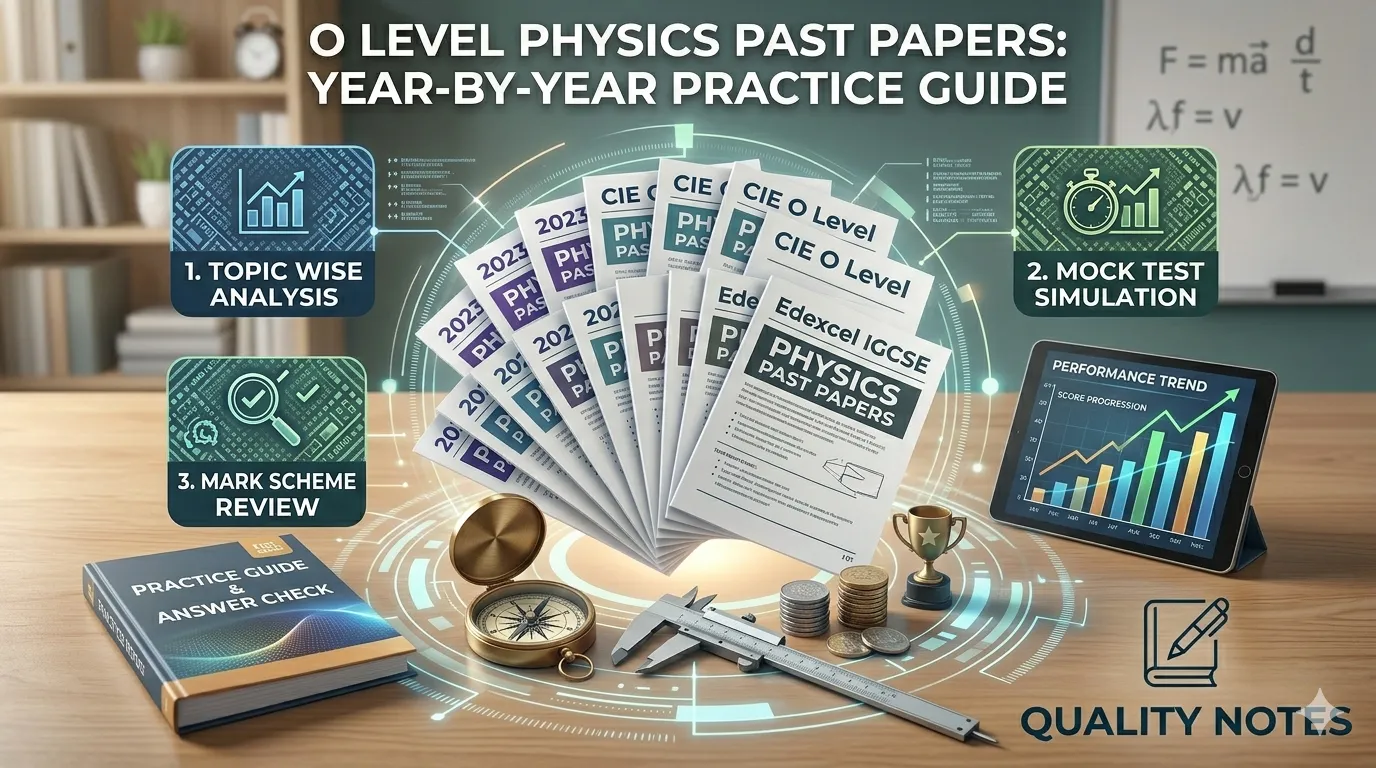
O Level Physics Past Papers: The Complete Year-by-Year Practice Guide
If there is one revision tool every Cambridge O Level Physics student must use from day one, it is O Level Physics past papers. Not just downloading them — actually working through them, marking them honestly, and learning from every mistake. This complete guide walks you through exactly how to practise year-by-year so that no mark is left on the table when exam day arrives.
Whether you are sitting the May/June or October/November series of CIE 5054, the method is the same. The students who score the highest grades are not always the most naturally talented — they are the ones who treat O Level Physics past papers as a structured training programme, not a last-minute panic tool.
Understanding the Cambridge O Level Physics 5054 Paper Structure
Before you start working through O Level Physics past papers, you need to understand exactly what you are practising for. Cambridge 5054 consists of three papers:
Paper 1 — Multiple Choice (40 marks, 60 minutes) Forty single-mark questions covering the full syllabus. There are no half marks and no partial credit. Speed and precision are everything here. A wrong answer costs you exactly as much as a blank one, so eliminate options systematically rather than guessing blindly.
Paper 2 — Theory (80 marks, 1 hour 45 minutes) A mix of short-answer and structured questions. The 6-mark questions in particular reward answers that are logically ordered and use precise physics terminology. Rushing these questions without a brief plan is where most students lose significant marks.
Paper 4 — Alternative to Practical (40 marks, 1 hour) This paper tests practical skills through written questions — reading apparatus, plotting graphs, identifying sources of error, and suggesting improvements to experiments. Many students underestimate Paper 4 and pay for it in their final grade.
Understanding this structure is the foundation. When you work through O Level Physics past papers, practise all three components — not just the theory paper.
Why Year-by-Year Practice Is the Most Effective Strategy
There are two ways students approach O Level Physics past papers: randomly, picking whichever paper they find online, or systematically, working year-by-year from the most recent sessions backwards. The second method is far superior, and here is why.
Starting with the most recent years ensures you are practising with papers that reflect the current syllabus structure, current examiner expectations, and current question styles. Cambridge periodically updates its 5054 syllabus — older papers may include topics that are no longer tested or miss topics that have recently been added. Begin with 2024, then 2023, then 2022, and work backwards. The further back you go, the more the papers serve as general problem-solving practice rather than precise exam preparation.
The year-by-year approach also builds an important psychological skill: you see yourself improving. When you mark your 2024 paper, then your 2023 paper, and compare the scores, you have measurable evidence of progress. That is motivating in a way that random practice never is.
The Year-by-Year Practice Schedule
Here is a structured schedule for working through O Level Physics past papers across a full revision period. Adjust the timeline based on how many weeks you have before your exam.
Phase 1 — Topical Foundation (First Half of Revision)
Do not open a full past paper yet. Work through O Level Physics past papers question by question, organised by topic. Focus on one syllabus chapter at a time:
- General Physics (measurements, motion, forces, energy)
- Thermal Physics (kinetic model, thermal properties)
- Waves (general wave properties, light, sound)
- Electricity and Magnetism (circuits, electromagnetism)
- Atomic Physics (radioactivity, the nuclear atom)
For each chapter, do topical questions from multiple years before moving on. This builds your confidence in individual topics and shows you exactly where your knowledge gaps are. The free topical past paper workbooks at Quality Notes are organised precisely for this kind of chapter-by-chapter practice.
Phase 2 — Full Timed Papers (Second Half of Revision)
Once you have covered all topics, start sitting full O Level Physics past papers under timed, exam conditions. Target at least 10 to 15 full papers in the final eight weeks. That means roughly two timed sittings per week, rotating between Paper 1, Paper 2, and Paper 4.
Begin with the most recent year — 2024 — and work backwards to 2019. These six years give you an excellent picture of current examiner trends.
Final Two Weeks
Stop doing new papers. Instead, revisit your error log (more on this below), rework the questions you got wrong in earlier sessions, and use your books and revision notes to consolidate any chapters that are still giving you trouble.
How to Get Maximum Value From Every Paper
Sitting O Level Physics past papers is only half the work. What you do after the paper determines how much you actually improve.
Mark Honestly Mark your own paper against the official mark scheme before looking at any answers. Do not give yourself benefit of the doubt on borderline responses. If your answer is missing a key term or a key step that the mark scheme requires, mark it wrong. Generous self-marking is one of the most common reasons students are surprised by their real exam results.
Analyse the Mark Scheme Line by Line Physics at O Level is a mark-scheme-sensitive subject. The exact phrasing used in the mark scheme — words like “directly proportional,” “rate of change of velocity,” “resistance increases because fewer free electrons” — is the language examiners reward. When you see these phrases, write them into your notes. Over time, your answers will naturally start matching examiner expectations.
Read the Examiner Report Cambridge publishes an Examiner Report for every session of O Level Physics past papers. These documents reveal exactly which questions most candidates struggled with and why. After completing any paper, read the examiner report for that same session. It is the closest you will ever get to the examiner telling you directly what to write.
Keep an Error Log For every question you get wrong or partially wrong, record:
- The paper reference and question number
- The topic
- Your answer versus the mark scheme answer
- The specific reason you lost marks (wrong formula, missing unit, incomplete explanation)
Review this log weekly. In the final two weeks before your exam, your error log is more valuable than any new paper.
Paper-Specific Tips for CIE 5054
Paper 1 — Multiple Choice Time pressure is real: 40 questions in 60 minutes leaves 90 seconds per question. Do not spend more than 60 seconds on any single question on your first pass. Mark uncertain questions and return. Use elimination — even ruling out two options improves your odds significantly. Practising O Level Physics past papers Paper 1 under strict timing is the only way to build this pace.
Paper 2 — Theory For 6-mark questions, always plan before you write. Spend 30 seconds identifying the physics principle, the key steps in your explanation, and the technical vocabulary you need. Candidates who plan consistently score better on long-mark questions than those who write immediately. Link your physics — state the principle, apply it to the context, reach the conclusion.
Paper 4 — Alternative to Practical This paper trips up students who have ignored practical skills. When working through O Level Physics past papers Paper 4, pay particular attention to:
- Graph plotting: scales, labels, line of best fit, identifying anomalous results
- Error analysis: identifying sources of error and suggesting realistic improvements
- Reading apparatus: correctly reading values from diagrams of measuring instruments
Many candidates lose easy marks on Paper 4 simply because they have never practised these skills systematically.
Most Repeated Topics in O Level Physics Past Papers
Analysing 5054 papers from 2015 to 2024 reveals that certain topics appear with very high frequency across both Paper 1 and Paper 2:
- Motion and forces — speed/velocity/acceleration calculations, Newton’s laws, pressure
- Energy — conservation of energy, efficiency calculations, energy stores and transfers
- Waves — reflection, refraction, diffraction, the electromagnetic spectrum
- Electricity — series and parallel circuits, potential divider, resistance calculations
- Radioactivity — types of radiation, half-life, nuclear equations
These topics together account for the majority of marks in every session. When you work through IGCSE/GCE O-Level resources and past papers, ensure these chapters receive the most focused attention.
People Also Ask About O Level Physics Past Papers
How many O Level Physics past papers should I do?
Aim for a minimum of 10 to 15 full timed papers in the final eight weeks before your exam, in addition to topical practice earlier in your revision. Focus on the most recent five to seven years first, as these best reflect current examiner expectations for CIE 5054.
What is the difference between O Level and IGCSE Physics past papers?
Both are Cambridge qualifications, but 5054 (O Level) and 0625 (IGCSE) have different syllabuses, paper structures, and question styles. For exam technique practice, always use 5054 papers specifically if you are sitting O Level.
Are older O Level Physics past papers still useful?
Papers from 2015 onwards are highly useful for topic practice and problem-solving. Papers older than 2015 may cover topics no longer in the current syllabus, so use them selectively for general physics practice rather than precise exam preparation.
How do I improve my grade in O Level Physics using past papers?
The biggest improvements come from deep mark-scheme analysis, not simply doing more papers. Study the exact language the examiner rewards, keep an error log of every mistake, and read examiner reports after each session. This targeted approach turns repeated errors into consistent marks.
Which topics come up most in O Level Physics past papers?
Motion, forces, energy, electricity, waves, and radioactivity are the highest-frequency topics across all recent 5054 sessions. These chapters appear in Paper 1 MCQs, Paper 2 structured questions, and Paper 4 practical contexts consistently.
What is the best way to revise for O Level Physics Paper 4?
Practise graph plotting, reading measuring instruments from diagrams, identifying experimental errors, and suggesting improvements to practical setups. These skills only develop through deliberate practice with Paper 4 questions from real O Level Physics past papers — they cannot be learned from notes alone.
The Role of Expert Teaching in Past Paper Revision
Practising O Level Physics past papers independently builds strong exam skills, but there are limits to what self-study can achieve. When you consistently lose marks on the same type of question despite reviewing the mark scheme, you need a teacher who can identify the root cause — whether it is a conceptual misunderstanding, a gap in syllabus knowledge, or a problem with exam technique.
Recorded lessons aligned with the 5054 syllabus allow you to revisit any chapter immediately after a past paper reveals a weakness. Combined with structured past paper practice, this is the most efficient revision model available.
If you are unsure how to structure your revision or feel overwhelmed by the volume of O Level Physics past papers available, students counselling at Quality Notes can help you build a personalised plan that fits your timeline and targets.
Final Thoughts: Make Every Paper Count
The students who achieve top grades in CIE 5054 do not simply do more O Level Physics past papers than everyone else — they do them better. They time themselves honestly, mark rigorously, study every mark scheme, read every examiner report, and fix every mistake before sitting the next paper.
Start with topical questions, move to full timed papers, work year-by-year from the most recent sessions backwards, and never skip the post-paper review. Follow this system consistently and the grade you are aiming for becomes a realistic target, not a wishful one.
When you get help from Mr. Adeel Chowhan, who is known as the best online physics teacher in Pakistan, you can’t do better in your studies. Go to Quality Notes right now to get a free trial class, for further access to structured topical past papers, lessons taught by experts, and all the tools you need to get the best grades.