
What Does “Show That” Mean in Cambridge Physics Questions?
Seeing the words “show that” in a Cambridge exam show that physics questions can be confusing, especially if you are not sure whether you need to calculate an answer, explain a concept or prove something mathematically.
In simple terms, “show that” means you need to use the information given in theshow that physics questions and your physics knowledge to demonstrate that the stated answer is correct.
The important point is that the question normally gives you the result you need to reach. Your job is to show the examiner how you get there.
For example, a question might say:
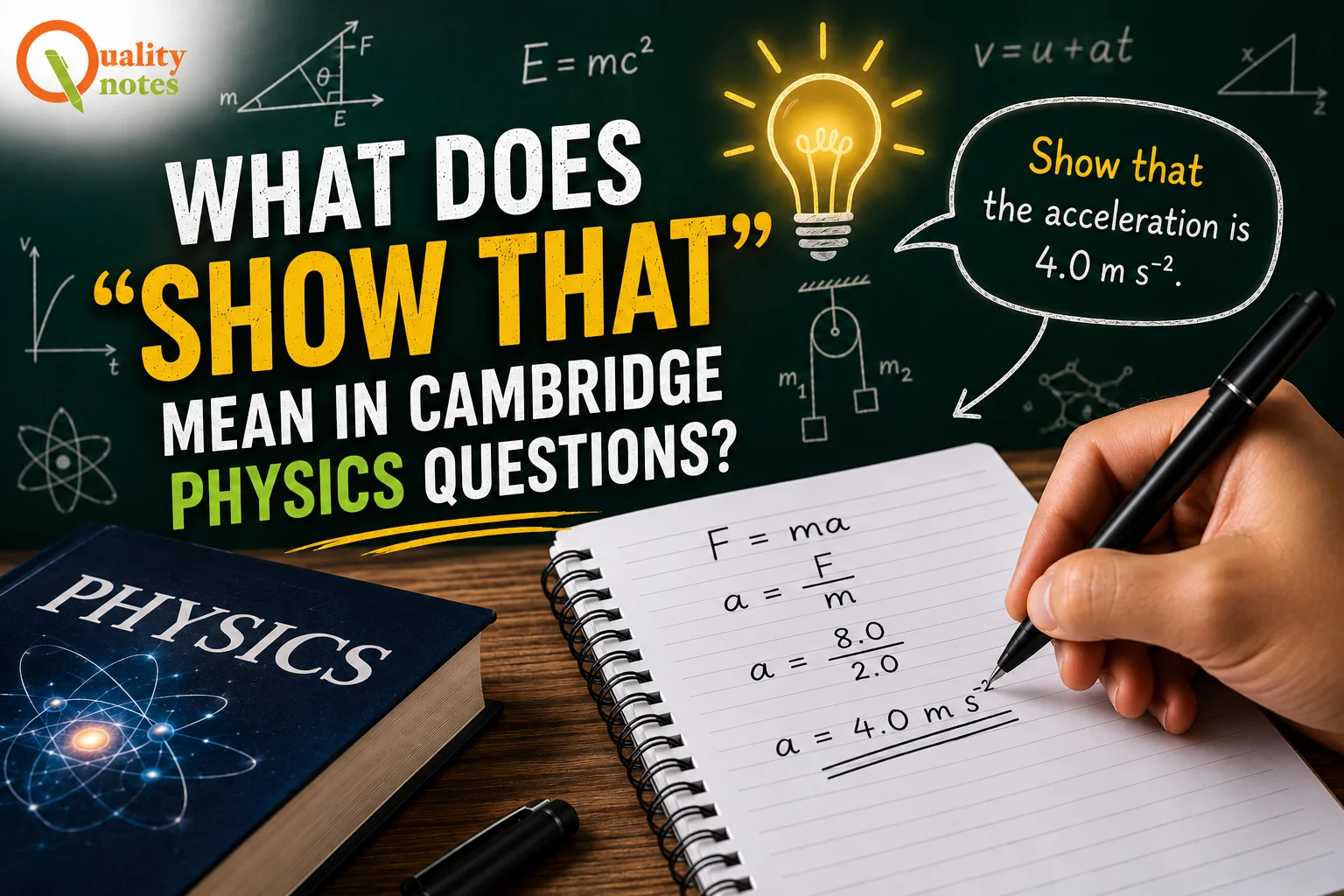
“Show that the acceleration of the object is 4.0 m s⁻².”
The value of 4.0 m s⁻² is already given. You are not trying to discover an unknown answer. Instead, you need to use the correct equation, substitute the relevant values and demonstrate that your calculation produces approximately 4.0 m s⁻².
According to Cambridge command-word guidance, “show (that)” requires candidates to provide structured evidence that leads to a given result. This is why your working is particularly important in show that physics questions.
What Are Show That Physics Questions Asking You to Do?
The purpose of show that physics questions is to test whether you can connect the information provided with the correct physics relationship.
Show that physics questions often combine several skills.
You may need to:
- Identify the correct equation.
- Rearrange an equation.
- Convert units.
- Substitute numerical values.
- Perform a calculation.
- Include the correct unit.
- Compare your final result with the answer given in the question.
You do not normally need to write a long explanation. What matters is that your working clearly demonstrates the route from the information given to the stated result.
Think of the question as giving you a destination. Your working shows the route you took to reach it.
How to Approach Show That Physics Questions
A reliable method for show that physics questions is to follow the same sequence every time.
1. Read the Target Carefully
First, identify exactly what the question wants you to show.
If the question says:
“Show that the kinetic energy is approximately 450 J.”
your target is approximately 450 J.
Knowing the target helps you decide whether your calculation is sensible when you reach the final step.
2. Find the Relevant Physics Equation
Next, identify the equation that connects the quantities given in the question.
For kinetic energy, you might use:
Ek=12mv2E_k = \frac{1}{2}mv^2
For force:
F=maF = ma
For electrical power:
P=IVP = IV
For density:
ρ=mV\rho = \frac{m}{V}
Do not begin by entering numbers into your calculator. First decide which physical relationship applies.
3. Check the Units
Unit conversions are a common source of mistakes.
For example, if a mass is given as 500 g but the equation requires kilograms:
500 g=0.500 kg500\text{ g}=0.500\text{ kg}
Similarly:
250 cm=2.50 m250\text{ cm}=2.50\text{ m}
If time is given in milliseconds, convert it to seconds when required.
Making important conversions visible in your working helps because it shows exactly how you handled the data.
4. Substitute the Values
Once you have selected the equation and checked the units, substitute the numbers.
Suppose an item has a mass of 2.0 kg and a velocity of 10 m/s.
Ek=12mv2E_k=\frac{1}{2}mv^2 Ek=12(2.0)(10)2E_k=\frac{1}{2}(2.0)(10)^2 Ek=100 JE_k=100\text{ J}
The calculation has demonstrated the required result.
5. Check the Final Answer
Compare your result with the value stated in the question.
If the question asks you to show that the answer is 100 J and your calculation gives 100 J, you have successfully demonstrated the result.
If your answer is slightly different, do not immediately assume that your method is wrong. Check your units, substitutions, formula and rounding first.
How to Write Answers to Show That Physics Questions
A strong answer for show that physics questions does not need to be complicated.
The best approach is usually to show the calculation in a logical order.
For example:
F=maF=ma F=(1200)(2.5)F=(1200)(2.5) F=3000 NF=3000\text{ N}
This is much stronger than simply writing:
3000 N
The final number tells the examiner what you got, but the working demonstrates how you obtained it.
This is particularly important when several marks are available. The examiner may award marks for the correct equation, substitution, calculation or final result depending on the specific question and mark scheme.
Do You Need to Prove the Answer?
The word “show” can make students think they need to write a formal mathematical proof.
Usually, that is not what is required.
In Cambridge Physics, the instruction is about providing structured evidence leading to the given result.
You should therefore think of it as a demonstration rather than a formal proof.
For a numerical problem, your demonstration might only take three or four lines.
For a more complicated problem, you may need several equations or an intermediate calculation before reaching the required result.
The key question to ask yourself is:
“Can the examiner clearly see how my working leads to the answer given in the question?”
If the answer is yes, your method is likely appropriate.
Why Units Matter So Much
Units can help you identify mistakes before you finish the question.
Suppose you calculate a force and obtain:
F=2500F=2500
You should not stop there.
Force is measured in newtons, so your final answer should be:
F=2500 NF=2500\text{ N}
Units also help reveal incorrect calculations.
For example, if you are calculating speed and somehow end up with joules, something has gone wrong because joules measure energy, not speed.
When solving physics questions, always ask:
What quantity am I calculating and what should its unit be?
This simple check can catch many errors.
What If Your Answer Does Not Match the Given Value?
This is one of the most common problems students face.
Imagine that the question says:
“Show that the acceleration is 6.0 m s⁻².”
You calculate:
a=5.2 m s−2a=5.2\text{ m s}^{-2}
Do not immediately move on.
Go through your calculation again.
First, check the equation.
For acceleration:
a=ΔvΔta=\frac{\Delta v}{\Delta t}
Then check whether you used the correct values for the change in velocity and time.
Next, check the units.
If velocity was given in km h⁻¹, you may need to convert it into m s⁻¹.
Then check whether you have accidentally rounded too early.
Finally, check whether you copied the numbers correctly from the question.
Most mismatches come from a simple calculation, unit or substitution error.
Common Mistakes Students Make
One of the biggest mistakes is giving only the final answer.
If the question asks you to show that something is true, the working is part of the answer.
Another common mistake is choosing a formula because it contains one of the numbers from the question. Every equation you use should have a clear physical reason for being relevant.
Students also sometimes forget unit conversions. A value in centimeters cannot automatically be treated as meters.
Another problem is premature rounding. If your calculator gives several decimal places, keep suitable precision during intermediate steps and round your final answer appropriately.
Finally, avoid filling your answer with unnecessary words. A clear sequence of equations is often more useful than a long paragraph.
Show That vs Calculate
“Show that” and “calculate” may appear similar, but they have an important difference.
If a question says:
“Calculate the acceleration.”
you need to determine the acceleration.
If it says:
“Show that the acceleration is 5.0 m s⁻².”
the expected result has already been provided. You need to demonstrate how the given information leads to 5.0 m s⁻².
This difference can affect how you approach the question.
For a calculation question, your focus is finding the answer.
For a show-that question, your focus is demonstrating the given answer through clear working.
Show That vs Derive
“Derive” is another command word that students sometimes confuse with “show that.”
When asked to derive an equation or expression, you are generally expected to develop it from known relationships.
For example, you may be asked to derive an expression for a physical quantity using other equations.
A “show that” question is different because the target result is normally already given.
This is why identifying the command word before starting your calculation is a useful exam habit.
How Many Steps Should You Show?
There is no fixed number of lines that every answer to a physics question must contain.
The amount of working depends on the difficulty of the problem.
A simple question may require:
F=maF=ma F=(4)(3)F=(4)(3) F=12 NF=12\text{ N}
A more complicated question may require unit conversion, equation rearrangement and several intermediate calculations.
The rule is simple:
Show enough working to make your method clear.
You do not need to show every calculator button you press. Still, you should show the important physics and mathematical steps.
How Mark Allocation Can Help
The number of marks can give you a useful indication of how much working is expected.
If a “show that” question is worth several marks, it is unlikely that the examiner expects only a final number.
For example, a three-mark question might involve selecting an equation, substituting correctly and reaching the required result.
However, the exact allocation depends on the question and its marking scheme.
Never assume that one mark always equals one particular step. Instead, use the marks as a general guide and provide enough clear working to demonstrate your method.
A Simple Exam Routine
When you see the words show that, use this routine:
Target → Formula → Units → Substitute → Calculate → Check
First identify the result you need to reach.
Then choose the appropriate physics equation.
Check that all quantities use compatible units.
Substitute the values clearly.
Calculate without unnecessary early rounding.
Finally, compare your result with the answer given in the question.
With practice, this process becomes almost automatic.
How to Improve Your Performance
The best way to become confident solving physics questions is to practice the process rather than memorizing one particular question.
When working through past-paper questions, cover the final answer and try to identify the equation yourself.
Then compare your working with the expected result.
If you make a mistake, identify exactly where it happened.
Was it the formula?
Was it unit conversion?
Was it substitution?
Was it calculator use?
Was it rounding?
Keeping track of the type of mistake you make can be more useful than simply marking the question wrong.
For additional clear explanations and study support, Quality Notes can also be a useful resource when revising Physics concepts and exam techniques.
Frequently Asked Questions
What does “show that” mean in Cambridge Physics?
It means you need to provide structured working that demonstrates how the information given in the question leads to the stated result.
Do I need to write an explanation?
Not usually a long explanation. For a numerical question, clear equations, substitutions, calculations and units are normally the most important parts.
Should I write the formula first?
Yes. Starting with the relevant physics equation makes your method clear and helps prevent incorrect substitutions.
What happens if my answer is slightly different?
Check your units, formula, substitution and rounding. A small difference may sometimes result from rounding. Still, a large difference usually indicates an error that needs investigation.
Should I show unit conversions?
Yes, particularly when the question gives values in units that need to be converted before using the equation.
Is “show that” the same as “prove”?
Not exactly. In Cambridge Physics, “show that” generally means providing structured evidence that leads to the given result rather than writing a formal mathematical proof.
Can I get marks if my final answer is wrong?
Depending on the question and marking scheme, correct intermediate working can receive credit even when the final answer is incorrect. This is another important reason to show your method rather than writing only a final number.
Final Takeaway
The meaning of show that in physics questions is much simpler once you understand what Cambridge is asking for. The answer is normally given in the question and your responsibility is to demonstrate how the supplied information and appropriate physics equations lead to that result.
Remember the basic sequence:
Find the target → choose the equation → check units → substitute → calculate → compare with the given answer.
Do not hide your important working. A clear calculation allows the examiner to see your reasoning and can help you identify mistakes yourself.
With regular practice, show that physics questions become much less intimidating. They are not asking you to guess the answer or write a complicated proof. They are asking you to show the physics behind the result.
For more student-friendly Physics explanations, revision material and exam-focused guidance, contact Quality Notes and use our free resources alongside your Cambridge Physics preparation. The more you practice turning equations and data into clear working, the more confidently you will handle these questions in an exam.