
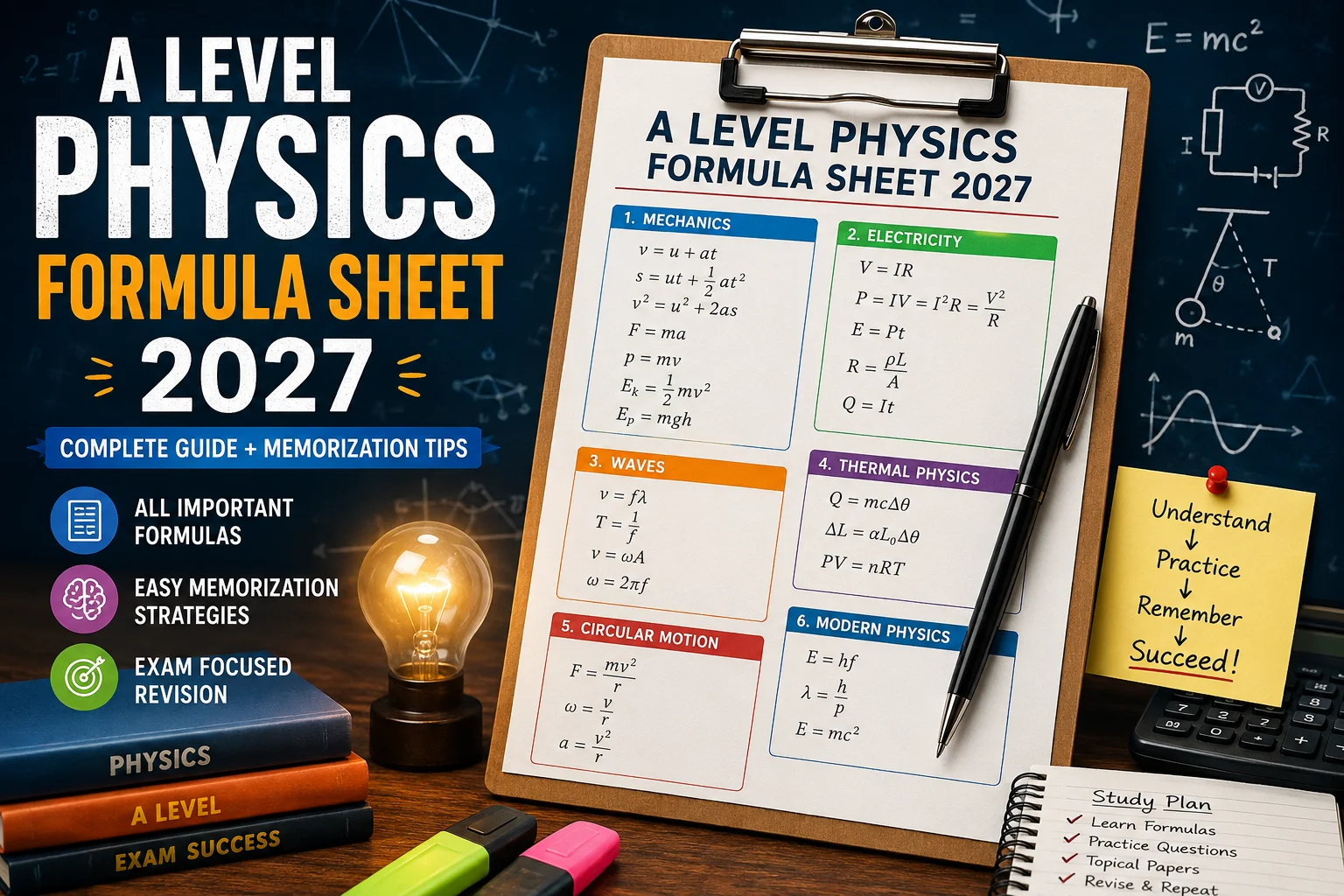
A Level Physics Formula Sheet 2027 + How to Memorize Them Effectively for Exam Success
Physics is one of the most rewarding yet challenging A Level subjects. Many students struggle not because they do not understand concepts, but because they find it difficult to remember the large number of equations required for problem-solving. Having access to the A Level Physics Formula Sheet 2027 and knowing how to use it effectively can significantly improve exam performance.
Whether you are preparing for AS Level examinations, full A Level assessments, mock exams or revision tests, a well-organized formula sheet can save valuable study time and help you build confidence. Instead of trying to memorize dozens of formulas randomly, successful students learn how formulas connect to concepts and apply them consistently through practice.
At Quality Notes, students can access high-quality revision resources, Formula Sheet 2027 materials, Topical Papers and Recorded Lessons designed to make learning easier and more effective.
Why Every Physics Student Needs a Formula Sheet
Physics is built on mathematical relationships. Every topic contains formulas that describe how physical quantities interact with one another.
A formula sheet helps students:
- Organize important equations in one place
- Revise efficiently before exams
- Identify relationships between topics
- Reduce exam anxiety
- Improve problem-solving speed
- Focus on understanding rather than searching for formulas
The A Level Physics Formula Sheet 2027 serves as a powerful revision tool when used alongside regular practice questions.
What Is Included in the A Level Physics Formula Sheet 2027?
A comprehensive formula sheet typically contains equations from every major syllabus section.
Mechanics Formulas
Equations pertaining to motion, force and energy are found in mechanics, which forms the basis of physics.
Common formulas include:
- Velocity = Distance ÷ Time
- Acceleration = Change in Velocity ÷ Time
- Force = Mass × Acceleration
- Momentum = Mass × Velocity
- Kinetic Energy = ½mv²
- Gravitational Potential Energy = mgh
Students often use these formulas extensively in numerical questions and practical applications.
Electricity Formulas
Electricity topics require familiarity with equations involving current, voltage, resistance and power.
Important examples include:
- V = IR
- Power = IV
- Electrical Energy = Power × Time
- Resistance = Voltage ÷ Current
Regular revision using the A Level Physics Formula Sheet 2027 helps students quickly recall these relationships during examinations.
Waves and Oscillations Formulas
Wave calculations are common in both theory and practical questions.
Key equations include:
- Wave Speed = Frequency × Wavelength
- Period = 1 ÷ Frequency
Understanding these formulas allows students to solve questions involving sound waves, light waves and electromagnetic radiation.
Thermal Physics Formulas
Thermal Physics introduces concepts related to heat and energy transfer.
Common equations include:
- Specific Heat Capacity Equation
- Thermal Expansion Relationships
- Internal Energy Calculations
These formulas frequently appear in structured and multiple-choice questions.
Circular Motion and Gravitation
Advanced Physics topics often require calculations involving circular motion and gravitational fields.
Students should understand formulas related to:
- Centripetal Force
- Gravitational Force
- Orbital Motion
Consistent exposure to these equations improves confidence when solving complex problems.
Modern Physics Formulas
Modern Physics covers atomic structure, quantum mechanics and nuclear physics.
Typical formulas include:
- Energy = hf
- E = mc²
Many students find these equations easier to remember once they understand their physical significance.
A Level Physics Formula Sheet 2027 Download Guide
Finding a reliable source for physics revision materials can be difficult. Students often download incomplete sheets that omit important equations or organize formulas poorly.
A high-quality Formula Sheet 2027 should:
- Cover the entire syllabus
- It is easy to print
- Include clearly labeled sections
- Use standard symbols
- Match current examination requirements
Quality Notes provides students with structured revision resources that simplify the learning process and help ensure that no important formula is overlooked.
A Level Physics Formula Sheet 2027 Revision Strategy
Simply downloading a formula sheet is not enough. Students must learn how to use it effectively.
A practical revision strategy includes:
Step 1: Categorize Formulas by Topic
Divide formulas into:
- Mechanics
- Electricity
- Waves
- Thermal Physics
- Modern Physics
Studying formulas in groups improves retention.
Step 2: Understand Before Memorizing
Students who understand where formulas come from remember them more easily.
Instead of memorizing:
F = ma
Understand that force causes acceleration and that larger masses require greater force.
Conceptual understanding creates stronger memory connections.
Step 3: Create Formula Flashcards
Flashcards remain one of the most effective learning tools.
Front Side:
Question or Concept
Back Side:
Formula and Explanation
Reviewing flashcards regularly strengthens long-term memory.
Step 4: Solve Numerical Questions Daily
Physics formulas become memorable through use.
Students should solve:
- Past paper questions
- Topical Papers
- Practice worksheets
The more frequently formulas are applied, the less likely they are to be forgotten.
How to Memorize Physics Formulas Faster
Many students believe they have poor memory. In reality, most students use ineffective study methods.
Use Active Recall
Rather than reading formulas repeatedly:
- Cover the formula
- Attempt to write it from memory
- Check for accuracy
Active recall improves memory retention by compelling the brain to recover information.
Apply Spaced Repetition
Review formulas:
- Day 1
- Day 3
- Day 7
- Day 14
- Day 30
This method dramatically improves long-term recall.
Connect Formulas to Real-Life Examples
For example:
Velocity = Distance ÷ Time
Think about calculating the speed of a car journey.
Real-world connections improve understanding and memory.
Build Formula Maps
Create diagrams showing how formulas relate to one another.
Students often discover that many equations are interconnected, making them easier to remember.
Common Mistakes Students Make
Memorizing Without Understanding
Rote learning often fails during exams.
Pupils should concentrate on comprehending each equation’s physical significance.
Ignoring Units
Units often help identify the correct formula.
Always learn formulas together with their units.
Revising Formulas Too Late
Last-minute cramming rarely works for Physics.
Start learning formulas months before the examination period.
Avoiding Difficult Topics
Many students focus only on familiar formulas.
Weak areas should receive extra revision time.
The Importance of Topical Papers
One of the fastest ways to master Physics formulas is through Topical Papers.
Benefits include:
- Focused topic practice
- Repeated formula application
- Better concept understanding
- Identification of weak areas
Instead of solving random questions, topical practice allows students to concentrate on one topic at a time until they become confident.
Quality Notes provides well-organized Topical Papers that help students efficiently strengthen their problem-solving skills.
How Recorded Lessons Improve Formula Retention
Many students learn better through visual explanations.
Recorded Lessons allow students to:
- Revisit difficult concepts
- Learn at their own pace
- Pause and review explanations
- Watch worked examples multiple times
Combining Recorded Lessons with the A Level Physics Formula Sheet 2027 creates a powerful revision system.
Students can immediately apply newly learned formulas to practice questions, reinforcing their understanding.
Exam-Day Tips for Formula-Based Questions
As examinations approach, students should focus on efficiency.
Read Questions Carefully
Identify:
- Known values
- Unknown variables
- Required formula
Write Down Relevant Equations First
Listing formulas before calculating reduces mistakes.
Check Units
Incorrect unit conversions can lead to wrong answers even when formulas are correct.
Review Final Answers
Always verify:
- Significant figures
- Units
- Calculation accuracy
Small checks often prevent costly errors.
Creating a Personal Formula Book
Many high-performing students create their own formula collection.
A personal formula book allows students to:
- Rewrite equations in their own words
- Add explanations
- Include solved examples
- Track difficult formulas
This personalized approach often leads to stronger understanding and retention.
The A Level Physics Formula Sheet 2027 can serve as the foundation for building such a resource.
Frequently Asked Questions
Is a formula sheet enough to score high marks in Physics?
No. Students must combine formula revision with concept understanding, Topical Papers and regular practice.
How often should I revise Physics formulas?
Daily 10–15-minute review sessions are generally more effective than occasional long study sessions.
What is the best way to remember difficult equations?
Active recall, spaced repetition and solving numerical questions are among the most effective techniques.
Should I memorize units as well as formulas?
Yes. Units often help identify the correct equation and improve accuracy.
Can Recorded Lessons help with Physics revision?
Absolutely. Visual explanations and worked examples make formulas easier to understand and remember.
Conclusion
Success in Physics is not about memorizing hundreds of equations overnight. It comes from understanding concepts, practicing consistently and using the right study resources. The A Level Physics Formula Sheet 2027 provides an essential foundation for effective revision. Still, students achieve the best results when they combine formula review with Topical Papers, active recall techniques and structured practice.
For students looking for comprehensive revision support, Quality Notes offers valuable resources, including Formula Sheet 2027 materials, expertly organized Topical Papers and Recorded Lessons that simplify complex Physics concepts. By using these resources consistently throughout the academic year, students can build confidence, strengthen problem-solving skills and approach their examinations fully prepared.