
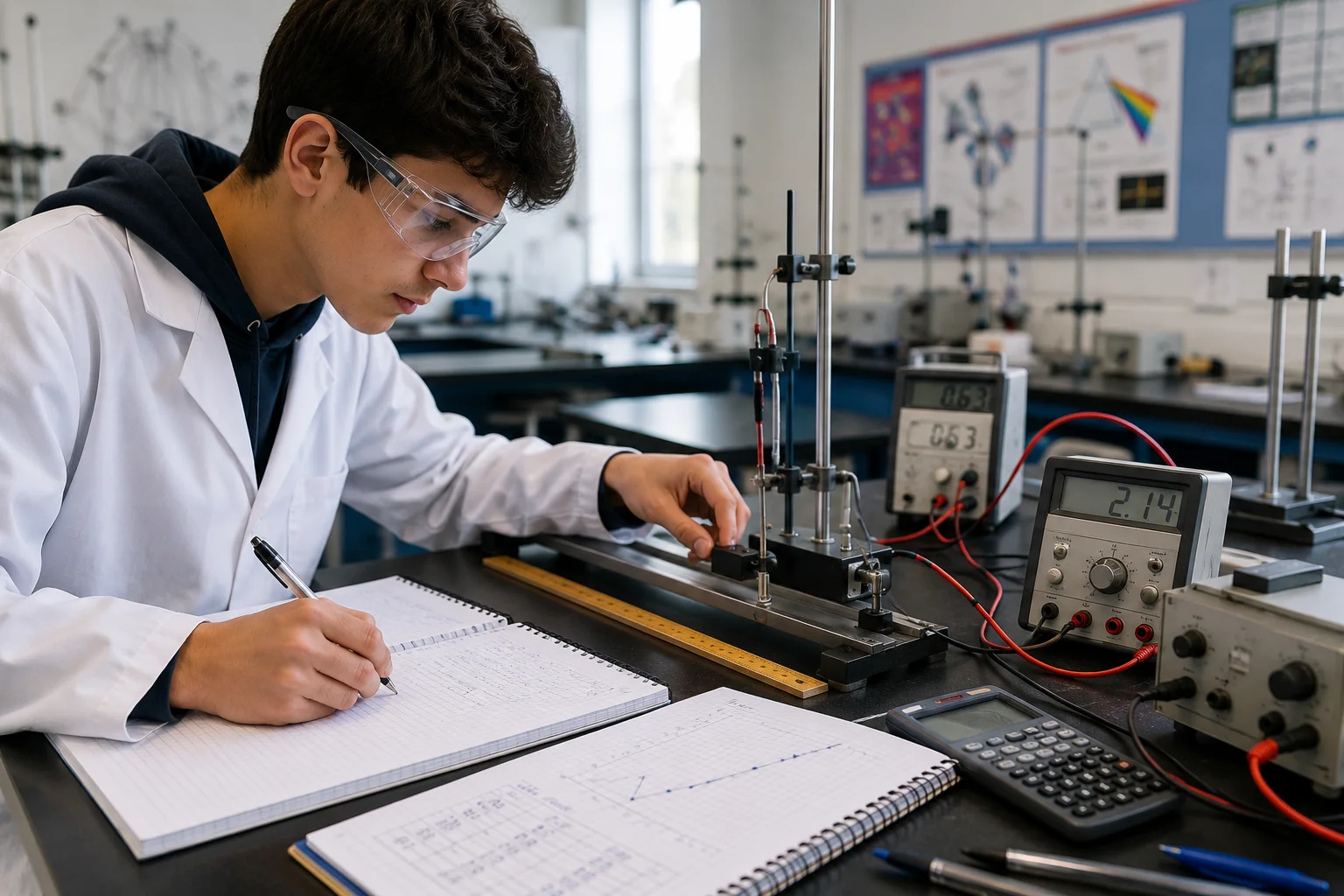
How to Score Full Marks in A Level Physics Practical Paper 3
For many students, Practical Paper 3 is the most challenging component of A Level Physics. Unlike theory papers, success depends not only on understanding physics concepts but also on applying them accurately under exam conditions. Students must perform experiments, record measurements, analyze data, draw graphs, evaluate uncertainties and communicate findings clearly within a limited time.
The good news is that Practical Paper 3 follows predictable assessment patterns. Examiners look for specific skills and students who master these skills consistently achieve excellent results.
Everything you need to know about A Level Physics practical paper 3 to face the test with confidence and optimise your score is included in this guide.
Understanding the Structure of Practical Paper 3
Before learning exam techniques, it is essential to understand what examiners assess.
Typically, the paper focuses on:
- Taking accurate measurements
- Recording observations systematically
- Constructing tables correctly
- Plotting graphs
- Performing calculations
- Drawing conclusions
- Evaluating experimental uncertainties
- Suggesting improvements
Many students lose marks not because they misunderstand physics but because they fail to present their work correctly.
A strong preparation strategy should therefore combine practical skills with theoretical understanding.
A Level Physics Practical Paper 3: Tips Every Student Should Know
One of the biggest mistakes students make is treating practical preparation as an afterthought. The most successful candidates spend time practicing experimental techniques throughout the year.
The following A level physics practical paper 3 tips can significantly improve performance.
Read the Entire Question First
Before touching any apparatus, spend a few minutes reading the complete question.
This helps you:
- Understand the aim of the experiment
- Identify variables
- Anticipate calculations
- Plan data collection efficiently
Students who rush often discover later that they missed important instructions.
Organize Your Workspace
A cluttered workspace increases the likelihood of errors.
Before beginning:
- Arrange equipment neatly
- Check apparatus functionality
- Prepare your answer booklet
- Keep a calculator nearby
A good organization saves valuable time during the exam.
Record Measurements Carefully
Every reading matters.
Always:
- Read scales at eye level
- Avoid parallax errors
- Include units
- Record all significant figures correctly
Examiners reward precision and consistency.
Common Experiments You Should Practice
Many practical exams use familiar experimental setups.
Students should regularly practice:
Oscillations
Experiments involving:
- Pendulums
- Springs
- Mass-spring systems
These often require measuring periods and investigating relationships between variables.
Electricity Experiments
Common tasks include:
- Measuring voltage
- Measuring current
- Determining resistance
- Investigating circuit behavior
Understanding proper meter usage is essential.
Mechanics Experiments
These may involve:
- Motion
- Forces
- Energy
- Momentum
Accurate timing and distance measurements are crucial.
Waves and Optics
Students frequently encounter:
- Light experiments
- Diffraction investigations
- Refraction measurements
Careful observation can make a significant difference in final marks.
Importance of Accurate Data Collection
Reliable results form the foundation of every practical task.
Students should:
- Repeat measurements when possible
- Identify anomalies
- Calculate averages correctly
- Maintain consistency throughout the experiment
Examiners value data quality more than speed.
When uncertain about a reading, repeating the measurement is usually beneficial.
Creating Perfect Tables
Tables appear simple but frequently cost students marks.
A high-quality table should include:
Clear Headings
Every column must contain:
- Quantity measured
- Appropriate unit
For example:
| Time / s | Distance / cm |
rather than simply:
| Time | Distance |
Consistent Precision
All values in a column should use the same number of decimal places where appropriate.
Logical Arrangement
Data should be organized clearly so patterns can be identified easily.
Well-structured tables help examiners follow your work and reduce marking errors.
Using Graphs to Gain Maximum Marks
Graphs often carry significant marks in Practical Paper 3.
Students should practice graphing regularly.
Choose Appropriate Scales
Good scales:
- Use more than half the graph paper
- They are easy to read
- Allow accurate plotting
Avoid awkward scales such as 3 units per square.
Plot Points Precisely
Use sharp pencils and mark points clearly.
Poor plotting can affect gradient calculations and reduce marks.
Draw the Best-Fit Line
Do not force the line through every point.
Instead:
- Consider overall trends
- Balance points above and below the line
- Ignore obvious anomalies where justified
Graph accuracy often separates average candidates from top scorers.
Advanced A level physics practical paper 3 Tips for Graph and Analysis Questions
Graph-based questions are among the highest-scoring sections of the exam.
Several advanced A level physics practical paper 3 tips can help students maximize their marks.
Calculate Gradients Correctly
When finding gradients:
- Use large triangles
- Select points on the line
- Avoid using plotted data points directly unless instructed
Large triangles reduce percentage error.
Understand Intercepts
Students should know how intercepts relate to physical quantities.
Many experiments require interpreting the graph rather than simply drawing it.
Check Units Carefully
A correct numerical answer with incorrect units may lose marks.
Always verify:
- Gradient units
- Intercept units
- Derived quantities
Attention to detail matters.
Mastering Error and Uncertainty Questions
Many students struggle with uncertainty analysis despite its predictable nature.
Common examiner expectations include:
Percentage Uncertainty
Understand how to calculate:
Percentage uncertainty =
(Uncertainty ÷ Measurement) × 100
Students who practice these calculations regularly gain confidence quickly.
Identifying Sources of Error
Examples include:
- Human reaction time
- Instrument limitations
- Environmental influences
- Alignment issues
Being able to identify realistic sources of error demonstrates practical understanding.
Suggesting Improvements
Strong answers explain how improvements reduce uncertainty.
Examples:
- Use digital sensors
- Increase measurement range
- Repeat measurements
- Use more precise instruments
Generic answers often receive fewer marks.
Time Management During the Exam
Even well-prepared students can struggle if they mismanage time.
A useful strategy includes:
First 5 Minutes
- Read all instructions carefully
- Examine apparatus
- Plan measurements
Middle Section
- Complete data collection efficiently
- Record results immediately
Final 10 Minutes
- Check calculations
- Verify graph labels
- Confirm units
- Review answers
This approach minimizes avoidable mistakes.
Most Common Mistakes That Cost Marks
Understanding common mistakes can help students avoid losing easy marks.
Missing Units
One of the simplest errors is forgetting units.
Always include units when:
- Recording measurements
- Writing calculated answers
- Labeling graph axes
- Determining gradients
Even an accurate numerical value may lose marks if the units are missing.
Inconsistent Significant Figures
Physics requires consistency.
Students should:
- Follow the precision of measuring instruments
- Keep decimal places consistent
- Avoid unnecessary rounding
Examiners often look for appropriate significant figures throughout calculations.
Poor Graph Presentation
Many students lose marks because of:
- Small graphs
- Incorrect scales
- Missing labels
- Thick or inaccurate lines
A well-drawn graph can secure several marks with minimal effort.
Skipping Working Steps
Even when calculations are simple, showing working is important.
Written steps allow examiners to award method marks if the final answer is incorrect.
How to Prepare Effectively Before the Exam
Success in Practical Paper 3 is built long before exam day.
Students should focus on developing practical confidence through consistent practice.
Use Topical Papers Regularly
One of the best revision methods is solving Topical papers.
Topical practice allows students to:
- Focus on specific experiment types
- Identify weak areas
- Improve calculation accuracy
- Become familiar with examiner expectations
Instead of completing random questions, topic-based practice builds targeted skills.
Review Mark Schemes
Mark schemes reveal exactly what examiners want.
By studying mark schemes, students learn:
- How conclusions are written
- What improvements are acceptable
- How uncertainties are evaluated
- Which graph techniques earn marks
This approach often produces faster improvement than repeatedly reading notes alone.
Learn from Recorded Lessons
Many students understand practical concepts more easily through visual demonstrations.
High-quality recorded lessons can help students:
- Observe correct experimental techniques
- Understand apparatus setup
- Follow graph plotting methods
- Learn examiner-approved approaches
Watching experienced teachers perform practical tasks reinforces classroom learning.
Building Confidence with Free Resources
Preparation does not always require expensive materials.
Many excellent free resources can support practical revision.
Useful resources include:
- Practical experiment walkthroughs
- Data analysis exercises
- Graph plotting activities
- Uncertainty calculation worksheets
- Examiner reports
The key is to select resources that closely match the actual examination requirements.
Students who combine quality notes, practical exercises and past-paper practice often achieve the best results.
Exam-Day Strategy for Full Marks
A clear strategy can significantly improve performance.
Before the Exam Begins
Make sure you:
- Bring approved equipment
- Check your calculator
- Get sufficient rest
- Arrive early
Academic preparation is crucial, but so is mental preparation.
During Measurements
Focus on:
- Accuracy
- Consistency
- Careful observation
Avoid rushing through readings to save time.
During Calculations
Check:
- Units
- Decimal places
- Formula substitutions
Many calculation errors occur because students work too quickly.
During Graph Questions
Ensure that:
- Axes are labeled
- Units are included
- Scales are appropriate
- Points are plotted accurately
A final review can often recover marks that would otherwise be lost.
Developing the Skills of a Top-Scoring Candidate
Students who consistently score highly share several habits.
They:
- Practice experiments regularly
- Analyze mistakes carefully
- Review examiner reports
- Use Topical papers frequently
- Study practical mark schemes
- Learn from recorded lessons
- Utilize trusted free resources
Most importantly, they treat practical preparation as seriously as theory revision.
The Role of Physics Understanding in Practical Success
Practical exams are not only about following instructions.
Strong conceptual understanding helps students:
- Predict trends
- Identify anomalies
- Interpret graphs
- Explain results
For example, students who understand Hooke’s Law can better analyze spring experiments.
Similarly, knowledge of electrical relationships improves performance in circuit investigations.
The best outcomes are achieved when theoretical knowledge and practical abilities are combined.
Revision Checklist Before the Examination
In the weeks leading up to the exam, ensure you can confidently:
✓ Record measurements accurately
✓ Construct tables correctly
✓ Plot graphs efficiently
✓ Calculate gradients
✓ Determine uncertainties
✓ Identify sources of error
✓ Suggest realistic improvements
✓ Interpret experimental trends
✓ Complete calculations with correct units
✓ Manage time effectively
This checklist covers nearly every skill assessed in Practical Paper 3.
Final Thoughts
Achieving full marks in Practical Paper 3 is not about luck. It comes from mastering a set of predictable skills, understanding examiner expectations and practicing consistently. Students who focus on measurement accuracy, graphing techniques, uncertainty analysis and time management place themselves in the strongest position for success.
Throughout your preparation, make use of Topical papers, reliable free resources and high-quality recorded lessons to strengthen both practical and analytical skills. Regular exposure to real exam-style questions helps transform knowledge into exam-ready performance.
For students looking for comprehensive revision support, detailed explanations, exam-focused notes, practice materials and structured learning resources, Quality Notes is an excellent platform to explore. Whether you need help understanding difficult concepts, improving practical techniques or accessing effective study materials, Quality Notes can support your journey toward achieving top grades in A Level Physics.
Start practicing consistently today, refine your practical skills, learn from your mistakes and approach your next Physics Practical Paper 3 with confidence.