
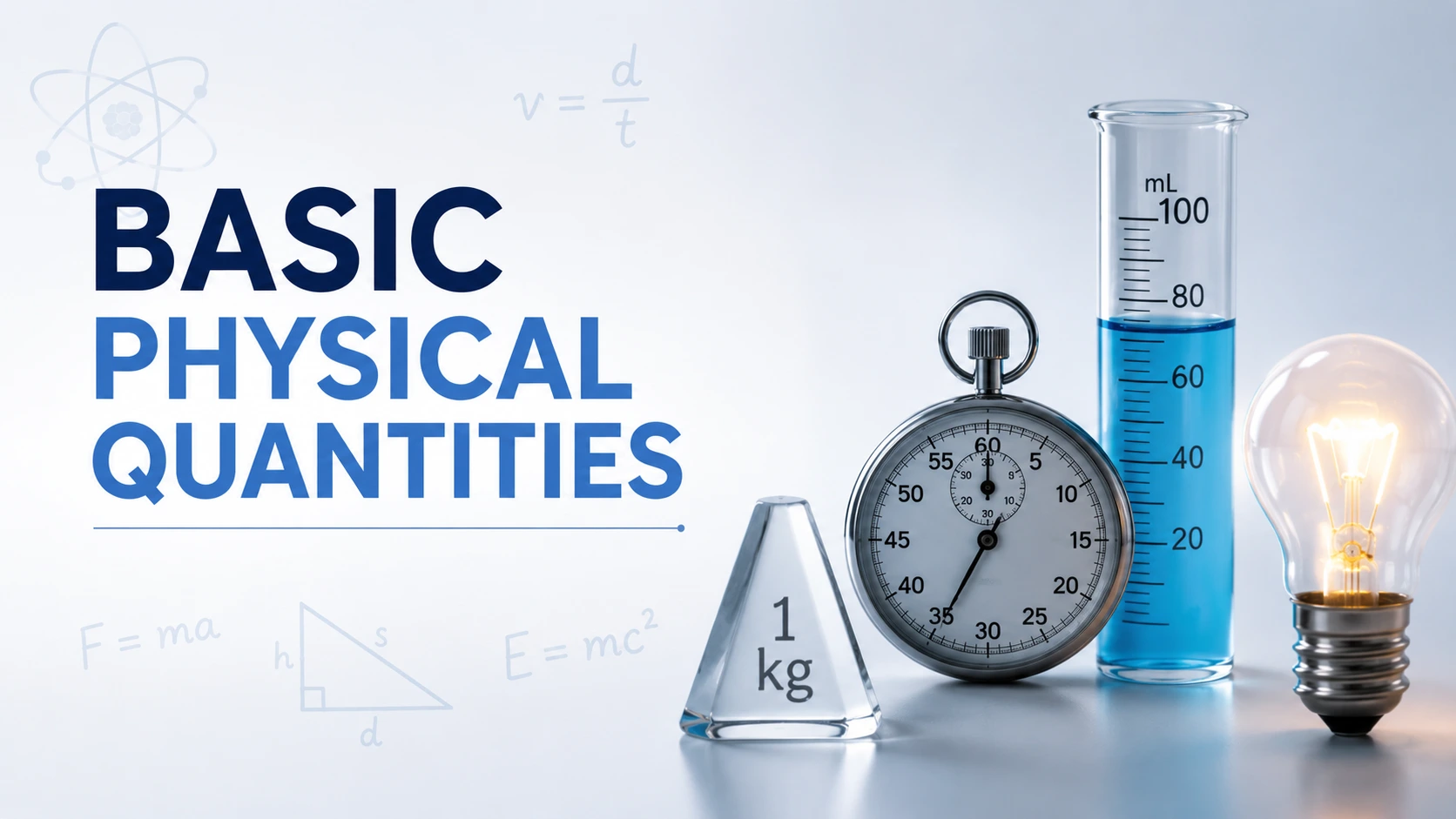
Basic Physical Quantities and Their SI Units: A Complete A Level Guide
Everything in physics begins with measurement. Before you can analyse motion, calculate electric fields, or understand nuclear reactions, you need a clear and precise understanding of basic physical quantities — what they are, how they are classified, and how their units are defined and combined. This is Topic 1 of the CIE 9702 syllabus for a reason: without it, nothing else in the course makes sense.
This complete guide covers every aspect of basic physical quantities that CIE 9702 students are required to know — from SI base quantities and derived units through to prefixes, homogeneity of equations, and estimation. Each section is built around the exact syllabus learning objectives and the question types that appear repeatedly in Paper 1 and Paper 2.
What Are Basic Physical Quantities?
A basic physical quantity is any property of a material or system that can be measured and expressed as a number combined with a unit. This definition contains two non-negotiable components: a numerical magnitude (how much) and a unit (compared to what standard). A measurement without a unit is not a physical quantity — it is meaningless in scientific terms.
For example, stating that an object has a mass of “5” tells you nothing. Stating it has a mass of 5 kg tells you precisely how much matter the object contains, expressed against the internationally agreed standard of the kilogram.
This principle applies to every basic physical quantity in physics — from the most fundamental measurements like length and time, to complex derived quantities like electric field strength and gravitational potential.
The Six SI Base Quantities for CIE 9702
The International System of Units (SI) defines seven base quantities — the fundamental basic physical quantities from which all other measurable quantities in physics are derived. CIE 9702 requires confident recall of six of them:
| Base Quantity | SI Unit | Symbol | What It Measures |
| Mass | kilogram | kg | Amount of matter in an object |
| Length | metre | m | Distance between two points |
| Time | second | s | Duration of an event |
| Electric current | ampere | A | Rate of flow of charge |
| Thermodynamic temperature | kelvin | K | Absolute temperature |
| Amount of substance | mole | mol | Number of particles (6.02 × 10²³) |
These six basic physical quantities are defined independently of each other. None can be expressed in terms of the others — that is what makes them base quantities. Every other measurable quantity in physics is derived from some combination of these six.
Three critical exam traps on base quantities:
First, the gram is not an SI base unit — the kilogram is. This trips up students who write g instead of kg when listing base units.
Second, the degree Celsius is not an SI base unit — the kelvin is. Temperature differences in Celsius and kelvin are equal, but only kelvin is the base unit. Absolute zero is 0 K, not −273 °C.
Third, the ampere is defined in terms of electric current, not charge. The coulomb (C) is a derived unit — it equals 1 A × 1 s. Students often incorrectly list charge as a base quantity.
Derived Quantities and Their SI Units
Derived quantities are all basic physical quantities beyond the six base quantities. They are obtained by combining base quantities through multiplication, division, or both. Every derived quantity has a derived unit that can be expressed entirely in terms of SI base units.
The ability to derive the SI base units of any quantity from its defining equation is a core CIE 9702 skill, tested in Paper 1 MCQs and Paper 2 structured questions in every exam session.
Method: Substitute base units into the defining equation, then simplify.
| Derived Quantity | Defining Equation | SI Base Unit Expression | Named Unit |
| Force | F = ma | kg m s⁻² | Newton (N) |
| Energy / Work | E = Fd | kg m² s⁻² | Joule (J) |
| Power | P = E/t | kg m² s⁻³ | Watt (W) |
| Pressure | P = F/A | kg m⁻¹ s⁻² | Pascal (Pa) |
| Charge | Q = It | A s | Coulomb (C) |
| Voltage | V = W/Q | kg m² s⁻³ A⁻¹ | Volt (V) |
| Resistance | R = V/I | kg m² s⁻³ A⁻² | Ohm (Ω) |
| Frequency | f = 1/T | s⁻¹ | Hertz (Hz) |
Practise deriving these base unit expressions from their equations — do not simply memorise the table. When an unfamiliar quantity appears in a Paper 2 question asking for its SI unit, the only reliable approach is to work from its equation. Memorising a fixed list will fail you the moment a less familiar quantity is asked.
For worked examples on unit derivation and all other Topic 1 skills, the free topical past paper workbooks at Quality Notes contain structured questions from multiple years of CIE 9702 past papers.
SI Prefixes: Expressing Very Large and Very Small Quantities
Physics spans an enormous range of scales — from the diameter of an atomic nucleus (~10⁻¹⁵ m) to the radius of the observable universe (~10²⁶ m). SI prefixes make these quantities manageable by attaching a multiplier symbol to the unit.
The full set required for CIE 9702:
| Prefix | Symbol | Multiplier | Example |
| tera | T | 10¹² | 1 THz = 10¹² Hz |
| giga | G | 10⁹ | 1 GHz = 10⁹ Hz |
| mega | M | 10⁶ | 1 MHz = 10⁶ Hz |
| kilo | k | 10³ | 1 km = 10³ m |
| deci | d | 10⁻¹ | 1 dm = 10⁻¹ m |
| centi | c | 10⁻² | 1 cm = 10⁻² m |
| milli | m | 10⁻³ | 1 mm = 10⁻³ m |
| micro | μ | 10⁻⁶ | 1 μm = 10⁻⁶ m |
| nano | n | 10⁻⁹ | 1 nm = 10⁻⁹ m |
| pico | p | 10⁻¹² | 1 pm = 10⁻¹² m |
The most important exam rule for prefixes: always convert prefixed units to standard SI base units before substituting into any equation. A cross-sectional area given as 2.5 mm² must become 2.5 × 10⁻⁶ m² before it enters a calculation. Failing to convert is one of the most frequently cited sources of numerical errors in CIE 9702 examiner reports.
Note the capital M for mega and lowercase m for milli — these are distinct and easily confused in handwritten exam answers. Similarly, lowercase k for kilo and uppercase K for kelvin must never be mixed up.
Homogeneity of Physical Equations
One of the most powerful applications of understanding basic physical quantities and their SI units is checking whether a physical equation is homogeneous — meaning the units on both sides of the equation are identical.
Every valid physics equation is homogeneous. If the units on the left-hand side do not match the units on the right-hand side, the equation is wrong. This gives you a reliable checking tool for both your own calculations and for examiner questions that ask you to verify or derive equations.
Worked example — checking homogeneity of kinetic energy:
KE = ½mv²
Right-hand side units: kg × (m s⁻¹)² = kg × m² s⁻² = kg m² s⁻²
Left-hand side: energy has units of J = kg m² s⁻² ✓
The equation is homogeneous — units match on both sides.
Worked example — finding unknown units using homogeneity:
The equation for the period of a simple pendulum is T = 2π√(l/g), where T is time, l is length, and g is gravitational field strength. Find the SI base units of g.
Rearranging: g = (2π)²l / T² → units of g = m / s² = m s⁻² ✓
Critical limitation of homogeneity: a homogeneous equation is not necessarily correct. Checking homogeneity confirms that an equation is dimensionally possible — it does not confirm that numerical constants (like ½ in KE = ½mv²) are correct, or that the equation describes the right physical relationship. CIE examiners frequently test this limitation directly.
Estimation of Physical Quantities
CIE 9702 Paper 1 includes questions requiring students to estimate the order of magnitude of common basic physical quantities. These questions test physical intuition — the ability to judge whether a value is plausible — rather than precise calculation.
The key technique is order-of-magnitude reasoning: identifying the power of ten closest to the true value without needing an exact calculation.
Essential estimates every CIE 9702 student should know:
| Quantity | Estimated Value | Order of Magnitude |
| Mass of an adult person | ~70 kg | 10¹ kg |
| Height of a person | ~1.7 m | 10⁰ m |
| Mass of a car | ~1000 kg | 10³ kg |
| Diameter of a hydrogen atom | ~10⁻¹⁰ m | 10⁻¹⁰ m |
| Speed of sound in air | ~340 m s⁻¹ | 10² m s⁻¹ |
| Gravitational force on adult | ~700 N | 10² N |
| Wavelength of visible light | ~500 nm = 5 × 10⁻⁷ m | 10⁻⁷ m |
| Charge of an electron | 1.6 × 10⁻¹⁹ C | 10⁻¹⁹ C |
When attempting an estimation question, start from a known quantity and reason outward. To estimate the gravitational force on a person: mass ≈ 70 kg, g ≈ 10 m s⁻², so weight ≈ 700 N. This process of chaining known values is more reliable than trying to recall a specific estimate under exam pressure.
For expert teaching on every aspect of basic physical quantities and the rest of the CIE 9702 AS Level syllabus, recorded lessons at Quality Notes walk through each skill with worked examples and exam technique built around real past paper questions.
Scalars and Vectors: The Final Classification
Beyond the base and derived distinction, basic physical quantities are also classified as scalar or vector:
Scalar quantities have magnitude only — no associated direction. Examples: mass, time, energy, temperature, distance, speed, pressure.
Vector quantities have both magnitude and direction. Examples: force, velocity, acceleration, displacement, momentum, electric field strength.
The distinction between scalar and vector is directly tested in Paper 1 MCQs every year — usually through the classic trap pairs: speed (scalar) vs velocity (vector), distance (scalar) vs displacement (vector), mass (scalar) vs weight (vector). These pairs must be memorised precisely.
When vector basic physical quantities are added or subtracted, direction must be accounted for. Two forces of 5 N each do not necessarily produce a resultant of 10 N — the result depends entirely on the angle between them. This vector addition principle underpins the entire mechanics section of the AS Level Physics syllabus and continues throughout A Level Physics.
Common Exam Mistakes on Basic Physical Quantities
Listing gram (g) as an SI base unit. The base unit is kilogram (kg). This error appears in Paper 1 MCQs where students are asked to identify which option is an SI base unit.
Confusing celsius with kelvin. The SI base unit of thermodynamic temperature is kelvin (K), not degree Celsius. A common Paper 2 mistake is using T in °C instead of K in equations involving thermal physics.
Attempting to memorise derived unit expressions instead of deriving them. Memorised lists fail on unfamiliar quantities. The reliable method is always to start from the defining equation and substitute base units — a skill that works for any quantity.
Concluding a homogeneous equation must be correct. Homogeneity checks dimensional consistency only. Constants and the specific form of the relationship are not confirmed by this method. CIE mark schemes award marks specifically for stating this limitation.
Not converting prefixed units before calculating. mm², nm, μA, MΩ — all of these must be converted to standard SI base units before substituting into equations. This is the most numerically costly mistake in Topic 1 calculations.
For structured support on IGCSE/GCE O Level foundations and the full A Level progression, students counselling at Quality Notes helps students build from first principles with a personalised revision plan.
People Also Ask About Basic Physical Quantities
What are the basic physical quantities in physics?
The basic physical quantities in the SI system are mass (kg), length (m), time (s), electric current (A), thermodynamic temperature (K), amount of substance (mol), and luminous intensity (cd). CIE 9702 requires recall of the first six. All other measurable quantities in physics are derived from these foundations.
What is the difference between base and derived quantities?
Base quantities are defined independently and cannot be expressed in terms of simpler physical quantities. Derived quantities are formed by combining base quantities through multiplication or division — for example, force (kg m s⁻²) is derived from mass, length, and time.
How do you find the SI base units of a derived quantity?
Write the equation that defines the quantity, then replace each variable with its SI base unit and simplify. For pressure: P = F/A → (kg m s⁻²)/m² = kg m⁻¹ s⁻². This method works for any derived quantity and is the only reliable approach for unfamiliar quantities in exams.
What is a homogeneous equation in physics?
A homogeneous equation is one where the SI base units on both sides of the equation are identical. Every valid physics equation must be homogeneous. Checking homogeneity confirms an equation is dimensionally consistent, but does not verify that numerical constants or the physical relationship itself is correct.
Why must units be converted before calculations?
SI equations are derived and balanced using SI base units. If prefixed units (mm, μA, MΩ) are substituted without conversion, the numerical answer will be wrong by factors of powers of ten. Converting all values to standard SI base units before substituting is a non-negotiable step in any physics calculation.
What is the difference between scalar and vector quantities?
Scalar quantities have magnitude only — examples include mass, speed, and energy. Vector quantities have both magnitude and direction — examples include force, velocity, and momentum. The distinction determines how quantities are added: scalars add arithmetically, vectors must be combined using vector methods that account for direction.
Conclusion
Basic physical quantities and their SI units are not a topic you revise once and move past. Unit derivation appears in mechanics, electricity, waves, and fields. Prefix conversion appears in every numerical question across the entire course. Homogeneity is tested in Paper 2 structured questions year after year. Estimation appears in Paper 1 every session.
The students who consistently collect these marks are those who understand the principles — not just the memorised facts — and apply them automatically from the first chapter of the course to the last.
When you get help from Mr. Adeel Chowhan, who is known as the best online physics teacher in Pakistan, you can’t do better in your studies. Go to Quality Notes right now to get a free trial class, for further access to structured topical past papers, lessons taught by experts, and all the tools you need to get the best grades.