
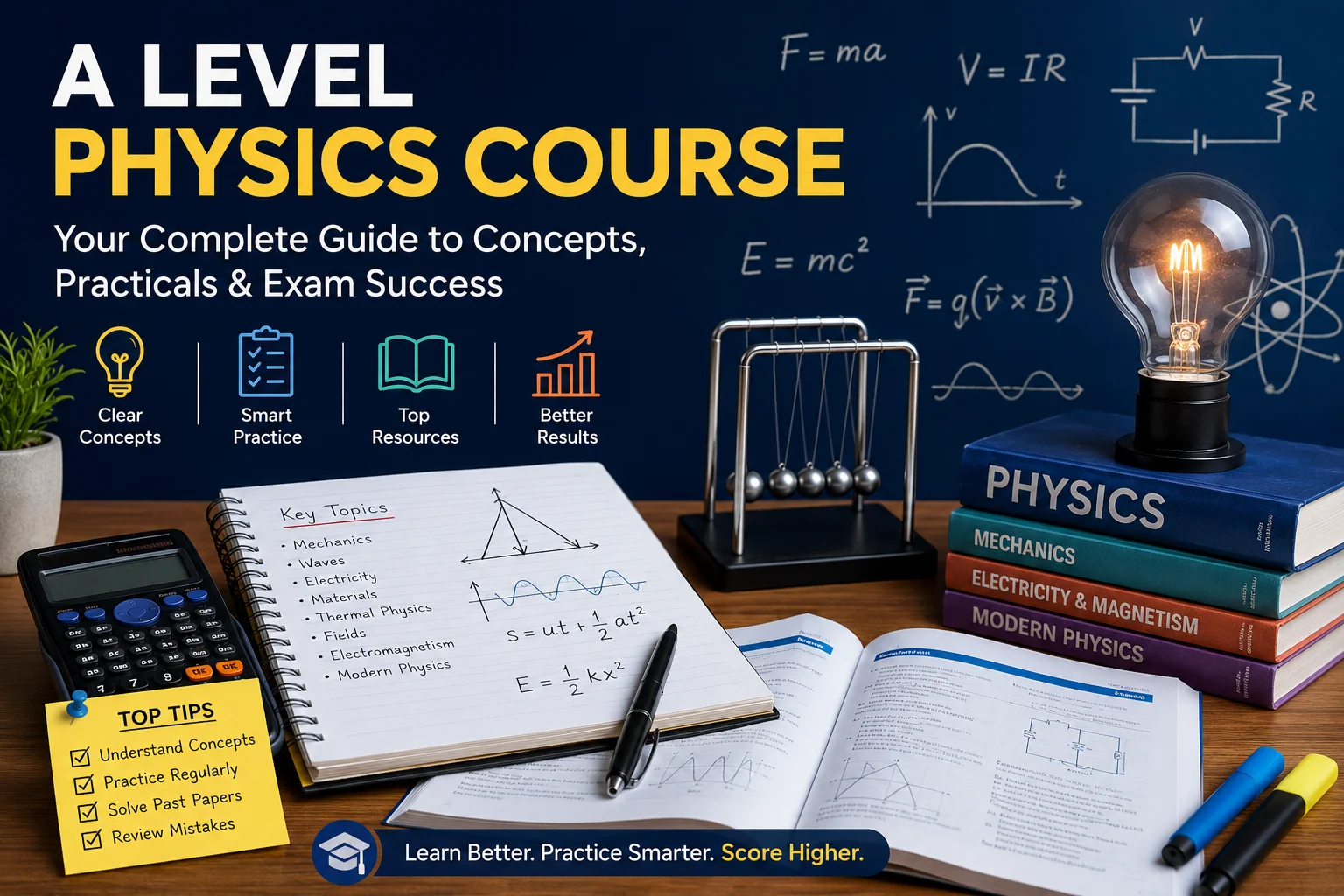
A Level Physics Course: Your Complete Guide to Learning Physics and Achieving Better Grades
Physics explains some of the most fascinating things around us. It tells us why objects move, how electricity flows, how waves travel, why planets remain in orbit, how electromagnetic devices work and what happens inside atoms. For students interested in engineering, medicine, computer science, mathematics, astronomy or other STEM fields, Physics can provide an excellent academic foundation.
However, succeeding in Physics requires more than remembering equations. Students need to understand concepts, apply mathematical relationships, interpret graphs, solve unfamiliar problems and evaluate experimental evidence.
That is why choosing a structured A Level Physics Course can make the learning process considerably easier. A good course should connect theory with practical work and examination practice rather than treating each chapter as an isolated collection of formulas.
Quality Notes focuses on Cambridge AS and A Level Physics preparation and provides online A Level Physics Course, recorded lessons, revision resources, topical past papers and solved examination questions. Its resources are designed to help students build understanding and then turn that understanding into examination performance.
What Topics Are Covered in an A Level Physics Course?
A comprehensive A Level Physics Course covers a broad range of classical and modern Physics. The exact order and content depend on the examination board, so students should always use their official syllabus as the final reference.
For Cambridge International Physics 9702, students study areas that develop from fundamental measurements and mechanics into electricity, waves, fields, electromagnetism and modern Physics.
How Difficult Is an A Level Physics Course?
An A Level Physics Course can be challenging, but difficulty does not mean that only naturally gifted students can succeed.
The main challenge is that Physics requires several abilities at once.
Mathematical Application
Students need to rearrange equations, work with units, interpret graphs, handle powers of ten and perform multi-step calculations.
Conceptual Understanding
Knowing an equation is not enough. You must understand what the equation represents and when it applies.
Application to New Situations
Examiners can present familiar Physics in unfamiliar contexts. Students therefore need to transfer their knowledge rather than recognize memorized questions.
Practical Reasoning
Students need to understand how measurements are taken, how uncertainties affect results and how experiments can be improved.
Examination Technique
Even students with strong knowledge can lose marks if they fail to show working, misread command words or provide explanations that are too vague.
The good news is that all of these skills can be developed through deliberate practice.
Where to Get Help With Difficult Physics Concepts
Some areas naturally require more explanation and practice.
Students commonly struggle with topics such as:
- Circular motion
- Electric fields
- Capacitors
- Electromagnetic induction
- Simple harmonic motion
- Quantum Physics
- Nuclear Physics
- Complex circuit calculations
When a concept remains unclear, do not repeatedly read the same paragraph and hope it suddenly makes sense.
Try a different approach.
Draw a diagram. Watch a worked explanation. Use a simpler example. Explain the concept to somebody else. Then attempt a question.
Recorded lessons are particularly useful because students can pause and replay difficult explanations.
Quality Notes offers recorded AS and A Level Physics lessons together with workbooks, revision notes, topical previous papers and solved questions. We also explains through our recorded resource bundles cover the relevant course material. At the same time, practical Paper 3 requires access to laboratory equipment. (AS & A-Level Physics)
Which A Level Physics Course Revision Resources Are Actually Worth Using?
A good A Level Physics Course should not depend on one type of resource.
The strongest preparation combines several tools.
| Resource | How It Helps |
|---|---|
| Official Syllabus | Defines the required content and assessment objectives |
| Class Notes | Builds initial understanding of key Physics concepts |
| Revision Notes | Makes reviewing important topics faster and easier |
| Formula Sheet | Supports quick recall and correct use of equations |
| Worked Examples | Demonstrates step-by-step problem-solving methods |
| Topical Questions | Builds confidence in individual Physics topics |
| Past Papers | Develops examination technique and time management |
| Mark Schemes | Shows how answers are assessed and where marks are awarded |
| Practical Resources | Develops experimental, data-analysis and evaluation skills |
| Recorded Lessons | Allows difficult explanations to be paused, replayed, and revisited |
Quality Notes offers best A Level Physics Course with several of these resources in one learning environment. Its resource packs include revision notes and solved past-paper questions. At the same time, its topical workbooks organize questions according to topic and difficulty.
Why Quality Notes Can Be a Useful Study Partner
For students who want additional support, Quality Notes provides a Cambridge-focused Physics, A Level Physics Course learning environment with online and in-person tuition, recorded lessons, revision materials and examination resources.
Our A Level Physics Course program as combining expert-led teaching with comprehensive study materials. It also offers flexible learning options, including online lessons and access to recorded classes.
Its resource library includes AS and A Level revision notes, solved past papers, topical workbooks and dedicated Paper 5 preparation. The materials are designed to help students progress from basic understanding toward examination-level problem solving.
For students who learn best by watching explanations, Quality Notes also provides recorded lessons covering A Level Physics papers and accompanying resource bundles.
The important advantage is that students can combine different learning methods instead of relying entirely on one textbook or one revision technique.
Frequently Asked Questions
Is A Level Physics harder than GCSE Physics?
It is generally more demanding because the mathematics, conceptual depth, practical reasoning and examination questions are more advanced. However, students who develop strong foundations and practice consistently can make the transition successfully.
Do I need strong mathematics for Physics?
You need to be comfortable with algebra, rearranging equations, graphs, units and other mathematical techniques required by your syllabus. You do not need to know everything perfectly at the beginning; these skills improve through practice.
How often should I solve Physics questions?
Regularly. Ideally, solve questions after learning each topic and continue revisiting older topics so that knowledge remains active.
Should I use past papers from the beginning?
Topical past-paper questions can be used early in your studies. Full timed papers are generally more useful once you have covered enough of the syllabus to attempt them meaningfully.
How can I remember Physics formulas?
Understand what each formula represents and practice applying it. Repeated use in different situations is usually more effective than repeatedly copying equations onto a page.
Are practical experiments important for A Level Physics?
Yes. Practical work develops measurement, data analysis, evaluation and experimental reasoning skills. For Cambridge Physics, practical assessment is an important component of the qualification.
What should I do if I keep getting the same questions wrong?
Create an error log, identify the underlying weakness, review the relevant concept and then solve several similar questions before moving on.
Are online Physics lessons useful?
They can be very useful when they provide clear explanations and allow students to revisit difficult material. They work particularly well when combined with active question practice rather than being used as passive video watching.
Final Thoughts
The most successful Physics students are not necessarily those who memorize the most formulas. They are the students who understand what the formulas mean, know when to use them, practice unfamiliar problems, learn from mistakes and develop practical and examination skills alongside theoretical knowledge.
A well-structured A Level Physics Course can provide the framework for developing all of these abilities. Start by understanding the syllabus, build your foundations carefully, practice numerical questions regularly, use topical past papers, prepare for practical work and gradually move toward timed examination papers.
Most importantly, do not wait until the final months to discover your weaknesses.
Find them early and work on them systematically.
For students who want extra guidance for A Level Physics Course, Quality Notes is a strong resource to consider. Its combination of Physics tuition, recorded lessons, revision notes, topical past papers, solved questions and practical preparation gives students multiple ways to strengthen their understanding and prepare for examinations.
Visit Quality Notes to explore our A Level Physics Course, learning resources and find the support that matches your preparation needs. Whether you are building your foundations, struggling with difficult numerical problems, revising for practical papers or preparing for final examinations, structured practice and consistent guidance can make Physics more manageable and help you approach your exams with much greater confidence.