
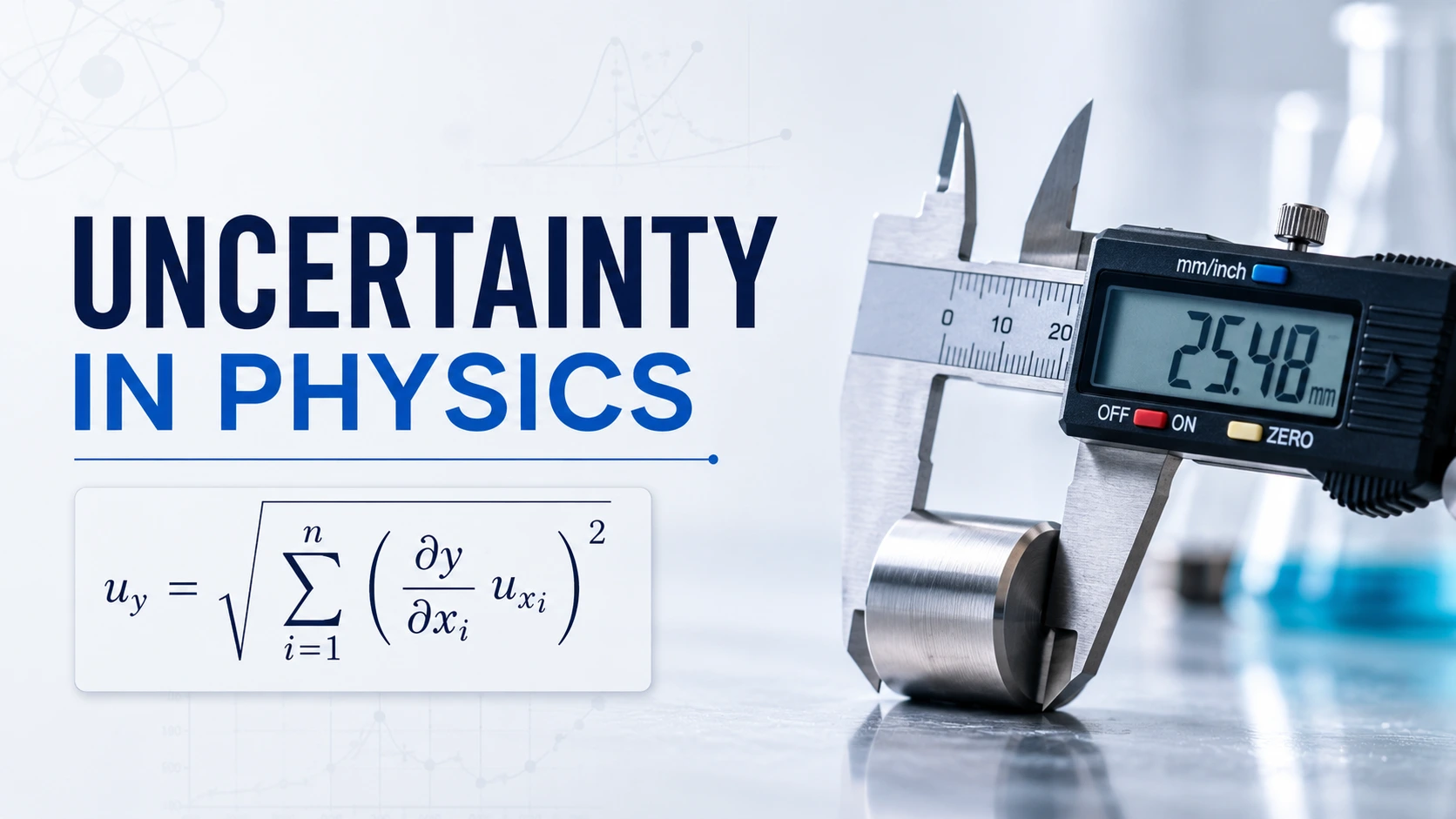
Uncertainty in Physics: How to Calculate, Combine, and Avoid Mistakes
Every measurement made in a physics experiment carries some degree of imperfection. No ruler, stopwatch, or voltmeter gives a perfectly exact reading — there is always a margin of doubt around every recorded value. This margin is what physicists call uncertainty in physics, and understanding it is not optional for CIE 9702 students. It is a core skill tested directly in Paper 2, Paper 3, and Paper 5, and it runs through every practical topic in the syllabus.
Students who master uncertainty in physics early gain a significant advantage — not just in practical papers, but in the structured questions where examiners ask them to calculate, combine, and interpret uncertainties in derived quantities. This guide covers everything from definitions and rules through to fully worked examples and the most common mistakes identified in CIE examiner reports from 2018 to 2025.
Errors vs Uncertainty in Physics: The Distinction Matters
Before calculating uncertainty in physics, it is essential to understand the difference between errors and uncertainties — two terms that students frequently confuse.
Errors are the difference between a measured value and the true value of a quantity. Errors come in two types:
Random errors cause unpredictable fluctuations in readings — sometimes too high, sometimes too low. They scatter measurements around the true value. Random errors affect precision — the degree of agreement between repeated measurements. They can be reduced by repeating measurements and calculating the mean.
Systematic errors shift all readings consistently in one direction — always too high or always too low by the same amount. A zero error on a micrometer screw gauge is a classic systematic error. Repeating measurements does not reduce systematic errors — the instrument fault must be identified and corrected. Systematic errors affect accuracy — how close the mean result is to the true value.
Uncertainty is the quantitative expression of the doubt in a measurement. It is not the same as error — uncertainty is an estimate of the range within which the true value is expected to lie. A measurement reported as (25.4 ± 0.1) cm means the true value is expected to fall between 25.3 cm and 25.5 cm.
The CIE mark scheme distinguishes these definitions precisely. Confusing accuracy with precision, or error with uncertainty, costs marks in definitions questions in Paper 2 and Paper 5.
Three Types of Uncertainty in Physics
Uncertainty in physics is expressed in three forms, each with a specific use in calculations.
1. Absolute Uncertainty
Absolute uncertainty is expressed in the same unit as the measured quantity. It represents the fixed margin of doubt around a measurement.
Example: length = (12.4 ± 0.1) cm
The absolute uncertainty here is 0.1 cm. When a single reading is taken from an analogue instrument, the absolute uncertainty is typically ± half the smallest scale division. For a ruler with 1 mm divisions, the absolute uncertainty of a single reading is ± 0.5 mm.
For a measurement obtained as the difference between two readings (such as measuring the length of an object using a ruler where you record both the start and end positions), the absolute uncertainty doubles — ± 1 mm — because two readings each contribute ± 0.5 mm.
For repeated measurements, the absolute uncertainty is taken as ± half the range: Δx = (x_max − x_min) / 2
2. Fractional Uncertainty
Fractional uncertainty expresses the absolute uncertainty as a fraction of the measured value. It is dimensionless:
Fractional uncertainty = Δx / x
Example: If length = (12.4 ± 0.1) cm, fractional uncertainty = 0.1 / 12.4 = 0.0081
3. Percentage Uncertainty
Percentage uncertainty converts the fractional uncertainty into a percentage:
Percentage uncertainty = (Δx / x) × 100%
Example: (0.1 / 12.4) × 100% = 0.81%
Percentage uncertainty and fractional uncertainty are the forms used when combining uncertainties in multiplication, division, and powers — the most important calculation rules in uncertainty in physics for CIE 9702.
For structured practice on all three forms and every combination rule, the free topical past paper workbooks at Quality Notes include past paper questions on uncertainties organised by topic and difficulty.
The Four Rules for Combining Uncertainties
This is the heart of uncertainty in physics at A Level — and the area where most marks are lost in Paper 3 and Paper 5.
Rule 1: Addition and Subtraction — Add Absolute Uncertainties
When two quantities are added or subtracted, the absolute uncertainties are added.
If z = x + y or z = x − y: Δz = Δx + Δy
Example: L₁ = (15.5 ± 0.1) cm, L₂ = (10.0 ± 0.1) cm Extension E = L₂ − L₁ = 5.5 cm ΔE = 0.1 + 0.1 = 0.2 cm Result: E = (5.5 ± 0.2) cm
Critical point: uncertainties always add — never subtract — regardless of whether the operation is addition or subtraction. This surprises students who expect subtraction to cancel uncertainties.
Rule 2: Multiplication and Division — Add Percentage Uncertainties
When two quantities are multiplied or divided, their percentage (or fractional) uncertainties are added.
If z = x × y or z = x / y: %Δz = %Δx + %Δy
Example: Force F = (10.0 ± 0.5) N → %ΔF = 5% Area A = (2.0 ± 0.2) m² → %ΔA = 10% Pressure P = F / A = 5.0 Pa %ΔP = 5% + 10% = 15% ΔP = 15% × 5.0 = 0.75 Pa Result: P = (5.0 ± 0.8) Pa (rounded to 1 sig fig on uncertainty)
Rule 3: Powers — Multiply Percentage Uncertainty by the Power
When a quantity is raised to a power n, the percentage uncertainty is multiplied by n.
If z = xⁿ: %Δz = n × %Δx
Example: Radius r = (3.0 ± 0.1) cm → %Δr = 3.33% Volume V = (4/3)πr³ %ΔV = 3 × 3.33% = 10%
This rule applies equally to fractional powers (square roots): if z = x^(1/2), then %Δz = ½ × %Δx.
Rule 4: Constants and Exact Numbers — No Uncertainty Contribution
Pure numbers, mathematical constants (π, 4/3), and exact conversion factors do not contribute any uncertainty in physics calculations. Only measured quantities carry uncertainty.
Worked Exam-Style Example: Multi-Step Uncertainty
A student measures the following quantities to calculate the resistance R of a component using R = V / I:
- Voltage V = (6.0 ± 0.3) V
- Current I = (0.25 ± 0.01) A
Step 1: Calculate R. R = V / I = 6.0 / 0.25 = 24 Ω
Step 2: Find percentage uncertainties. %ΔV = (0.3 / 6.0) × 100% = 5% %ΔI = (0.01 / 0.25) × 100% = 4%
Step 3: Add percentage uncertainties (division rule). %ΔR = 5% + 4% = 9%
Step 4: Calculate absolute uncertainty in R. ΔR = 9% × 24 = 2.16 ≈ 2 Ω (rounded to 1 significant figure)
Final answer: R = (24 ± 2) Ω
The CIE mark scheme requires the uncertainty to be expressed to 1 significant figure, and the main value rounded to match the same decimal place as the uncertainty. Both conditions must be met for full marks.
Uncertainty in Physics on Graphs: Paper 3 and Paper 5
Uncertainty in physics appears in a different form in practical papers — as error bars on graphs. Error bars represent the absolute uncertainty in each plotted point and are drawn symmetrically above and below (or either side of) each data point.
In Paper 3, students are required to:
- Draw error bars on plotted points based on given or calculated absolute uncertainties
- Draw a line of best fit that passes through or close to all error bars
- Draw a worst acceptable line (steepest or shallowest line that still passes through all error bars)
- Calculate the uncertainty in the gradient: Δgradient = (gradient of best fit − gradient of worst line)
The uncertainty in the gradient is one of the most frequently dropped marks in Paper 3. Students often draw the line of best fit correctly but then fail to draw a worst acceptable line or calculate the gradient uncertainty.
For expert-guided walkthroughs of every Paper 3 and Paper 5 skill including uncertainty on graphs, recorded lessons at Quality Notes cover these practical techniques with worked exam examples from real CIE past papers.
Common Mistakes in Uncertainty in Physics
Adding absolute uncertainties when multiplying quantities. This is the most common rule error in CIE 9702. When multiplying or dividing, percentage uncertainties must be added — not absolute ones. Mixing up the rules loses marks on almost every multi-step uncertainty question.
Rounding uncertainty to too many significant figures. Uncertainties should be expressed to 1 significant figure (occasionally 2). Reporting an uncertainty as ± 2.16 Ω instead of ± 2 Ω indicates a misunderstanding of the precision of the estimate itself.
Not matching the decimal places of value and uncertainty. If the uncertainty is ± 2 Ω, the main value must be rounded to the same place — 24 Ω, not 24.0 Ω. Mismatched precision is penalised in CIE mark schemes.
Treating systematic errors as reducible by repetition. Repeated measurements reduce random errors by averaging, but have no effect on systematic errors. Confusing these in Paper 5 explanation questions costs marks every time.
Forgetting to double the uncertainty for a measurement using two readings. If both ends of an object are read from a ruler, both readings carry uncertainty. The total absolute uncertainty in the length is the sum of both — twice the single-reading uncertainty.
According to analysis of CIE 9702 examiner reports from 2018 to 2025, the inability to handle uncertainty in physics propagation correctly is one of the top three recurring errors across all practical papers — making this one of the highest-return topics to master thoroughly before exam day.
For personalised support on uncertainty calculations and practical exam technique, students counselling at Quality Notes helps students identify their specific gaps and build a targeted plan to fix them.
People Also Ask About Uncertainty in Physics
What is uncertainty in physics?
Uncertainty in physics is the quantitative expression of the doubt in a measurement — the range within which the true value is expected to lie. It is distinct from error: error is the deviation from the true value, while uncertainty is the estimated margin around a measurement. It is expressed as absolute, fractional, or percentage uncertainty.
What is the difference between absolute and percentage uncertainty?
Absolute uncertainty has the same unit as the measured quantity and gives the fixed margin of doubt (e.g. ± 0.1 cm). Percentage uncertainty expresses this margin as a percentage of the measured value (e.g. 0.81%). Percentage uncertainty is used when combining measurements through multiplication, division, or powers.
How do you combine uncertainties when multiplying quantities?
When multiplying or dividing two measured quantities, add their percentage (or fractional) uncertainties. For example, if force has 5% uncertainty and area has 10% uncertainty, the pressure calculated from P = F/A has 15% percentage uncertainty.
What is the rule for uncertainty with powers?
When a quantity is raised to a power n, multiply its percentage uncertainty by n. For a volume calculated from V = (4/3)πr³, the percentage uncertainty in V is three times the percentage uncertainty in r.
How do you find uncertainty from repeated measurements?
The absolute uncertainty from repeated measurements is ± half the range of the recorded values: Δx = (x_max − x_min) / 2. The mean of the measurements is used as the best estimate of the true value.
What is the difference between random and systematic error?
Random errors cause unpredictable scatter in measurements and affect precision — they can be reduced by repeating and averaging. Systematic errors shift all readings consistently in one direction and affect accuracy — they must be eliminated by identifying and correcting the instrument fault or experimental design issue.
Conclusion
Uncertainty in physics is not a standalone topic confined to Chapter 1 of the 9702 syllabus. It reappears in every practical experiment, every Paper 3 graph, every Paper 5 analysis question, and every multi-step calculation where measured quantities are combined. Students who master the four combination rules, apply them consistently, and present uncertainties in the correct format pick up marks across every paper — not just in dedicated uncertainty questions.
The rules are straightforward once practised with real exam questions. Learn them precisely, apply them systematically, and the marks follow.
When you get help from Mr. Adeel Chowhan, who is known as the best online physics teacher in Pakistan, you can’t do better in your studies. Go to Quality Notes right now to get a free trial class, for further access to structured topical past papers, lessons taught by experts, and all the tools you need to get the best grades.