
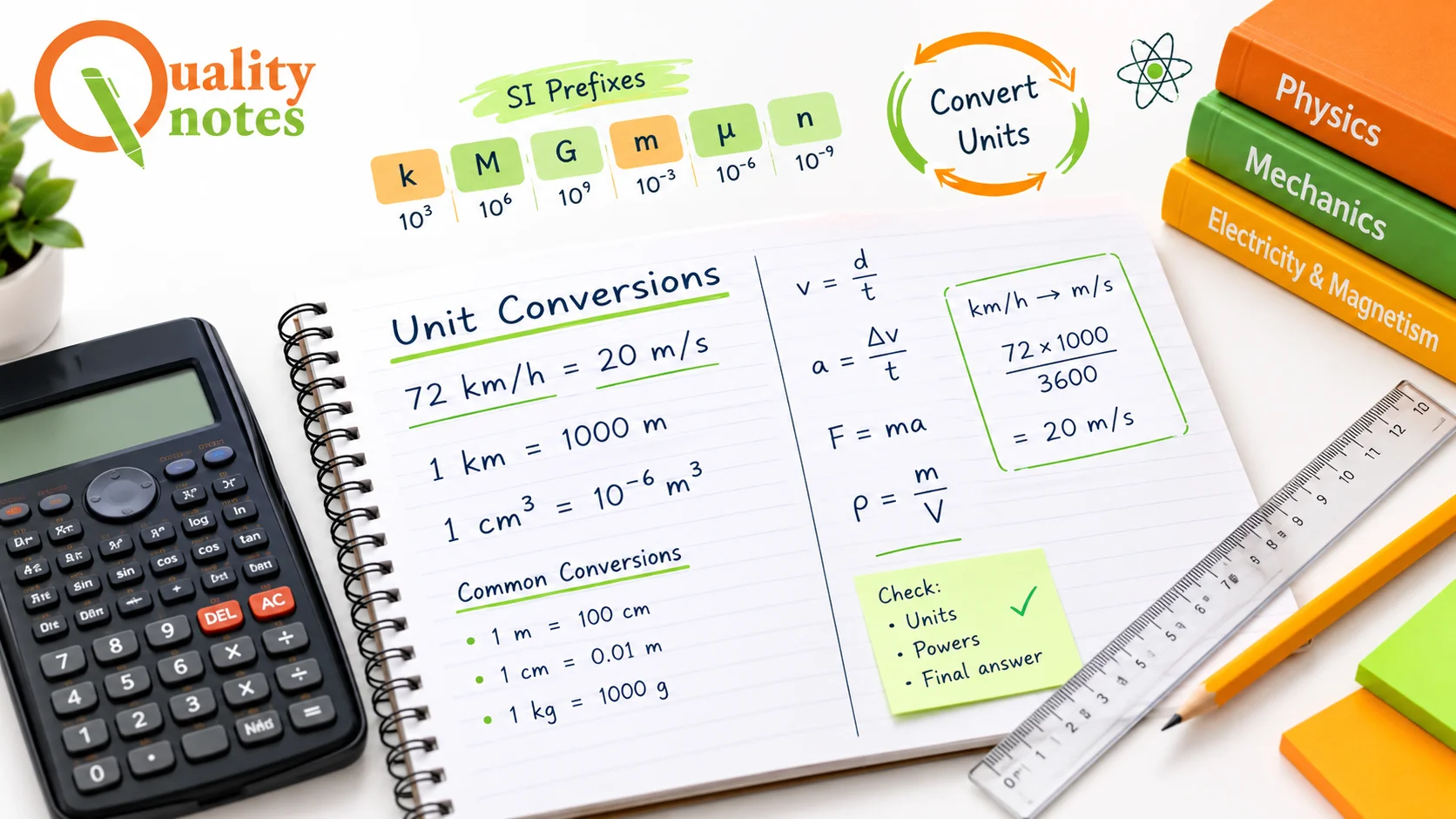
How to Convert Units Correctly in A Level Physics
Physics unit conversion is an essential skill in A Level Physics. Whether you are calculating Speed, acceleration, force, energy or electrical quantities, you must use the correct units to obtain an accurate answer. Even with the right formula, a small conversion error can lead to an incorrect result.
Understanding physics unit conversion helps you recognize SI units, work confidently with prefixes, convert between different measurements and present answers clearly in examinations. The key is to understand what each prefix means and how changing a unit affects a measurement’s numerical value.
This guide explains the methods step by step for physics unit conversion, with useful conversion tables, worked examples and practical exam advice. If you need more support with physical quantities and SI units, Quality Notes also provides educational physics guides to help you strengthen your understanding about physics unit conversion.
What Is Physics Unit Conversion?
Physics unit conversion means expressing the same physical quantity using a different unit. The quantity itself does not change; only the way it is measured changes.
For example:
- 1 kilometre = 1,000 metres
- 1 kilogram = 1,000 grams
- 1 second = 1,000 milliseconds
- 1 hour = 3,600 seconds
A distance of 2 km and a distance of 2,000 m represent the same length.
In A Level Physics, conversions are important because questions may provide data in different units. You need to identify whether the supplied values suit the equation you intend to use.
The most reliable approach to physics unit conversion is to write down the relationship between the units before changing the numerical value. This reduces guesswork and makes your working easier to check.
Why Correct Physics Unit Conversion Matter in A Level Physics
Units are part of every physical measurement. A numerical answer without its unit is often incomplete because the unit tells the reader what the number represents.
Consider the equation for Speed:
Speed = Distance ÷ Time
Measured meters in distance and seconds in time, speed is computed in meters per second (m/s).
However, if distance is given in kilometers and time in minutes, the answer will initially be in kilometers per minute unless you convert the values first.
Correct physics unit conversion is particularly important when working with:
- Motion, Speed, velocity and acceleration
- Forces, momentum and energy
- Electrical charge, current and potential difference
- Waves, frequency and time period
- Density, pressure and volume
- Experimental measurements and uncertainties
For students following Cambridge International A Level Physics, SI units, derived units and prefixes form part of the physical quantities and units content. The Cambridge syllabus also advises students to use consistent units and avoid unnecessary conversions when the supplied units are already suitable.
Learning these principles early makes later topics much easier.
Understanding SI Units and Prefixes
System of Units (SI) defines a standard foundation for measuring physical quantities. Many A Level Physics calculations use SI units, so you should be comfortable recognizing their symbols.
Common SI Units in Physics
|
Physical Quantity |
SI Unit |
Symbol |
|---|---|---|
|
Length |
meter |
m |
|
Mass |
kilogram |
kg |
|
Time |
second |
s |
|
Electric current |
ampere |
A |
|
Temperature |
kelvin |
K |
|
Force |
newton |
N |
|
Energy |
joule |
J |
|
Power |
watt |
W |
|
Electric charge |
coulomb |
C |
|
Frequency |
hertz |
Hz |
Some units, such as the newton and joule, are derived from combinations of base units. For example, 1 newton equals kg m s⁻².
SI Prefixes You Must Know
Prefixes represent powers of ten. Memorizing the most common prefixes makes physics unit conversion quicker and more accurate.
|
Prefix |
Symbol |
Value |
|---|---|---|
|
Tera |
T |
10¹² |
|
Giga |
G |
10⁹ |
|
Mega |
M |
10⁶ |
|
Kilo |
k |
10³ |
|
Centi |
c |
10⁻² |
|
Milli |
m |
10⁻³ |
|
Micro |
μ |
10⁻⁶ |
|
Nano |
n |
10⁻⁹ |
|
Pico |
p |
10⁻¹² |
Pay close attention to capitalization. The symbols M and m represent different prefixes: mega means 10⁶, while milli means 10⁻³.
For example:
- 1 MW = 1,000,000 W
- 1 mW = 0.001 W
- 1 μs = 0.000001 s
- 1 nm = 0.000000001 m
Remember that the kilogram is already the SI base unit of mass. To convert mass from grams to kilograms, divide the number of grams by 1,000.
A Simple Method for Converting Units
You don’t need to memorize every possible conversion. Instead, follow a consistent method.
Step 1: Identify the Original and Required Units
Read the question carefully and identify the unit supplied and the unit needed.
For example, converting 450 cm to meters means changing centimeters to meters.
Step 2: Write the Conversion Relationship
Use the correct relationship:
1 m = 100 cm
This tells you how many centimeters make one meter.
Step 3: Choose the Correct Operation
Converting a small unit to a larger one, the numerical value typically drops. When converting a larger unit into a smaller unit, the numerical value usually increases.
For example:
450 cm ÷ 100 = 4.50 m
Therefore, 450 cm = 4.50 m.
Step 4: Check the Result
Ask yourself whether the answer is reasonable. A measurement of 450 cm should be greater than 4.50 cm but equal to 4.50 m.
This simple check can help you catch mistakes before moving on to the next calculation.
For a more formal method, multiply by a conversion factor arranged so that the unwanted unit cancels. For example:
450 cm × (1 m / 100 cm) = 4.50 m
The centimeter units cancel, leaving meters.
Worked Examples of Physics Unit Conversion
The best way to improve is to practice common conversions using real physics quantities.
Example 1: Converting Kilometers to Meters
Question: Convert 3.6 km into meters.
We know:
1 km = 1,000 m
Therefore:
3.6 × 1,000 = 3,600 m
Answer: 3,600 m
The numerical value increases because a kilometer is larger than a meter.
Example 2: Converting Milliseconds to Seconds
Question: Convert 25 ms into seconds.
The prefix milli means 10⁻³.
Therefore:
25 ms = 25 × 10⁻³ s
Answer: 0.025 s
This conversion is useful in experiments involving short time intervals and oscillations.
Example 3: Converting Grams to Kilograms
Question: Convert 750 g into kilograms.
Since 1 kg = 1,000 g:
750 ÷ 1,000 = 0.750 kg
Answer: 0.750 kg
This conversion is particularly useful in calculations involving force, momentum and kinetic energy, where mass is normally expressed in kilograms.
Example 4: Converting Speed from km/h to m/s
Speed conversions are among the most common challenges in mechanics.
Question: Convert 72 km/h into m/s.
First, convert kilometers into meters and hours into seconds:
72 km/h = 72 × 1,000 m / 3,600 s
Therefore:
72 × 1,000 ÷ 3,600 = 20 m/s
Answer: 20 m/s
A quick rule is to divide Speed in km/h by 3.6 to obtain Speed in m/s.
To convert from m/s to km/h, multiply by 3.6.
Example 5: Converting Microseconds to Seconds
Question: Express 8 μs in seconds.
The micro prefix means 10⁻⁶.
8 μs = 8 × 10⁻⁶ s
Answer: 0.000008 s
Standard form is often the clearest way to present very small quantities because it reduces the risk of miscounting zeros.
Converting Compound Units
Compound units combine two or more units through multiplication, division or powers. They require extra care because you must convert each unit correctly.
For example, acceleration is measured in m/s², while density is measured in kg/m³.
Converting Acceleration
Suppose an acceleration is given as 36 km/h² and needs to be expressed in m/s².
First, convert the distance unit:
1 km = 1,000 m
Then convert the squared time unit:
1 h² = (3,600 s)² = 12,960,000 s²
Therefore:
36 km/h² = (36 × 1,000) / 12,960,000 m/s²
Answer: approximately 0.00278 m/s²
The important point is that the time conversion factor must also be squared.
Converting Density
Density is calculated using:
Density = Mass ÷ Volume
Suppose a material has a density of 2 g/cm³. Convert this to kg/m³.
First, convert the mass:
1 g = 10⁻³ kg
Next, convert the volume:
1 cm³ = (10⁻² m)³ = 10⁻⁶ m³
Therefore:
2 g/cm³ = (2 × 10⁻³ kg) / (10⁻⁶ m³)
Answer: 2,000 kg/m³
This example shows why you can’t convert cubed units using the length conversion factor alone. The factor must be raised to the third power.
Common Physics Unit Conversion Mistakes
Students often understand the physics but lose accuracy because of avoidable conversion errors.
|
Common Mistake |
Why It Is a Problem |
How to Avoid It |
|---|---|---|
|
Multiplying instead of dividing |
Produces an incorrect magnitude |
Write the conversion relationship first. |
|
Confusing milli and mega |
Changes the value by a factor of 10⁹ |
Learn prefix symbols and capitalisation. |
|
Forgetting to square a factor |
Gives an incorrect area or squared-time conversion |
Apply the power to the entire conversion factor. |
|
Forgetting to cube a factor |
Gives an incorrect volume conversion |
Cube the length factor. |
|
Mixing units in an equation |
Can make the calculation inconsistent |
Check that all quantities use compatible units. |
|
Rounding too early |
Can reduce the accuracy of the final answer |
Keep extra digits until the final step. |
|
Omitting the final unit |
Leaves the physical answer incomplete |
Include the correct unit with the result. |
Another common error is converting values that do not need conversion. If a question provides compatible SI units, you can often substitute them directly. Always follow the specific instructions in the question.
How to Avoid Conversion Errors in Exams
A reliable examination routine can improve both accuracy and presentation.
1. Underline the units in the question. This helps you notice when quantities are expressed using different prefixes.
2. Write down the equation. Identify which quantities you need before substituting values.
3. Convert values before calculating when necessary. For example, convert grams to kilograms if the equation requires mass in kilograms.
4. Keep your working visible. Showing the conversion factor makes errors easier to spot and lets the examiner follow your method.
5. Check the dimensions. For example, force should have the dimensions kg m s⁻². If your result has the dimensions of Speed, revisit your calculation.
6. Check the order of magnitude. A automobile travelling at 20 m/s is going 72 km/h. If your conversion gives 7,200 m/s, you should check your working.
7. Use sensible significant figures. Keep enough digits during intermediate calculations and round the final result appropriately.
For further revision, Quality Notes explains physical quantities, SI units and related A Level Physics concepts. Reviewing these fundamentals alongside worked examples can help you build a consistent approach to examination calculations.
Frequently Asked Questions
1. What is the easiest way to convert units in A Level Physics?
Identify the original and required units, write the conversion relationship and multiply or divide by the appropriate factor. Check the result before using it in an equation.
2. How do I convert km/h to m/s?
Divide the speed in km/h by 3.6. For example, 90 km/h divided by 3.6 equals 25 m/s.
3. Which SI prefixes should A Level Physics students memorize?
Start with kilo (10³), mega (10⁶), milli (10⁻³), micro (10⁻⁶), nano (10⁻⁹) and pico (10⁻¹²). Check your exam board’s specification for the complete required list.
4. Do I always need to convert values into SI units?
Not always. Use consistent units that suit the equation and follow the question’s instructions. SI units are widely used in A Level Physics, but some questions may permit other compatible units.
5. How do I convert cm² and cm³ into m² and m³?
For area, square the length factor: 1 cm² = 10⁻⁴ m². For volume, Cube it: 1 cm³ = 10⁻⁶ m³.
Conclusion
Accurate physics unit conversion is a foundation of success in A Level Physics. By learning SI prefixes, writing conversion factors correctly and paying attention to squared and cubed units, you can avoid many common calculation errors. Practice converting familiar quantities such as distance, mass, time, Speed and density until the process becomes automatic.
The best way to improve your confidence is to combine clear explanations with regular problem-solving. Contact Quality Notes for more educational physics guides, revision support and explanations of essential topics. With consistent practice and a careful approach to units, you can make your physics calculations more accurate and easier to follow.