
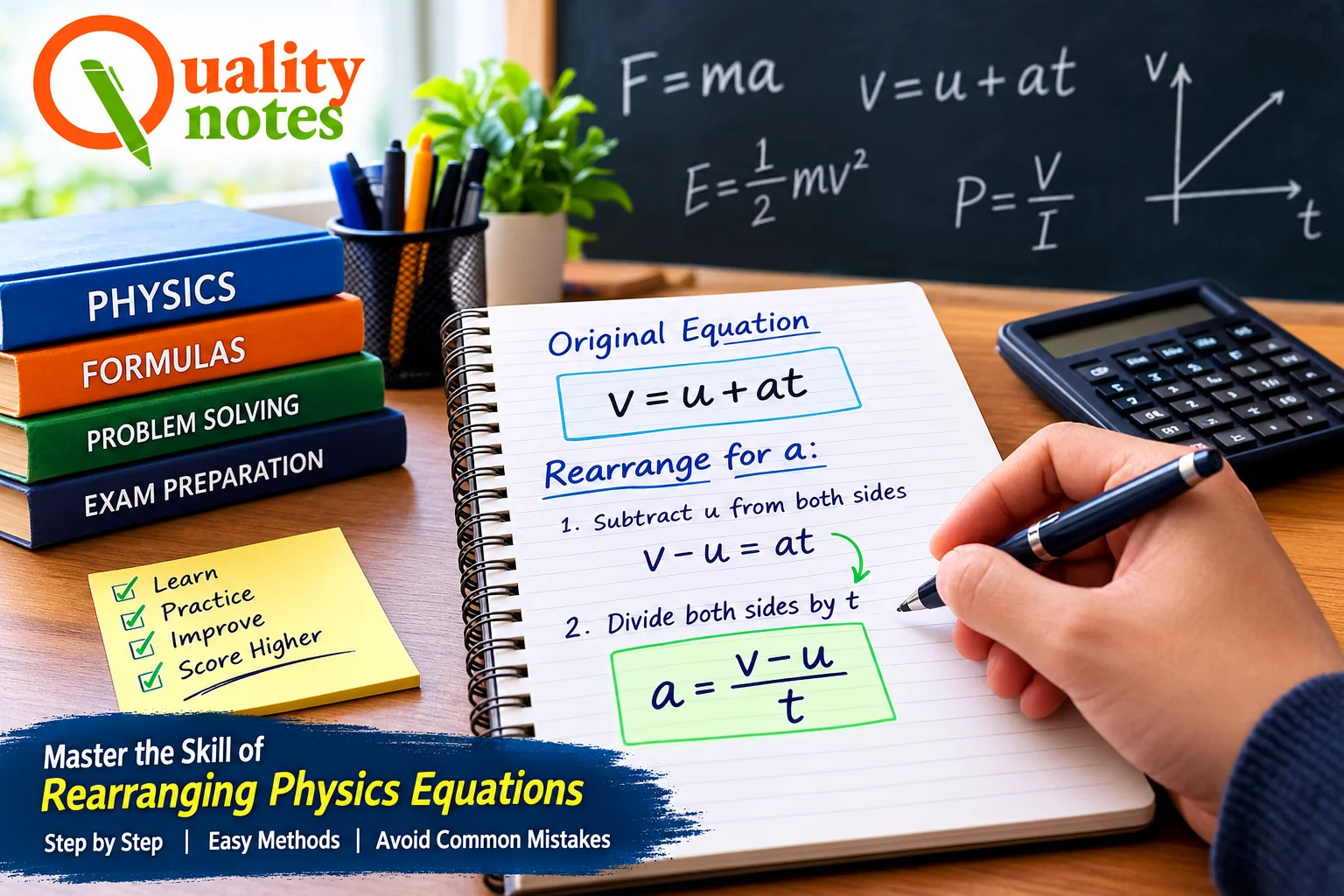
How to Rearrange Physics Equations Without Making Mistakes
Physics equations are useful because they describe relationships between physical quantities. However, knowing an equation is only part of solving a problem. You also need to use algebra correctly when the quantity you need is not already isolated.
For example, you may know the equation:
v = u + at
but the question may ask you to calculate acceleration, a, rather than final velocity, v.
This is where rearranging physics equations becomes an important skill. Instead of memorizing a different version of every equation, you can learn a reliable method for changing the subject of a formula.
The good news is that the process is usually simpler than it first appears. You are using the same algebra rules you learned for solving equations. The main principle is to perform the same valid operation on both sides of the equals sign.
Students studying IGCSE, GCSE, AS Level, A Level and similar physics courses can use this method to build confidence with calculations.
What Does Rearranging physics equations Mean?
Rearranging physics equations means changing an equation so that a different variable becomes the subject.
The subject is the quantity that has been isolated on one side of the equals sign.
For example:
v = u + at
Here, v is the subject.
If you need to calculate a, the equation can be changed to:
a = (v − u) / t
The physical relationship has not changedonly the mathematical form changes so you can calculate the required quantity directly.
This is sometimes called changing the subject of a formula, transposing a formula or rearranging a formula.
Why Rearranging Physics Equations Skill Important?
Many physics questions do not give you an equation with the required quantity already on its own.
For example:
- You may need to find force when acceleration and mass are given.
- Time may be required when distance and speed are known.
- Resistance may be required when voltage and current are provided.
- Acceleration may be required when initial and final velocities and time are known.
- Wavelength may be required when wave speed and frequency are given.
If you cannot manipulate the equation correctly, you may lose marks even when you understand the physics behind the question.
This is why you should treat rearranging physics equations as a core physics calculation skill rather than just an algebra exercise.
The Golden Rule for Rearranging Physics Equations
The most important rule is:
Whatever mathematical operation you perform on one side of an equation must also be performed on the other side.
Think of an equation as a balanced scale. If you subtract something from one side, you must subtract it from the other side. If you divide one side by a number, you must divide the other side by the same number.
For example:
v = u + at
To remove u from the right side, subtract u from both sides:
v − u = at
Now divide both sides by t:
(v − u) / t = a
Therefore:
a = (v − u) / t
This method is much safer than moving symbols mentally without showing your working.
A Simple Step-by-Step Method
Use the following process whenever you need to rearrange an equation.
1. Identify the Quantity You Need
Read the question carefully.
Ask:
What quantity am I trying to calculate?
If the question asks for acceleration, identify a as the target.
Do not start manipulating the equation before you know exactly what you are trying to isolate.
2. Write the Original Equation
Always begin with the correct equation.
For example:
v = u + at
Writing the original equation reduces the chance of accidentally changing the formula.
3. Find Everything Attached to the Target
Look at how the required variable is connected to other terms.
In:
v = u + at
The acceleration a is multiplied by t, while the whole term at is added to u.
You therefore need to remove these operations in the correct order.
4. Undo Operations in Reverse Order
Use inverse operations.
| Operation | Inverse Operation |
|---|---|
| Addition (+) | Subtraction (−) |
| Subtraction (−) | Addition (+) |
| Multiplication (×) | Division (÷) |
| Division (÷) | Multiplication (×) |
| Squaring (²) | Square root (√) |
| Square root (√) | Squaring (²) |
The key idea is to undo the outermost operation first.
For example:
v = u + at
First remove u:
v − u = at
Then remove t by dividing:
a = (v − u) / t
5. Check Your Final Equation
Before substituting numbers, look at your answer.
Ask:
- Is the required variable alone?
- Have I accidentally changed a sign?
- Have I divided the entire expression correctly?
- Are brackets needed?
- Do the units make sense?
A quick check can catch many algebra errors before they affect the numerical answer.
Worked Example 1: Finding Acceleration
Consider:
v = u + at
Make a the subject.
Start:
v = u + at
Subtract u from both sides:
v − u = at
Divide both sides by t:
(v − u) / t = a
Therefore:
a = (v − u) / t
Suppose:
- v = 20 m/s
- u = 5 m/s
- t = 3 s
Then:
a = (20 − 5) / 3
a = 5 m/s²
This rearrangement lets you use the known values directly.
Worked Example 2: Finding Time
Start with:
v = u + at
This time, make t the subject.
Subtract u:
v − u = at
Now divide by a:
t = (v − u) / a
Notice that the steps are almost identical. The only difference is which variable you need to isolate.
This shows why understanding the method is more useful than memorizing every possible version of an equation.
Worked Example 3: Rearranging a Fraction
Consider the power equation:
P = E / t
Suppose you need to find energy, E.
Multiply both sides by t:
Pt = E
Therefore:
E = Pt
Now suppose you need time instead.
Start with:
P = E / t
Multiply by t:
Pt = E
Then divide by P:
t = E / P
You can therefore use the same original equation to find different quantities.
Worked Example 4: When the Variable Is Squared
Some equations are slightly more challenging because the required quantity is raised to a power.
Consider:
E = ½mv²
Suppose you need to find v.
First multiply both sides by 2:
2E = mv²
Now divide by m:
2E / m = v²
Take the square root of both sides:
v = √(2E/m)
The key point is not to take the square root too early. First remove the multiplication by m, then deal with the square.
This is common when rearranging physics equations, especially in mechanics and energy calculations.
Worked Example 5: A Variable Inside a Bracket
Consider:
V = IR
This equation is already simple, but some equations contain brackets.
For example:
F = k(x + a)
Suppose you need to find x.
First divide both sides by k:
F/k = x + a
Then subtract a:
x = F/k − a
The important technique is to work from the outside of the expression toward the variable you want.
Worked Example 6: Finding a Variable Under a Square Root
Consider the pendulum relationship:
T = 2π√(L/g)
Suppose you need to find g.
First divide by 2π:
T/(2π) = √(L/g)
Square both sides:
T²/(4π²) = L/g
Multiply by g:
gT²/(4π²) = L
Then rearrange for g:
g = 4π²L/T²
This type of question shows why a formula triangle alone is not always enough. A systematic algebraic method can handle equations containing powers, roots, brackets and fractions.
Common Mistakes to Avoid
Many errors happen because students try to rearrange mentally.
Moving a Term Without Changing the Operation
If:
x + 5 = y
then:
x = y − 5
The +5 becomes -5 because you subtract 5 from both sides.
Dividing Only One Part of an Expression
Suppose:
v − u = at
Dividing by t gives:
a = (v − u)/t
It does not mean:
a = v − u/t
Those are different expressions.
Brackets are important when an entire numerator is divided by the same quantity.
Changing Signs Incorrectly
Consider:
F = ma + b
To make a the subject:
F − b = ma
then:
a = (F − b)/m
Do not accidentally write F + b.
Substituting Numbers Too Early
It is usually safer to rearrange the equation first, then substitute numbers.
For example, instead of immediately inserting values into:
v = u + at
first obtain:
a = (v − u)/t
Then substitute the numbers.
This makes the algebra easier to follow and reduces confusion.
Forgetting Units
A correct-looking number can still be wrong if the units are inconsistent.
For example, if an equation requires time in seconds but the question gives minutes, convert the time before using it.
Unit checking is a powerful second layer of protection after you finish the algebra.
How to Check Whether Your Rearrangement Is Correct
There are several useful checks.
Check 1: Substitute Back
Take your rearranged equation and substitute it back into the original equation.
For example:
Original:
v = u + at
Rearranged:
a = (v − u)/t
Substituting:
v = u + t[(v − u)/t]
The t values cancel:
v = u + v − u
Therefore:
v = v
The rearrangement is consistent.
Check 2: Check the Units
Suppose:
a = (v − u)/t
Velocity has units of:
m/s
Time has units of:
s
Therefore:
(m/s) ÷ s = m/s²
That is the correct unit for acceleration.
Unit checking is particularly useful in physics because it can reveal errors that ordinary algebra checking may not immediately show.
Check 3: Think About the Physics
Ask whether the result makes physical sense.
For example, if you calculate a speed of several million meters per second for an ordinary car, something may have gone wrong with the calculation, units or interpretation of the question.
When a Formula Triangle Helps and When It Does Not
Formula triangles can help with very simple relationships involving three quantities.
For example:
v = s/t
A triangle can help you remember the relationship between speed, distance and time.
However, formula triangles become less useful when equations contain:
- several terms
- brackets
- squares
- square roots
- fractions
- multiple variables
- plus or minus signs
For these equations, proper algebra is safer.
Learning to rearranging physics equations through inverse operations gives you a method that works even when the equation gets more complicated.
How to Get Better at Rearranging Equations
Improvement comes from practicing different equation structures rather than repeatedly solving the same simple type.
Start with equations such as:
F = ma
v = u + at
P = E/t
Then practice equations containing fractions:
R = V/I
Next, practice squares:
E = ½mv²
Finally, move to equations involving brackets and square roots.
Do not focus only on getting the final answer. Write every algebraic step. Once the method becomes automatic, you can gradually become faster.
A useful revision strategy is to take one familiar physics equation and practice making every major variable the subject.
For example, from:
V = IR
derive:
I = V/R
and:
R = V/I
This helps you understand the relationship rather than memorize isolated formulas.
Final Takeaway
Rearranging physics equations is not about memorizing dozens of different versions of the same formula. It is about understanding how equations work and using inverse operations to isolate the quantity you need.
Start by identifying the unknown. Write the original equation, undo operations in reverse order and apply every operation to both sides. Then substitute values only after the algebra is complete.
Always finish by checking the units and considering whether the answer makes physical sense.
With regular practice, rearranging physics equations becomes much faster and more reliable. It can also make many physics calculations feel easier because you no longer have to remember a specially rearranged version of every formula.
For students looking for structured Physics learning resources, contact Quality Notes is a useful place to continue studying. Our Physics resources can help students build a stronger understanding of formulas, calculations, revision techniques and exam preparation across IGCSE, AS Level and A Level Physics.
The goal is not simply to remember equations. The goal is to understand how and why they work so that you can confidently use them when a question presents the information in a different form.