
Why Do Physics Students Lose Marks Even When Their Answer Is Numerically Correct?
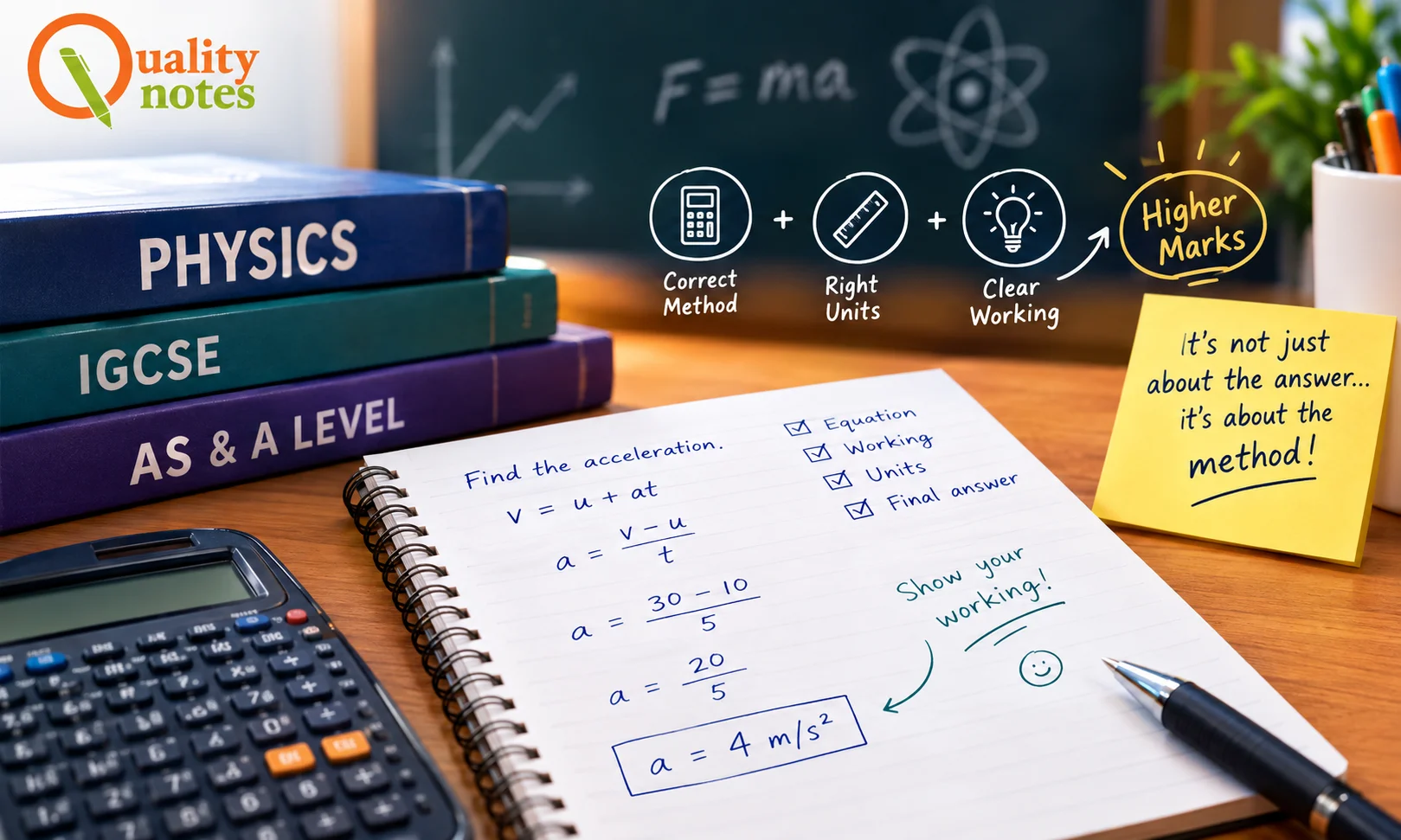
Getting the correct number in a Physics exam does not always mean getting full marks. Physics questions often test your method, units, formulas, working and explanation, not just the final calculation.
This is why physics marks lost despite correct answer is a common problem among students. A calculator can give you the right number, but examiners also need to see how you reached it.
The good news is that most lost marks come from simple, fixable mistakes.
Why Physics Marks Lost Despite Correct Answer Happens
A numerical Physics question usually involves several steps. You may need to choose an equation, substitute values, convert units, calculate the result and give the correct unit.
For example:
F = ma
If a mass of 5 kg accelerates at 3 m/s²:
F = 5 × 3 = 15 N
Writing only 15 may not show enough of your method. Writing the equation, substitution and unit makes your answer much clearer.
Common reasons for physics marks lost despite correct answer include:
| Common Mistake | Why Marks May Be Lost |
|---|---|
| No working shown | The examiner cannot clearly see your method |
| Missing units | The final answer is incomplete |
| Wrong unit conversion | The calculation uses an incorrect value |
| Incorrect formula | The equation does not match the Physics problem |
| Early rounding | Rounding too soon can affect the final result |
| Sign error | The direction or meaning of the answer may be incorrect |
| Poor explanation | The response does not fully address what the question asks |
| Incorrect substitution | Values may be placed into the formula incorrectly |
| Wrong significant figures | The final answer may have unsuitable precision |
| Misreading the question | You may solve a different problem from the one asked |
How to Prevent Physics Marks Lost Despite Correct Answer
Use a simple process for every calculation:
1. Read the question carefully.
Identify exactly what you need to find.
2. Write down the known values.
Include their units.
3. Choose the correct equation.
Do not select a formula simply because it contains familiar numbers.
4. Convert units.
For example, convert minutes to seconds or centimeters to meters when required.
5. Show your substitution.
Put the values into the equation clearly.
6. Calculate carefully.
Avoid rounding intermediate values unnecessarily.
7. Check your final answer.
Look at the number, unit, sign, precision and whether it makes physical sense.
This routine can significantly reduce physics marks lost despite correct answer during exams.
Units Can Make a Big Difference
One of the easiest mistakes to avoid is forgetting units.
Different Physics quantities have different units:
- Force → N
- Energy → J
- Power → W
- Speed → m/s
- Acceleration → m/s²
- Momentum → kg m/s
- Resistance → Ω
For example, writing 500 for an energy question is less complete than writing 500 J.
Also check whether the question requires unit conversion. If a formula expects meters but the question gives centimeters, convert the value before calculating.
Show Enough Working
You do not need to write pages of calculations. However, your method should be clear.
A useful format is:
Equation:
v = d/t
Substitution:
v = 100/5
Answer:
v = 20 m/s
This takes only a few seconds and makes your reasoning easy to follow.
Showing working is particularly important in multi-step questions. If one value is incorrect but your later method is correct, clearly presented working can help demonstrate your approach.
Do Not Round Too Early
Calculators often produce several decimal places. Avoid rounding intermediate answers unless the question specifically requires it.
For example, if your calculator gives:
6.728
and you immediately use 6.7 in another calculation, the final result may become less accurate.
A better approach is to keep the calculator value during the calculation and round the final answer appropriately.
Check Whether Your Answer Makes Sense
A calculator cannot tell you whether your Physics answer is realistic.
Suppose you calculate the speed of a normal car and obtain an extremely large value. That should make you check your work.
Ask yourself:
- Did I use the correct equation?
- Did I copy the numbers correctly?
- Did I convert the units?
- Is the unit correct?
- Is the sign correct?
- Does the answer make physical sense?
This final check can catch many careless mistakes.
Read the Command Word
Physics questions use different command words and each can require a different type of response.
Calculate: Show the calculation and give the numerical answer with an appropriate unit.
Explain: Give a reason using relevant Physics concepts.
Describe: State what happens or what can be observed.
State: Give a short, direct answer.
Compare: Identify relevant similarities or differences.
A student may know the Physics but still lose marks by giving a calculation when the question asks for an explanation.
Learn From Your Mistakes
If you regularly experience physics marks lost despite correct answer, do not only practice more questions. Study why you lost the marks.
Create a simple mistake log:
| Mistake | Solution |
|---|---|
| Forgot the unit | Check the unit before finalizing your answer |
| Used the wrong formula | Identify the unknown quantity first |
| Rounded too early | Keep full calculator values and round at the end |
| Missed unit conversion | Convert all values before substitution |
| Missing explanation | Read the command word and answer accordingly |
| Sign error | Identify the positive direction before calculating |
Over time, this helps you identify your personal weaknesses.
Quality Notes can also support this process with structured Physics learning resources, including notes, topical past-paper workbooks, recorded lessons and tuition options for IGCSE, AS Level and A Level Physics. These resources can help students combine concept learning with exam-focused practice.
A Simple Exam Checklist
Before moving to the next question, quickly check:
✓ Correct equation
✓ Correct values
✓ Correct units
✓ Clear working
✓ Correct calculation
✓ Appropriate rounding
✓ Correct sign
✓ Final answer makes sense
This simple checklist can help reduce physics marks lost despite correct answer without taking much exam time.
Final Takeaway
A correct number is only part of a strong Physics answer. Examiners may also need to see your equation, working, units, reasoning and appropriate precision.
If you want to avoid physics marks lost despite correct answer, build a consistent habit:
Read → Identify → Choose → Show → Calculate → Check
Practice this method in past papers until it becomes automatic. For additional structured revision, exam practice, recorded lessons and personalized Physics support, Quality Notes is a useful resource for students preparing for IGCSE, AS Level and A Level Physics.
The goal is not simply to get the right number. It is to show clearly that you understand why that number is the correct Physics answer.